
Penny Dreadfuls, 1849 · page 284 of 394
The Mysteries of the Court of London — page 284: what you’re looking at
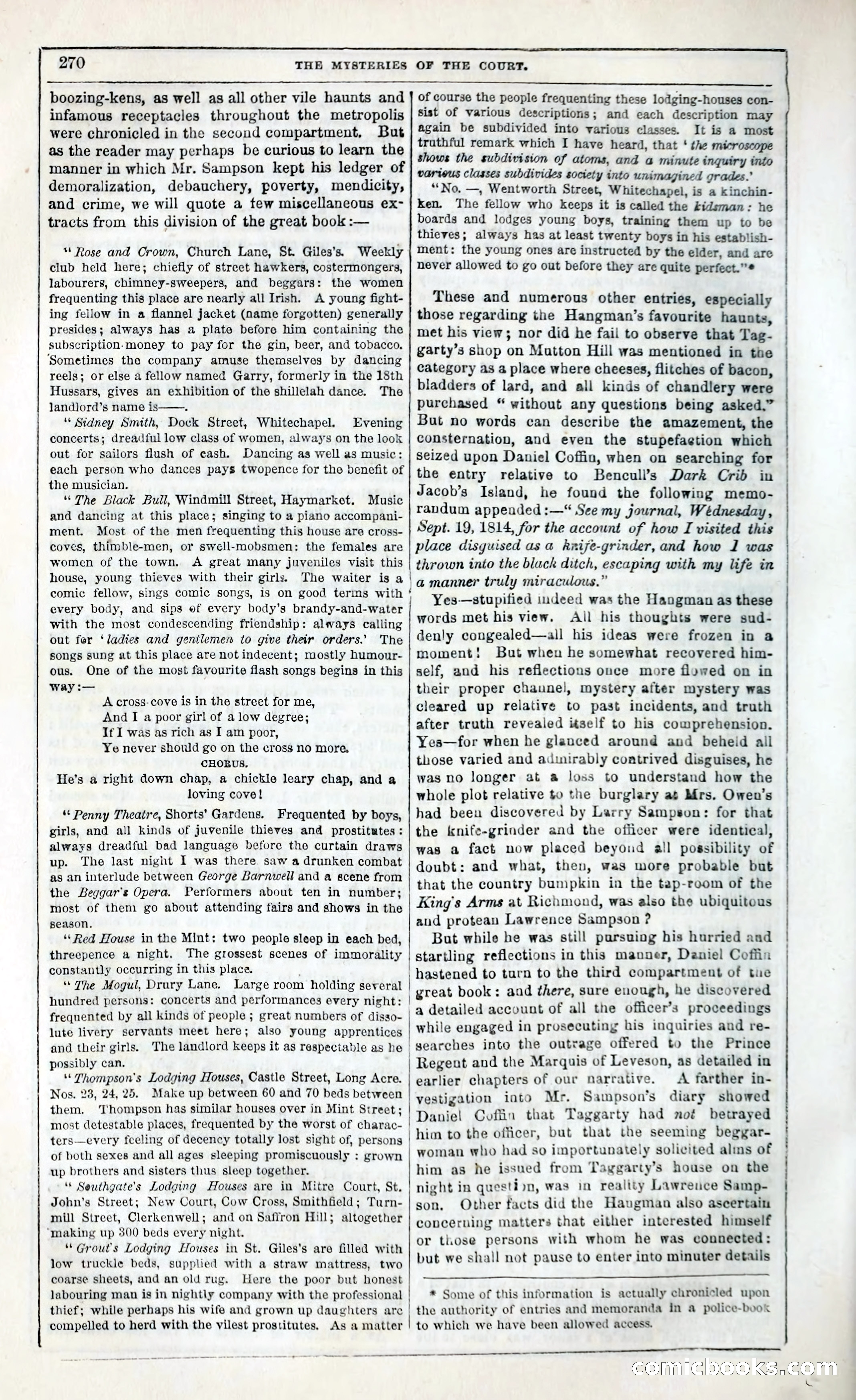
A restored page from Penny Dreadfuls, 1849. Page through the whole issue in the reader above.
📄 Transcribed text from this page (OCR, searchable)
Machine-transcribed from the original scan — historical spelling and the odd misread are preserved.
270 boozing-kens, as well as all other vile haunts and infamous receptacles throughout the metropolis were chronicled in the second compartment, But as the reader may perhaps be curious to learn the manner in which Mr. Sampson kept his ledger of demoralization, debauchery, poverty, mendicity, and crime, we will quote a few miscellaneous ex- tracts from this division of the great book :— ** Rose and Crown, Church Lane, St. Giles’s. Weekly club held here; chiefly of street hawkers, costermongers, labourers, chimney-sweepers, and beggars: the women frequenting this place are nearly all Irish. A young fight- ing fellow in a flannel jacket (name forgotten) generally presides; always has a plate before him containing the subscription-money to pay for the gin, beer, and tobacco. Sometimes the company amuse themselves by dancing reels; or else a fellow named Garry, formerly in the 18th Hussars, gives an exhibition of the shillelah dance. The landlord’s name is——. * Sidney Smith, Dock Street, Whitechapel. Evening concerts; dreadful low class of women, always on the look out for sailors flush of eash. Dancing as well as music: each person who dances pays twopence for the benefit of the musician. “The Black Bull, Windmill Street, Haymarket. Music and dancing at this place; singing to a piano accompani- ment. Most of the men frequenting this house are cross- coves, thimble-men, or swell-mobsmen: the females are women of the town. A great many juveniles visit this house, young thieves with their girls. The waiter is a comic fellow, sings comic songs, 1s on good terms with every body, and sips of every body’s brandy-and-water with the most condescending friendship: always calling out fer ‘ladies and genilemen to give their orders.’ The songs sung at this place are not indecent; mostly humour- ous. One of the most favourite flash songs begins in this Way :— A cross-cove is in the street for me, And I a poor girl of a low degree; If I was as rich as I am poor, Ye never shoud go on the cross no more, CHORUS, He’s a right down chap, a chickle leary chap, and a loving cove! ‘* Penny Theatre, Shorts’ Gardens. Frequented by boys, girls, and all kinds of juvenile thieves and prostitutes : always dreadful bad language before the curtain draws up. The last night I was there saw a drunken combat as an interlude between George Barnwell and a scene from the Beggar's Opera. Performers about ten in number; most of them go about attending fairs and shows in the season. ‘Red House in the Mint: two people sleep in each bed, threepence a night. The grossest scenes of immorality constantly occurring in this place. ‘“ The Mogul, Drury Lane. Large room holding several hundred persons: concerts and performances every night: frequented by all kinds of people; great numbers of disao- lute livery servants meet here; also young apprentices and their girls. The landlord keeps it as respectable as he possibly can. “Thompson's Lodging Houses, Castle Street, Long Acre. Nos. 23, 24, 25. Make up between 60 and 70 beds between them. ‘Thompson has similar houses over in Mint Street; most detestable places, frequented by the worst of charac- ters—every feeling of decency totally lost sight of, persons of both sexes and all ages sleeping promiscuously : grown up brothers and sisters thus sleep together. “ Seuthgate’s Lodging Houses are in Mitre Court, St. John’s Street; New Court, Cow Cross, Smithfield; Turn- mill Street, Clerkenwell; and on Saffron Hill; altogether ‘making up 300 beds every night. ‘* Grout’s Lodging LTouses in St. Giles's are filled with low truckle beds, supplied with a straw mattress, two coarse sheets, and an old rug. Here the poor but honest labouring man is in nightly company with the professional THE MYSTERIES OF THE COURT, rr eee of course the people frequenting these lodging-houses con- sist of various descriptions; and each description may again be subdivided into various classes. It is a most trathful remark which I have heard, that ‘ the microscope shows the subdivision of atoms, and a minute inquiry into various classes subdivides society into unimagined grades.’ “No. —, Wentworth Street, Whitechapel, is a kinchin- ken. The fellow who keeps it is called the kidsman: he boards and lodges young boys, training them up to be thieves; always has at least twenty boys in his establish- ment: the young ones are instructed by the elder, and are never allowed to go out before they are quite perfect.” These and numerous other entries, especially those regarding the Hangman’s favourite haunts, met his view; nor did he fail to observe that Tag- garty’s shop on Mutton Hill was mentioned in the category as a place where cheeses, flitches of bacon, bladders of lard, and all kinds of chandlery were purchased “ without any questions being asked,” But no words can describe the amazement, the consternation, and even the stupefaetion which seized upon Daniel Coffin, when on searching for the entry relative to Bencull’s Dark Crib in Jacob’s Island, he found the following memo- randum appended :—* See my journal, Wédnesday, Sept. 19, 1814, for the account of how I visited this place disguised as a knife-grinder, and how J was thrown into the bluck ditch, escaping with my life in a manner truly miraculous.” Yes-—stupified indeed was the Hangman as these words met his view. Ail his thoughts were sud- denly congealed—all his ideas were frozen in a moment: But when he somewhat recovered him- self, and his reflections once more flowed on in their proper channel, mystery after mystery was cleared up relative to past incidents, and truth after truth revealed itself to his comprehension. Yes—for when he glauced around and beheid ail those varied and admirably contrived disguises, he was no longer at a loss to understand how the whole plot relative to the burglary at Mrs. Owen’s had been discovered by Larry Sampson: for that the knife-grinder and the officer were identical, was a fact now placed beyond all possibility of doubt: and what, then, was wore probable but that the country bumpkin in the tap-room of the King’s Arms at Richmond, was also the ubiquitous aud protean Lawrence Sampson ? But while he was still pursuing his hurried and startling reflections in this manner, Daniel Coffin hastened to turn to the third compartment of tue great book: and there, sure enough, he discovered a detailed account of all the officer’s proceedings while engaged in prosecuting his inquiries and re- searches into the outrage offered to the Prince Regent and the Marquis of Leveson, as detailed in earlier chapters of our narrative. <A farther in- vestigation into Mr. Sampson’s diary showed Daniel Coffin that Taggarty had noé betrayed | him to the officer, but that the seeming beggar- woman who had so importunately solicited alins of him as he issued from Taygarty’s house on the night in question, was in reality Lawreuce Samp- son. Other facts did the Haugman also ascertain concerning matters that either interested himself or those persons with whom he was connected: but we shall not pause to enter into minuter details * Some of this information is actually chronicled upon thief; while perhaps his wife and grown up daughters are | the authority of entries and memoranda in a police-book compelled to herd with the vilest prostitutes. As a matter | to which we have been allowed access. EE GOmMIGoOOKS (C (€()