
Penny Dreadfuls, 1849 · page 285 of 394
The Mysteries of the Court of London — page 285: what you’re looking at
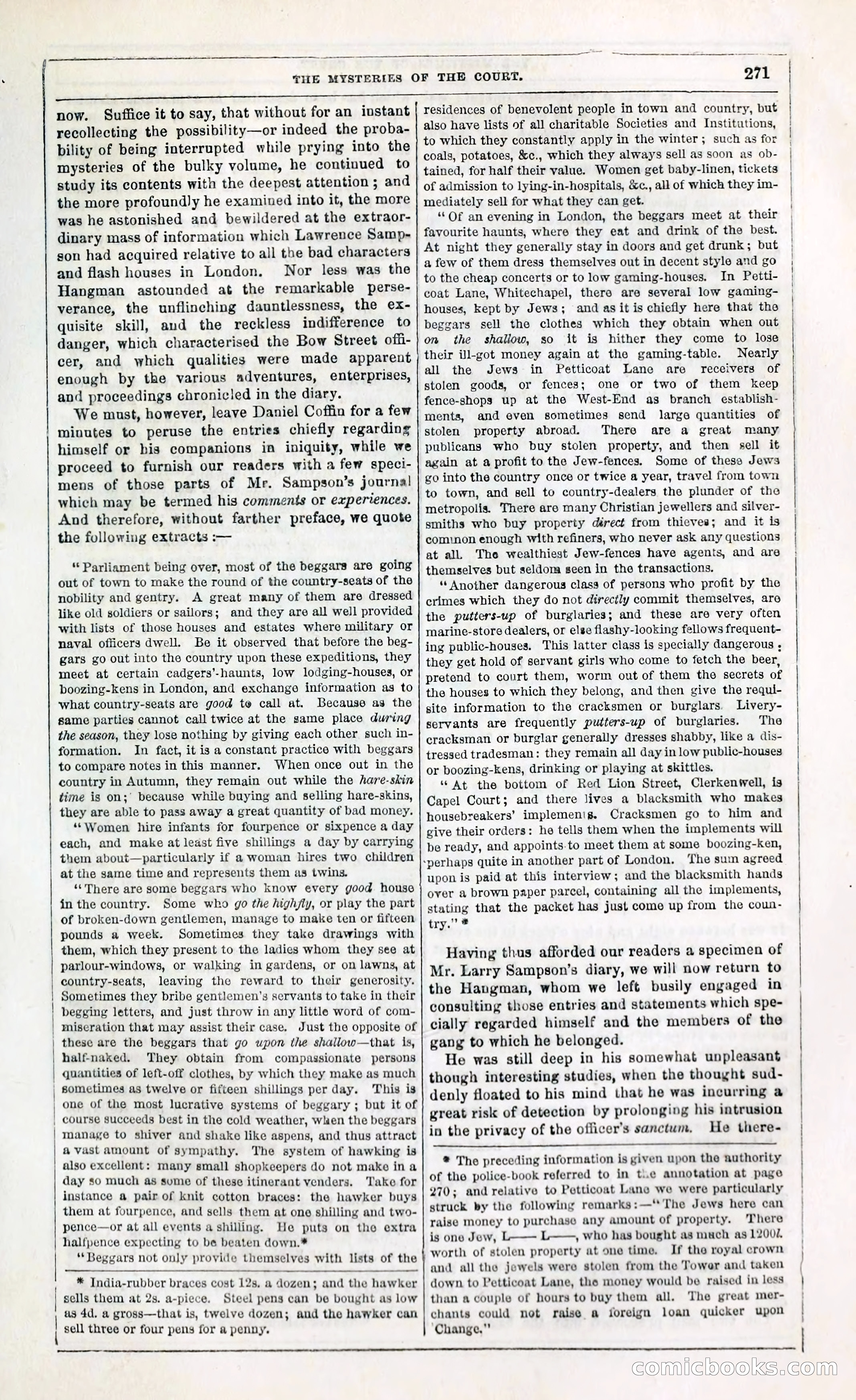
A restored page from Penny Dreadfuls, 1849. Page through the whole issue in the reader above.
📄 Transcribed text from this page (OCR, searchable)
Machine-transcribed from the original scan — historical spelling and the odd misread are preserved.
| | ——— ————— ee ——_ -_.----————— THE MYSTERIES OF THE COURT. now. Suffice it to say, that without for an instant recollecting the possibility—or indeed the proba- bility of being interrupted while prying into the mysteries of the bulky volume, he continued to study its contents with the deepest attention ; and the more profoundly he examined into it, the more was he astonished and bewildered at the extraor- dinary mass of information which Lawrence Samp- son had acquired relative to all the bad characters and flash houses in London. Nor less was the Hangman astounded at the remarkable perse- verance, the unflinching dauntlessness, the ex- quisite skill, and the reckless indifference to danger, which characterised the Bow Street offi- cer, and which qualities were made apparent enough by the various adventures, enterprises, and proceedings chronicled in the diary. We must, however, leave Daniel Coffin for a few minutes to peruse the entries chiefly regarding himself or bis companions in iniquity, while we proceed to furnish our readers with a few speci- mens of those parts of Mr. Sampson’s journal which may be termed his comments or experiences. And therefore, without farther preface, we quote the following extracts :— ‘“‘ Parliament being over, most of the beggars are going out of town to make the round of the country-seats of the nobility and gentry. A great many of them are dressed like old soldiers or sailors; and they are all well provided with lists of those houses and estates where military or naval officers dwell. Be it observed that before the beg- gars go out into the country upon these expeditions, they meet at certain cadgers’-haunts, low lodging-houses, or boozing-kens in London, and exchango information as to what country-seats are good te call at. Because as the same parties cannot call twice at the same place during the season, they lose nothing by giving each other such in- formation. In fact, it is a constant practice with beggars to compare notes in this manner. When once out in the country in Autumn, they remain out while the hare-skin time is on;’ because while buying and selling hare-skins, they are able to pass away a great quantity of bad money. ‘Women hire infants for fourpence or sixpence a day each, and make at least five shillings a day by carrying them about—particularly if a woman hires two children at the same time and represents them as twins. ‘‘There are some beggars who know every good house in the country. Some who go the high/ly, or play the part of broken-down gentlemen, Manage to make ten or fifteen pounds a week. Sometimes they take drawings with them, which they present to the ladies whom they see at parlour-windows, or walking in gardens, or on lawns, at country-seats, leaving the reward to their generosity. Sometimes they bribe gentlemen's servants to take in their begging letters, and just throw in any little word of com- miseration that may assist their case. Just the opposite of these are the beggars that go upon the shallow—that ls, half-naked. They obtain from compassionate persons quantities of left-off clothes, by which they make as much sometimes as twelve or fifteen shillings per day. This is one of the most lucrative systems of beggary; but it of course succeeds best in the cold weather, wlien the beggars manage to shiver and shake like aspens, and thus attract a vast amount of sympathy. The system of hawking is also excellent: many small shopkeepers do not make ina day so much as sume of these itinerant venders. Take for instance a pairof knit cotton braces: the hawker buys them at fourpence, and sells them at one shilling and two- pence—or at all events a shilling. He puts on the extra halfpence expecting to be beaten down.* ‘* Beggars not only provide themselves with lists of the * India-rubber braces cost 12s, a dozen; and the hawker sells them at 2s. a-piece. Steel pens can be bought as low us 4d. a gross—that is, twelve dozen; and the hawker can sell three or four pens for a penny. an ee Se SS - residences of benevolent people in town and country, but also have lists of all charitable Societies and Institutions, to which they constantly apply in the winter; such as for coals, potatoes, &c., which they always sell as soon as ob- tained, for half their value. Women get baby-linen, tickets of admission to lying-in-hospitals, &c., all of which they im- mediately sell for what they can get. ‘Of an evening in London, the beggars meet at their favourite haunts, where they eat and drink of the best. At night they generally stay in doors and get drunk; but a few of them dress themselves out in decent style and go to the cheap concerts or to low gaming-houses. In Petti- coat Lane, Whitechapel, there are several low gaming- houses, kept by Jews; and asitis chiefly here that the beggars sell the clothes which they obtain when out on the shallow, so it is hither they come to lose their Ul-got money again at the gaming-table. Nearly all the Jews in Petticoat Lane are receivers of stolen goods, or fences; one or two of them keep fence-shops up at the West-End as branch establish- ments, and even sometimes send large quantities of stolen property abroad. There are a great many publicans who buy stolen property, and then sell it again at a profit to the Jew-fences. Some of these Jews go into the country once or twice a year, travel from town to town, and sell to country-dealers the plunder of the metropolis. There are many Christian jewellers and silver- smiths who buy property dérect from thieves; and it is cominon enough with refiners, who never ask any questions at all The wealthiest Jew-fences have agents, and are themselves but seldom seen in the transactions. ‘ Another dangerous class of persons who profit by the crimes which they do not directly commit themselves, are the putters-up of burglaries; and these are very often marine-store dealers, or else flashy-looking fellows frequent- ing public-houses. This latter class is specially dangerous ,; they get hold of servant girls who come to fetch the beer, pretend to court them, worm out of them the secrets of the houses to which they belong, and then give the requi- site information to the cracksmen or burglars. Livery- servants are frequently putters-up of burglaries. The cracksman or burglar generally dresses shabby, like a dis- tressed tradesman: they remain all day in low public-houses or boozing-kens, drinking or playing at skittles. ‘ At the bottom of Red Lion Street, Clerkentvell, is Capel Court; and there lives a blacksmith who makes housebreakers’ implemenig. Cracksmen go to him and give their orders: he tells them when the implements will be ready, and appoints.to meet them at some boozing-kKen, ‘perhaps quite in another part of London. The sum agreed upon is paid at this interview; and the blacksmith hands over a brown paper parcel, containing all the implements, stating that the packet has just come up from the coun- tra. * Having thus afforded our readers a specimen of Mr. Larry Sampson’s diary, we will now return to the Hangman, whom we left busily engaged in consulting those entries and statements which spe- cially regarded himself and the members of the gang to which he belonged. He was still deep in his somewhat unpleasant though interesting studies, when the thought sud- denly floated to his mind that he was incurring a great risk of detection by prolonging his intrusion in the privacy of the officer’s sanctum. He there- # The preceding information is given upon the authority of the police-book referred to in ti.e annotation at page 270; and relative to Petticoat Lane we were particularly struck by the following remarks:—‘ The Jews here can raise money to purchase any amount of property. There is one Jew, L—— L——, who has bought as much as 12004 worth of stolen property at one time. If the royal crown and all the jewels were stolen from the Tower and taken down to Petticoat Lane, the money would be raised in less than a couple of hours to buy them all. The great mer- chants could not raise a foreign loan quicker upon Change." ee ree GOmMiiGsvoo (Cc S) (CO)