
Penny Dreadfuls, 1849 · page 397 of 394
The Mysteries of the Court of London — page 397: what you’re looking at
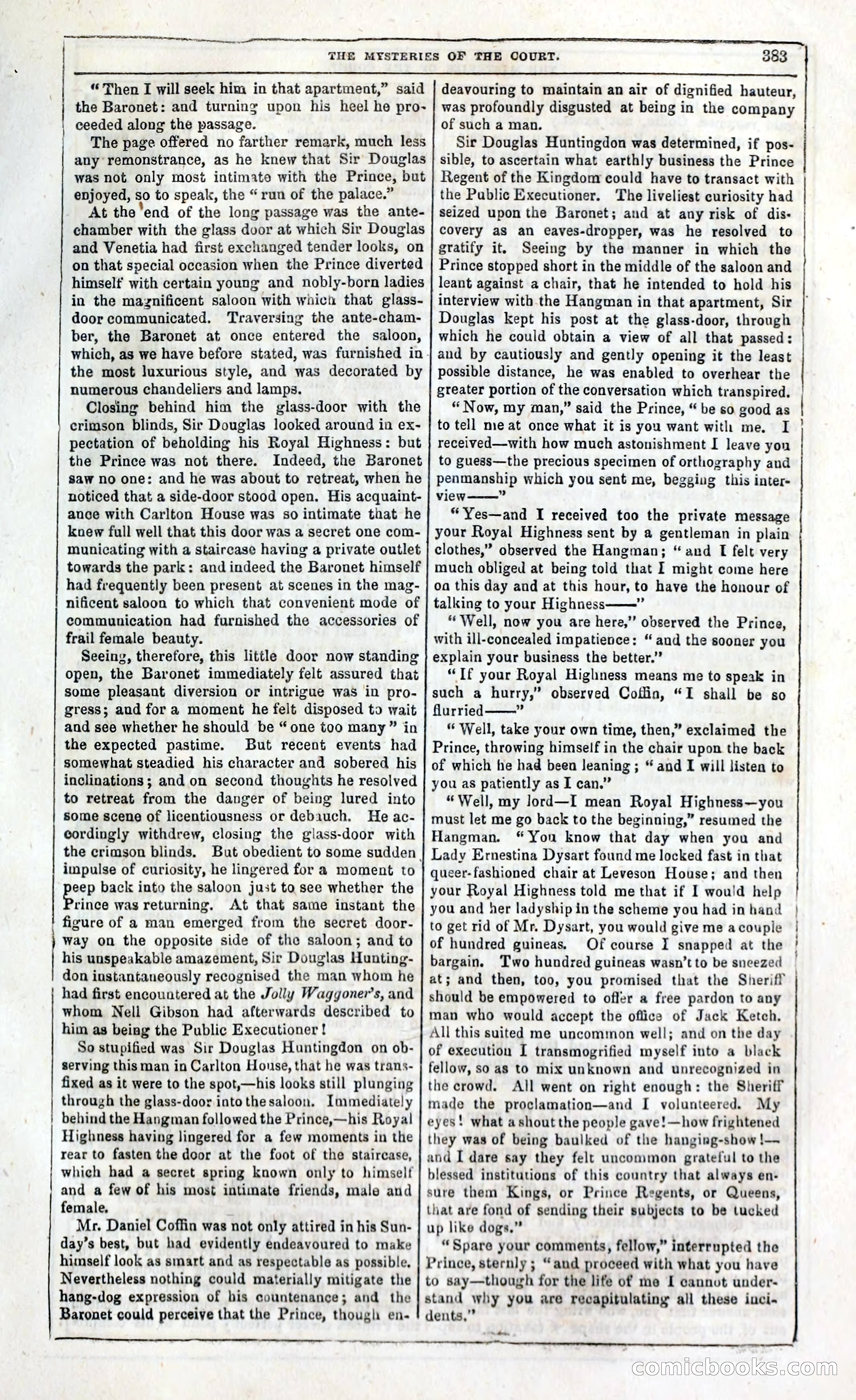
A restored page from Penny Dreadfuls, 1849. Page through the whole issue in the reader above.
📄 Transcribed text from this page (OCR, searchable)
Machine-transcribed from the original scan — historical spelling and the odd misread are preserved.
THE MYSTERIES OF THE COURT. “Then I will seek him in that apartment,” said the Baronet: and turning upon his heel he pro- ceeded along the passage. rc —_— The page offered no farther remark, much less any remonstrance, as he knew that Sir Douglas was not only most intimate with the Prince, but enjoyed, so to speak, the “ run of the palace.” At the'end of the long passage was the ante- chamber with the glass door at which Sir Douglas and Venetia had first exchanged tender looks, on on that special occasion when the Prince diverted himself with certain young and nobly-born ladies in the magnificent saloon with which that glass- door communicated. Traversing the ante-cham- ber, the Baronet at once entered the saloon, which, as we have before stated, was furnished in. the most luxurious style, and was decorated by numerous chandeliers and lamps. Closing behind him the glass-door with the crimson blinds, Sir Douglas looked around in ex- pectation of beholding his Royal Highness: but the Prince was not there. ance with Carlton House was so intimate that he koew full well that this door was a secret one com- municating with a staircase having a private outlet towards the park: and indeed the Baronet himself had frequently been present at scenes in the mag- nificent saloon to which that convenient mode of communication had furnished the accessories of frail female beauty. Seeing, therefore, this little door now standing open, the Baronet immediately felt assured that some pleasant diversion or intrigue was in pro- gress; and fora moment he felt disposed to wait and see whether he should be “one too many” in the expected pastime. But recent events had somewhat steadied his character and sobered his inclinations; and on second thoughts he resolved to retreat from the danger of being lured into some scene of licentiousness or debauch. He ac- cordingly withdrew, closing the glass-door with the crimson blinds, impulse of curiosity, he lingered for a moment to peep back into the saloon just to see whether the rince was returning. At that same instant the figure of a man emerged from the secret door- way on the opposite side of the saloon; and to his unspeakable amazement, Sir Douglas Hunting- don instantaneously recognised the man whom he had first encountered at the Jolly Waggoner’s, and whom Nell Gibson had afterwards described to him as being the Public Executioner! So stupified was Sir Douglas Huntingdon on ob- serving this man in Carlton House, that he was trans- fixed as it were to the spot,—his looks still plunging through the glass-door intothesaloon. Immediately behind the Hangman followed the Prince,—his Royal Highness having lingered for a few moments in the rear to fasten the door at the foot of the staircase, which had a secret spring known only to himself and a few of his most intimate friends, male and female, Mr. Daniel Coffin was not only attired in his Sun- day’s best, but had evidently endeavoured to make himself look as smart and as respectable as possible, Nevertheless nothing could materially mitigate the hang-dog expression of his countenance; and the Baronet could perceive that the Prince, though en- —_—-— Indeed, the Baronet saw no one: and he was about to retreat, when he noticed that a side-door stood open. His acquaint- But obedient to some sudden. deavouring to maintain an air of dicnified hauteur, was profoundly disgusted at being in the company of such a man. Sir Douglas Huntingdon was determined, if pos- sible, to ascertain what earthly business the Prince Regent of the Kingdom could have to transact with the Public Executioner. The liveliest curiosity had seized upon the Baronet; and at any risk of dis- covery as an eaves-dropper, was he resolved to gratify it. Seeing by the manner in which the Prince stopped short in the middle of the saloon and leant against a chair, that he intended to hold his interview with the Hangman in that apartment, Sir Douglas kept his post at the glass-door, through which he could obtain a view of all that passed: aud by cautiously and gently opening it the least possible distance, he was enabled to overhear the greater portion of the conversation which transpired. “Now, my man,” said the Prince, “ be so good as to tell meat once what it is you want with me. I received—with how much astonishment I leave yon to guess—the precious specimen of orthography and penmanship which you sent me, begging this inter- view———” “Yes—and I received too the private message your Royal Highness sent by a gentleman in plain clothes,” observed the Hangman; “and I felt very much obliged at being told that I might come here Oa this day and at this hour, to have the honour of talking to your Highness a “Well, now you are here,” observed the Prince, with ill-concealed impatience: “ and the sooner you explain your business the better.’ “If your Royal Highness means me to speak in such a hurry,” observed Collin, “I shall be so flurried-——” * Well, take your own time, then,” exclaimed the Prince, throwing himself in the chair upon the back of which he had been leaning; “ and I will listen to you as patiently as I can.” “Well, my lord—I mean Royal Highness—you must let me go back to the beginning,” resumed the Hangman. “You know that day when you and Lady Ernestina Dysart found me locked fast in that queer-fashioned chair at Leveson House; and then your Royal Highness told me that if I would help you and her ladyship in the scheme you had in hand to get rid of Mr. Dysart, you would give me acouple of hundred guineas. Of course I snapped at the bargain. Two hundred guineas wasn’t to be sneezed at; and then, too, you promised that the Sheriff should be empowered to offer a free pardon to any man who would accept the office of Jack Ketch. All this suited me uncommon well; and on the day of execution [ transmogrified myself into a black fellow, so as to mix unknown and unrecognized in the crowd. All went on right enough: the Sheriff made the proclamation—and I volunteered. My eyes! what ashout the people gave! —how frightened they was of being baulked of the hanging-show !— and I dare say they felt uncommon grateful to the blessed institutions of this country that always en- sure them Kings, or Prince Regents, or Queens, that are fond of sending their subjects to be tucked up like dogs.” “Spare your comments, fellow,” interrupted the Prince, sternly; “and proceed with what you have to say—though for the life of me I cannot under- stand why you are recapitulating all these iuci. dents,” ~o~, SS . = "eae re a COnnicloooks (CO)