
Penny Dreadfuls, 1849 · page 398 of 394
The Mysteries of the Court of London — page 398: what you’re looking at
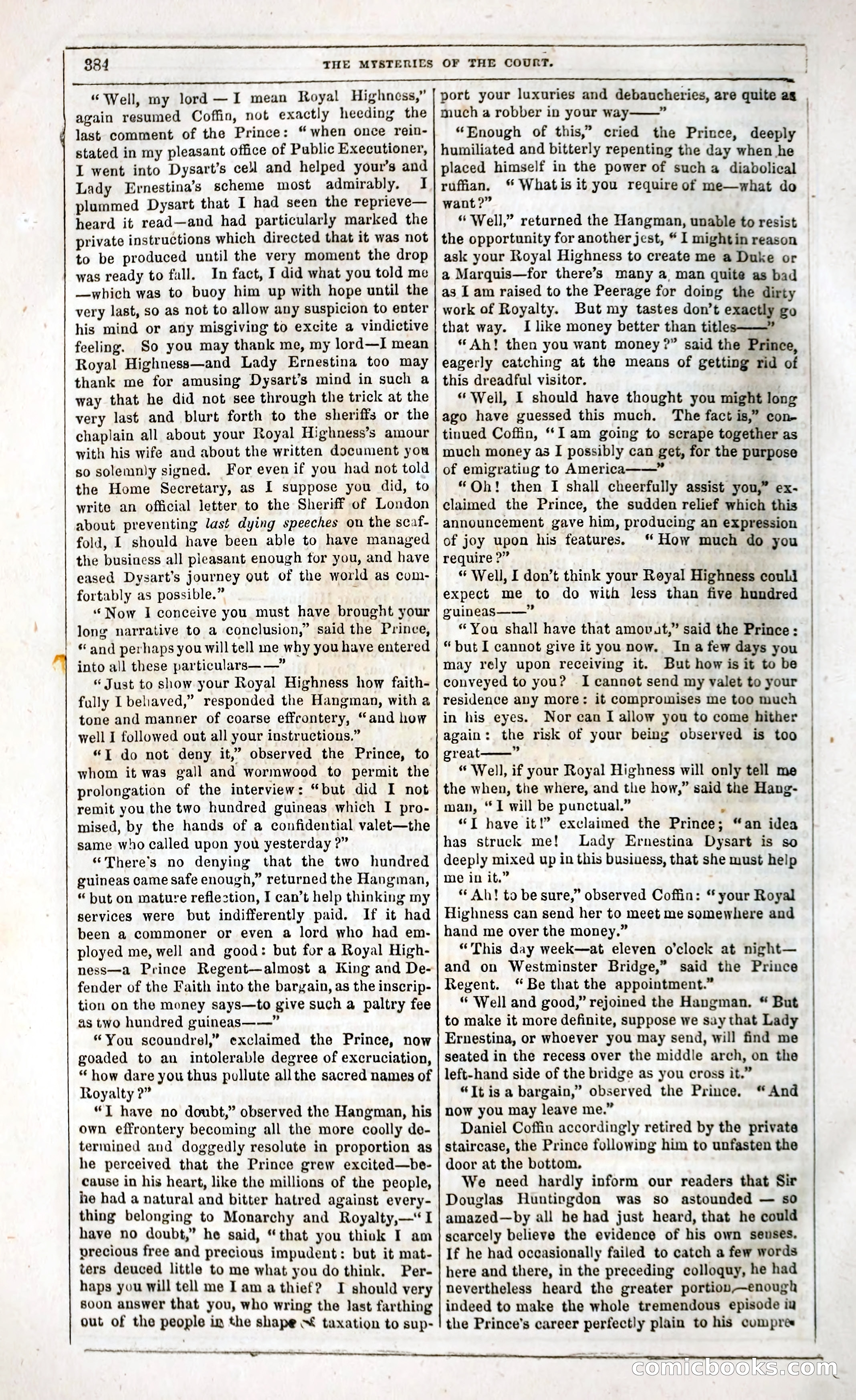
A restored page from Penny Dreadfuls, 1849. Page through the whole issue in the reader above.
📄 Transcribed text from this page (OCR, searchable)
Machine-transcribed from the original scan — historical spelling and the odd misread are preserved.
8384 “Well, my lord —I mean Royal Highness,” again resumed Coffin, not exactly heeding the / last comment of the Prince: “when once rein- stated in my pleasant office of Public Executioner, I went into Dysart’s cell and helped your’s and Lady Ernestina’s scheme most admirably. I plummed Dysart that I had seen the reprieve— heard it read—and had particularly marked the private instructions which directed that it was not to be produced until the very moment the drop was ready to fall. In fact, I did what you told me —which was to buoy him up with hope until the very last, so as not to allow any suspicion to enter his mind or any misgiving to excite a vindictive feeling. So you may thank me, my lord—I mean Royal Highness—and Lady Ernestina too may thank me for amusing Dysart’s mind in such a way that he did not see through the trick at the very last and blurt forth to the sheriffs or the chaplain all about your Royal Highness’s amour with his wife aud about the written document you so solemnly signed. For even if you had not told the Home Secretary, as I suppose you did, to write an official letter to the Sheriff of London about preventing last dying speeches on the scaf- fold, I should have been able to have managed the business all pleasant enough for you, and have eased Dysart’s journey out of the world as com- fortably as possible.” , “Now I conceive you must have brought your long narrative to a conclusion,” said the Prince, and perhaps you will tell me why you have entered into all these particulars——” « Just to show your Royal Highness how faith- fully I beliaved,” responded the Hangman, with a tone and manner of coarse effrontery, “and how well I followed out all your instructions.” “JT do not deny it,” observed the Prince, to whom it was gall and wormwood to permit the prolongation of the interview: “but did I not remit you the two hundred guineas which I pro- mised, by the hands of a confidential valet—the same who called upon you yesterday ?” ‘There's no denying that the two hundred guineas came safe enough,” returned the Hangman, “but on mature reflection, I can’t help thinking my services were but indifferently paid. If it had been a commoner or even a lord who had em- ployed me, well and good: but for a Royal High- ness—a Prince Regent—almost a King and De- fender of the Faith into the bargain, as the inscrip- tion on the money says—to give such a paltry fee as two hundred guineas——” * You scoundrel,” exclaimed the Prince, now goaded to an intolerable degree of excruciation, * how dare you thus pollute allthe sacred names of Royalty ?” “I have no doubt,” observed the Hangman, his own effrontery becoming all the more coolly de- termined and doggedly resolute in proportion as he perceived that the Prince grew excited—be- cause in his heart, like the millions of the people, he had a natural and bitter hatred against every- thing belonging to Monarchy and Royalty,—‘ I have no doubt,” he said, “that you think I am precious free and precious impudent: but it mat- ters deuced little to me what you do think. Per- haps you will tell me Lam athief? I should very soon answer that you, who wring the last farthing out of the people in the shape “ taxation to sup- ct gt ee te —E eee a aaa aaa, THE MYSTERICS OF THE COURT. port your luxuries and debaucheries, are quite ag | much a robber in your way——” “Enough of this,” cried the Prince, deeply humiliated and bitterly repenting the day when he placed himself in the power of such a diabolical rufhan. © Whatis it you require of me—what do want?” * Well,” returned the Hangman, unable to resist the opportunity for another jest, * I mightin reason ask your Royal Highness to create me a Duke or a Marquis—for there’s many a man quite as bad as [ am raised to the Peerage for doing the dirty work of Royalty. But my tastes don’t exactly go that way. I like money better than titles——” “Ah! then you want money ?” said the Prince, eagerly catching at the means of getting rid of this dreadful visitor. “ Weil, I should have thought you might long ago have guessed this much. The fact is,” con- — tinued Coffin, ‘Iam going to scrape together as much money as I possibly can get, for the purpose of emigratiug to America——” “Oh! then I shall cheerfully assist you,” ex- claimed the Prince, the sudden relief which this announcement gave him, producing an expression of joy upon his features. require 2” “ Well, I don’t think your Royal Highness could expect me to do with less than five hundred guineas——” | “You shall have that amovut,” said the Prince: “but I cannot give it you now. Ina few days you may rely upon receiving it. But how is it to be conveyed to you? I cannot send my valet to your residence any more: it compromises me too much in his eyes. Nor can I allow you to come hither again: the risk of your being observed is too great——” “ Well, if your Royal Highness will only tell me the when, the where, and the how,” said the Hang- man, “I will be punctual.” . ‘“T have it!” exclaimed the Prince; “an idea has struck me! Lady Ernestina Dysart is so deeply mixed up in this busiuess, that she must help me in it.” * Ah! ta be sure,” observed Coffin: “ your Royal Highness can send her to meet me somewhere and hand me over the money.” “This day week—at eleven o'clock at night— and on Westminster Bridge,” said the Prince Regent. “Be that the appointment.” “ Well and good,” rejoined the Hangman, “ But to make it more definite, suppose we say that Lady Ernestina, or whoever you may send, will find me seated in the recess over the middle arch, on the left-hand side of the bridge as you cross it.” “It is a bargain,” observed the Prince. now you may leave me.” Daniel Coffin accordingly retired by the private staircase, the Prince following him to unfasten the door at the bottom. We need hardly inform our readers that Sir Douglas Huntingdon was so astounded — so amazed—by all he had just heard, that he could scarcely believe the evidence of his own seuses. If he had occasionally failed to catch a few words here and there, in the preceding colloquy, he had nevertheless heard the greater portion —enough indeed to make the whole tremendous episode iu the Prince's career perfectly plain to his compres “And “How much do you — COL CLOOOKS (€©)