
Penny Dreadfuls, 1849 · page 84 of 394
The Mysteries of the Court of London — page 84: what you’re looking at
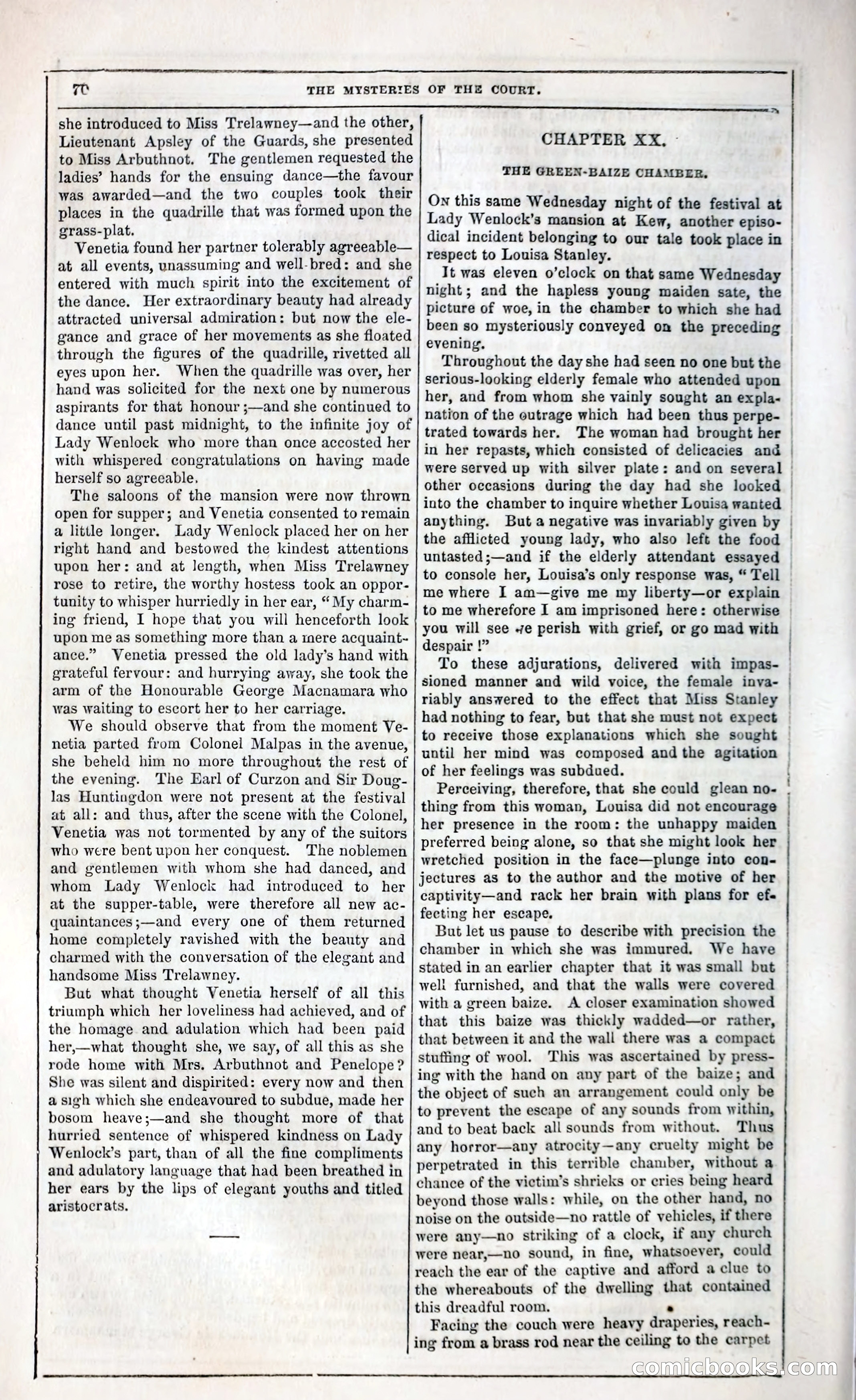
A restored page from Penny Dreadfuls, 1849. Page through the whole issue in the reader above.
📄 Transcribed text from this page (OCR, searchable)
Machine-transcribed from the original scan — historical spelling and the odd misread are preserved.
70 THE MYSTERIES OF THE COURT. IR a A a TTT IS at a a a ce she introduced to Miss Trelawney—and the other, Lieutenant Apsley of the Guards, she presented to Miss Arbuthnot. The gentlemen requested the ladies’ hands for the ensuing dance—the favour was awarded—and the two couples took their places in the quadrille that was formed upon the grass-plat. Venetia found her partner tolerably agreeable— at all events, unassuming and well-bred: and she entered with much spirit into the excitement of the dance. Her extraordinary beauty had already attracted universal admiration: but now the ele- gance and grace of her movements as she floated through the figures of the quadrille, rivetted all eyes upon her. When the quadrille was over, her hand was solicited for the next one by numerous aspirants for that honour ;—and she continued to dance until past midnight, to the infinite joy of Lady Wenlock who more than once accosted her with whispered congratulations on having made herself so agreeable, The saloons of the mansion were now thrown open for supper; and Venetia consented to remain a little longer. Lady Wenlock placed her on her right hand and bestowed the kindest attentions upon her: and at length, when Miss Trelawney rose to retire, the worthy hostess took an oppor- tunity to whisper hurriedly in her ear, “ My charm- ing friend, L hope that you will henceforth look upon me as something more than a inere acquaint~ ance.” Venetia pressed the old lady’s hand with grateful fervour: and hurrying away, she took the arm of the Honourable George Macnamara who was waiting to escort her to her carriage. We should observe that from the moment Ve- netia parted from Colonel Malpas in the avenue, she beheld him no more throughout the rest of the evening. The Earl of Curzon and Sir Doug- las Huntingdon were not present at the festival at all: and thus, after the scene with the Colonel, Venetia was not tormented by any of the suitors who were bent upon her conquest. The noblemen and gentlemen with whom she had danced, and whom Lady Wenlock had introduced to her at the supper-table, were therefore all new ac- quaintances;—and every one of them returned home completely ravished with the beauty and charmed with the conversation of the elegant and handsome Miss Trelawney. But what thought Venetia herself of all this triumph which her loveliness had achieved, and of the homage and adulation which had been paid her,—what thought she, we say, of all this as she rode home with Mrs. Arbuthnot and Penelope? She was silent and dispirited: every now and then a sigh which she endeavoured to subdue, made her bosom heave;—and she thought more of that hurried sentence of whispered kindness on Lady Wenlock’s part, than of all the fine compliments and adulatory language that had been breathed in her ears by the lips of elegant youths and titled aristocrats. LE CHAPTER XX, - THE GREEN-BAIZE CHAMBER, On this same Wednesday night of the festival at Lady Wenlock’s mansion at Kew, another episo- dical incident belonging to our tale took place in respect to Louisa Stanley. It was eleven o’clock on that same Wednesday night; and the hapless young maiden sate, the picture of woe, in the chamber to which she had _— — + ee. been so mysteriously conveyed on the preceding — | evening. Throughout the day she had seen no one but the serious-looking elderly female who attended upon | her, and from whom she vainly sought an expla. nation of the outrage which had been thus perpe- trated towards her. The woman had brought her in her repasts, which consisted of delicacies and were served up with silver plate: and on several other occasions during the day had she looked into the chamber to inquire whether Louisa wanted anything. But a negative was invariably given by the afflicted young lady, who also left the food untasted;—and if the elderly attendant essayed — to console her, Louisa’s only response was, “ Tell me where I am—give me my liberty—or explain to me wherefore I am imprisoned here: otherwise | you will see +e perish with grief, or go mad with despair !” To these adjurations, delivered with impas- sioned manner and wild voice, the female inva- riably answered to the effect that Miss Stanley | had nothing to fear, but that she must not expect — to receive those explanations which she sought until her mind was composed andthe agitation of her feelings was subdued. Perceiving, therefore, that she could glean no- thing from this woman, Louisa did not encourage her presence in the room: the unhappy maiden preferred being alone, so that she might look her wretched position in the face—plunge into con- jectures as to the author and the motive of her captivity—and rack her brain with plans for ef- fecting her escape. But let us pause to describe with precision the chamber in which she was immured. We have stated in an earlier chapter that it was small but well furnished, and that the walls were covered with a green baize. A closer examination showed that this baize was thickly wadded—or rather, that between it and the wall there was a compact stuffing of wool. This was ascertained by press- ing with the hand on any part of the baize; and the object of such an arrangement could only be to prevent the escape of any sounds from within, and to beat back all sounds from without. Thus any horror—any atrocity—any cruelty might be perpetrated in this terrible chamber, without a chance of the victim’s shrieks or cries being heard beyond those walls: while, on the other hand, no noise on the outside—no rattle of vehicles, if there were any—no striking of a clock, if any church were near,—no sound, in fine, whatsoever, could reach the ear of the captive and afford a clue to the whereabouts of the dwelling that contained this dreadful room. . Facing the couch were heavy draperies, reach- ing from a brass rod near the ceiling to the carpet era ee ee OMmillGiIook (E(0)