
Penny Dreadfuls, 1849 · page 85 of 394
The Mysteries of the Court of London — page 85: what you’re looking at
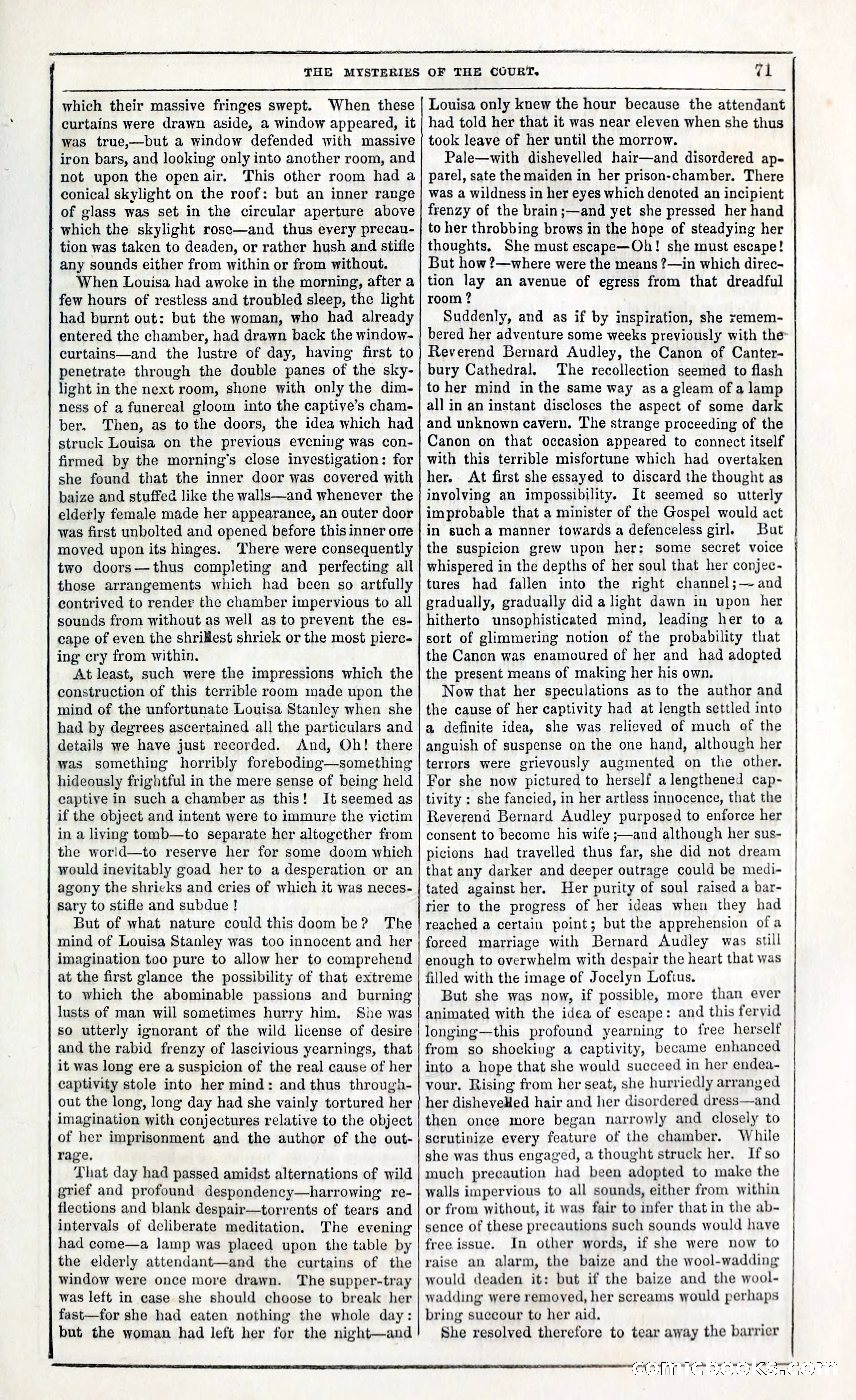
A restored page from Penny Dreadfuls, 1849. Page through the whole issue in the reader above.
📄 Transcribed text from this page (OCR, searchable)
Machine-transcribed from the original scan — historical spelling and the odd misread are preserved.
THE MYSTERIES OF THE COURT, G1 which their massive fringes swept. When these curtains were drawn aside, a window appeared, it was true,—but a window defended with massive iron bars, and looking only into another room, and not upon the openair. This other room had a conical skylight on the roof: but an inner range of glass was set in the circular aperture above which the skylight rose—and thus every precau- tion was taken to deaden, or rather hush and stifle any sounds either from within or from without. When Louisa had awoke in the morning, after a few hours of restless and troubled sleep, the light had burnt out: but the woman, who had already entered the chamber, had drawn back the window- curtains—and the lustre of day, having first to penetrate through the double panes of the sky- light in the next room, shone with only the dim- ness of a funereal gloom into the captive’s cham- ber. Then, as tothe doors, the idea which had struck Louisa on the previous evening was con- firmed by the morning’s close investigation: for she found that the inner door was covered with baize and stuffed like the walls—and whenever the elderly female made her appearance, an outer door was first unbolted and opened before this inner ore moved upon its hinges. There were consequently two doors—thus completing and perfecting all those arrangements which had been so artfully contrived to render the chamber impervious to all sounds from without as well as to prevent the es- cape of even the shrillest shriek or the most pierc- ing cry from within. At least, such were the impressions which the construction of this terrible room made upon the mind of the unfortunate Louisa Stanley when she had by degrees ascertained all the particulars and details we have just recorded. And, Oh! there was something horribly foreboding—something hideously frightful in the mere sense of being held captive in such a chamber as this! It seemed as if the object and intent were to immure the victim in a living tomb—to separate her altogether from the world—to reserve her for some doom which would inevitably goad her to a desperation or an agony the shrieks and cries of which it was neces- sary to stifle and subdue ! But of what nature could this doom be? The mind of Louisa Stanley was too innocent and her imagination too pure to allow her to comprehend at the first glance the possibility of that extreme to which the abominable passions and burning lusts of man will sometimes hurry him, She was so utterly ignorant of the wild license of desire and the rabid frenzy of lascivious yearnings, that it was long ere a suspicion of the real cause of her captivity stole into her mind: and thus through- out the long, long day had she vainly tortured her imagination with conjectures relative to the object of her imprisonment and the author of the out- rage. That day had passed amidst alternations of wild grief and profound despondency—harrowing re- flections and blank despair—torrents of tears and intervals of deliberate meditation. The evening had come—a lamp was placed upon the table by the elderly attendant—and the curtains of the window were once more drawn. The supper-tray was left in case she should choose to break her fast—for she had eaten nothing the whole day: but the woman had left her for the night—and Dt DME 2. Ma en a ies ne peepee COMM LGIOOKSiCO Louisa only knew the hour because the attendant had told her that it was near eleven when she thus took leave of her until the morrow. Pale—with dishevelled hair—and disordered ap- parel, sate the maiden in her prison-chamber. There was a wildness in her eyes which denoted an incipient frenzy of the brain;—and yet she pressed her hand to her throbbing brows in the hope of steadying her thoughts. She must escape—Oh! she must escape! But how ?—where were the means ?—in which direc- tion lay an avenue of egress from that dreadful room ? Suddenly, and as if by inspiration, she xemem- bered her adventure some weeks previously with the Reverend Bernard Audley, the Canon of Canter- bury Cathedral. The recollection seemed to flash to her mind in the same way as a gleam of a lamp all in an instant discloses the aspect of some dark and unknown cavern. The strange proceeding of the Canon on that occasion appeared to connect itself with this terrible misfortune which had overtaken her. At first she essayed to discard the thought as involving an impossibility. It seemed so utterly improbable that a minister of the Gospel would act in sucha manner towards a defenceless girl But the suspicion grew upon her: some secret voice whispered in the depths of her soul that her conjec- tures had fallen into the right channel;— and gradually, gradually did a light dawn in upon her hitherto unsophisticated mind, leading her to a sort of glimmering notion of the probability that the Canon was enamoured of her and had adopted the present means of making her his own. Now that her speculations as to the author and the cause of her captivity had at length settled into a definite idea, she was relieved of much of the anguish of suspense on the one hand, although her terrors were grievously augmented on tlie other. For she now pictured to herself a lengthened cap- tivity : she fancied, in her artless innocence, that the Reverend Bernard Audley purposed to enforce her consent to become his wife ;—and although her sus- picions had travelled thus far, she did not dream that any darker and deeper outrage could be medi- tated against her. Her purity of soul raised a bar- tier to the progress of her ideas when they had reached a certain point; but the apprehension ofa forced marriage with Bernard Audley was still enough to overwhelm with despair the heart that was filled with the image of Jocelyn Lofius. But she was now, if possible, more than ever animated with the idea of escape: and this feryid longing—this profound yearning to free herself from so shocking a captivity, became enhanced into a hope that she would succeed in her endea- your, Rising from her seat, she hurriedly arranged her disheveHed hair and her disordered dress—and then once more began narrowly and closely to scrutinize every feature of the chamber. While she was thus engaged, a thought struck her. Ifso much precaution had been adopted to make the walls impervious to all sounds, either from within or from without, it was fair to infer that in the ab- sence of these precautions such sounds would have free issue. In other words, if she were now to raise an alarm, the baize and the wool-wadding would deaden it: but if the baize and the wool- wadding were removed, her screams would perhaps bring succour to her aid. She resolved therefore to tear away the barrier 2. ee |