
Penny Dreadfuls, 1849 · page 106 of 394
The Mysteries of the Court of London — page 106: what you’re looking at
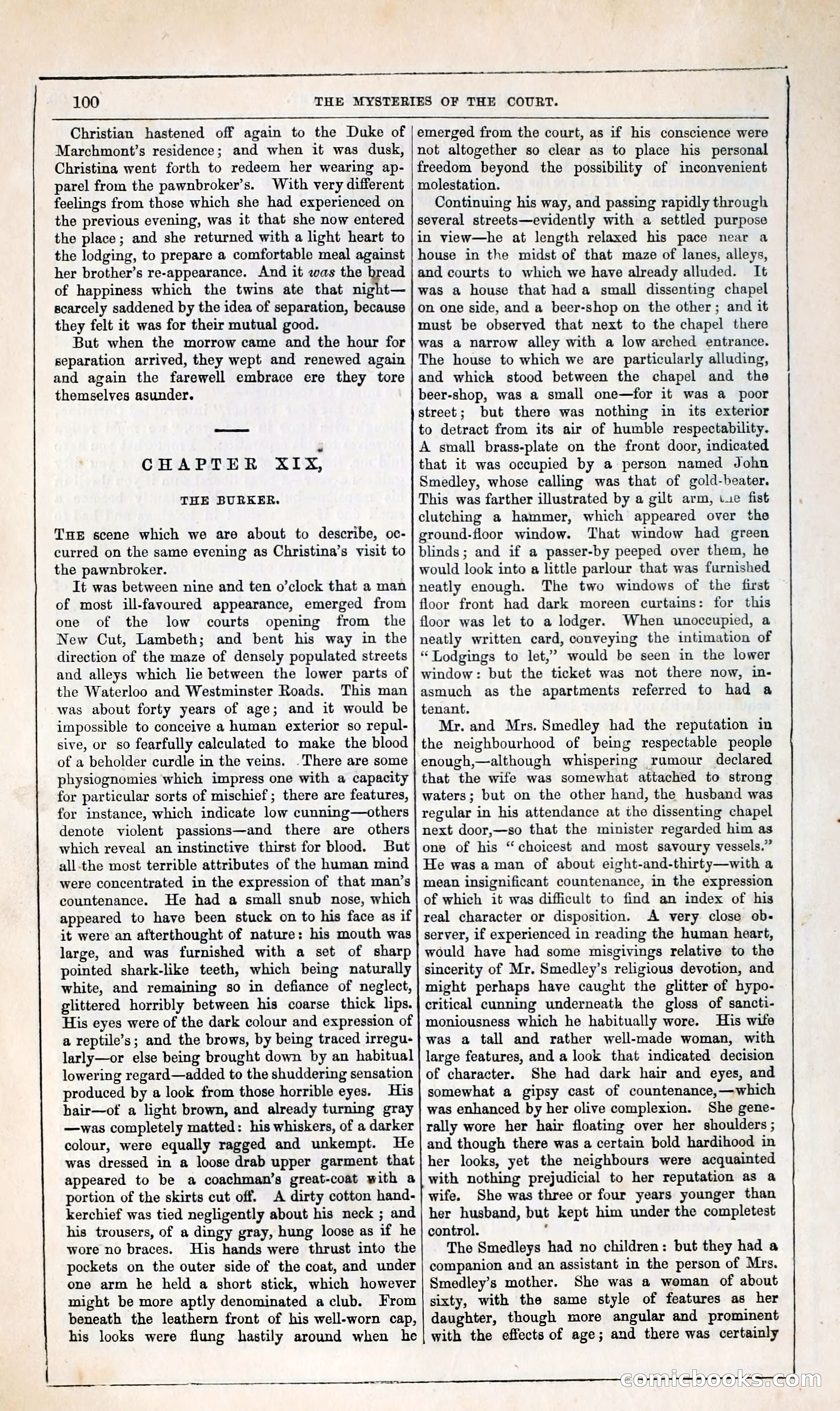
A restored page from Penny Dreadfuls, 1849. Page through the whole issue in the reader above.
📄 Transcribed text from this page (OCR, searchable)
Machine-transcribed from the original scan — historical spelling and the odd misread are preserved.
err 100 THE MYSTERIES OF THE COURT. Christian hastened off again to the Duke of Marchmont’s residence; and when it was dusk, Christina went forth to redeem her wearing ap- parel from the pawnbroker’s. With very different feelings from those which she had experienced on the previous evening, was it that she now entered the place; and she returned with a light heart to the lodging, to prepare a comfortable meal against her brother’s re-appearance. And it was the bread of happiness which the twins ate that night— scarcely saddened by the idea of separation, because they felt it was for their mutual good. But when the morrow came and the hour for separation arrived, they wept and renewed again and again the farewell embrace ere they tore themselves asunder. CHAPTER XIX, THE BURKER. THE scene which we are about to describe, oc- curred on the same evening as Christina’s visit to the pawnbroker. It was between nine and ten o’clock that a man of most ill-favoured appearance, emerged from one of the low courts opening from the New Cut, Lambeth; and bent his way in the direction of the maze of densely populated streets and alleys which lie between the lower parts of the Waterloo and Westminster Roads. This man was about forty years of age; and it would be impossible to conceive a human exterior so repul- sive, or so fearfully calculated to make the blood of a beholder curdle in the veins. . There are some physiognomies which impress one with a capacity for particular sorts of mischief; there are features, for instance, which indicate low cunning—others denote violent passions—and there are others which reveal an instinctive thirst for blood. But all-the most terrible attributes of the human mind were concentrated in the expression of that man’s countenance. He had a small snub nose, which appeared to have been stuck on to his face as if it were an afterthought of nature: his mouth was large, and was furnished with a set of sharp pointed shark-like teeth, which being naturally white, and remaining so in defiance of neglect, glittered horribly between his coarse thick lips. His eyes were of the dark colour and expression of a reptile’s; and the brows, by being traced irregu- larly—or else being brought down by an habitual lowering regard—added to the shuddering sensation produced by a look from those horrible eyes. His hair—ot a light brown, and already turning gray —was completely matted: his whiskers, of a darker colour, were equally ragged and unkempt. He was dressed in a loose drab upper garment that appeared to be a coachman’s great-coat with a portion of the skirts cut off. A dirty cotton hand- kerchief was tied negligently about his neck ; and his trousers, of a dingy gray, hung loose as if he wore no braces. His hands were thrust into the pockets on the outer side of the coat, and under one arm he held a short stick, which however might be more aptly denominated aclub. From beneath the leathern front of his well-worn cap, his looks were flung hastily around when he EAA emerged from the court, as if his conscience were not altogether so clear as to place his personal freedom beyond the possibility of inconvenient molestation. Continuing his way, and passing rapidly through several streets—evidently with a settled purpose in view—he at length relaxed his pace near a house in the midst of that maze of lanes, alleys, and courts to which we have already alluded. It was a house that had a small dissenting chapel on one side, and a beer-shop on the other; and it must be observed that next to the chapel there was a narrow alley with a low arched entrance. The house to which we are particularly alluding, and which stood between the chapel and the beer-shop, was a small one—for it was a poor street; but there was nothing in its exterior to detract from its air of humble respectability. A small brass-plate on the front door, indicated that it was occupied by a person named John Smedley, whose calling was that of gold-beater. This was farther illustrated by a gilt arm, ve fist clutching a hammer, which appeared over the ground-floor window. That window had green blinds; and if a passer-by peeped over them, he would look into a little parlour that was furnished neatly enough. The two windows of the first floor front had dark moreen curtains: for this floor was let to a lodger. When unoccupied, a neatly written card, conveying the intimation of “Lodgings to let,’ would be seen in the lower window: but the ticket was not there now, in- asmuch as the apartments referred to had a tenant. Mr. and Mrs. Smedley had the reputation in the neighbourhood of being respectable people enough,—although whispering rumour declared that the wife was somewhat attached to strong waters; but on the other hand, the husband was regular in his attendance at the dissenting chapel next door,—so that the minister regarded him as one of his “choicest and most savoury vessels.” He was aman of about eight-and-thirty—with a mean insignificant countenance, in the expression of which it was difficult to find an index of his real character or disposition. A very close ob- server, if experienced in reading the human heart, would have had some misgivings relative to the sincerity of Mr. Smedley’s religious devotion, and might perhaps have caught the glitter of hypo- critical cunning underneath the gloss of sancti- moniousness which he habitually wore. His wite was a tall and rather well-made woman, with large features, and a look that indicated decision of character. She had dark hair and eyes, and somewhat a gipsy cast of countenance,—which was enhanced by her olive complexion. She gene- rally wore her hair floating over her shoulders ; and though there was a certain bold hardihood in her looks, yet the neighbours were acquainted with nothing prejudicial to her reputation as a wife. She was three or four years younger than her husband, but kept him under the completest control. ‘ The Smedleys had no children: but they had a companion and an assistant in the person of Mrs. Smedley’s mother. She was a woman of about sixty, with the same style of features as her daughter, though more angular and prominent with the effects of age; and there was certainly ne a 'GDOOKSnaGG