
Penny Dreadfuls, 1849 · page 107 of 394
The Mysteries of the Court of London — page 107: what you’re looking at
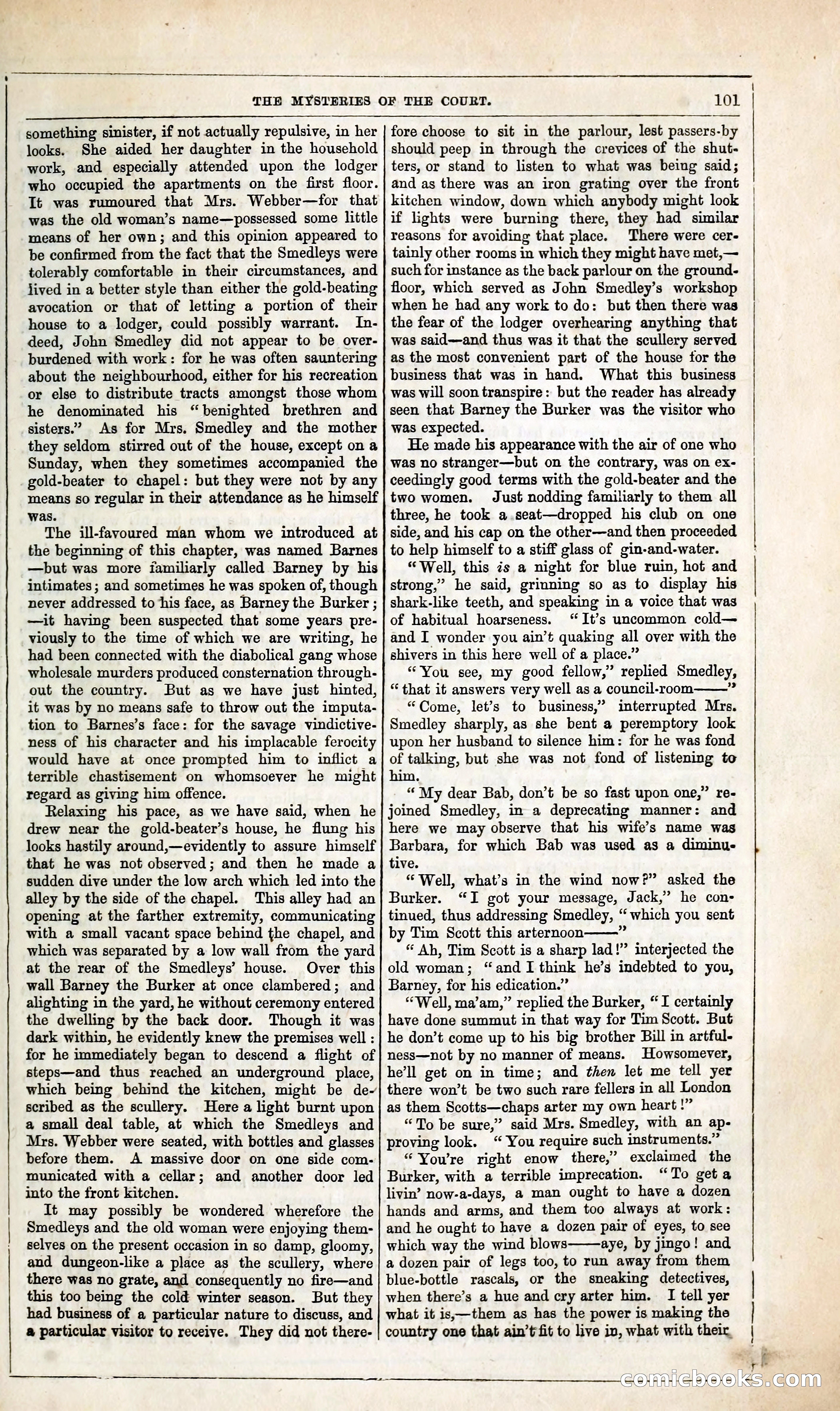
A restored page from Penny Dreadfuls, 1849. Page through the whole issue in the reader above.
📄 Transcribed text from this page (OCR, searchable)
Machine-transcribed from the original scan — historical spelling and the odd misread are preserved.
LLL LLL THE MYSTERIES OF THE COURT. something sinister, if not actually repulsive, in her looks. She aided her daughter in the household work, and especially attended upon the lodger who occupied the apartments on the first floor. It was rumoured that Mrs. Webber—for that was the old woman’s name—possessed some little means of her own; and this opinion appeared to be confirmed from the fact that the Smedleys were tolerably comfortable in their circumstances, and lived in a better style than either the gold-beating avocation or that of letting a portion of their house to a lodger, could possibly warrant. In- deed, John Smedley did not appear to be over- burdened with work: for he was often sauntering about the neighbourhood, either for his recreation or else to distribute tracts amongst those whom he denominated his “benighted brethren and sisters.’ As for Mrs. Smedley and the mother they seldom stirred out of the house, except on a Sunday, when they sometimes accompanied the gold-beater to chapel: but they were not by any means so regular in their attendance as he himself was. The ill-favoured man whom we introduced at the beginning of this chapter, was named Barnes —but was more familiarly called Barney by his intimates ; and sometimes he was spoken of, though never addressed to his face, as Barney the Burker ; —it having been suspected that some years pre- viously to the time of which we are writing, he had been connected with the diabolical gang whose wholesale murders produced consternation through- out the country. But as we have just hinted, it was by no means safe to throw out the imputa- tion to Barnes’s face: for the savage vindictive- ness of his character and his implacable ferocity would have at once prompted him to inflict a terrible chastisement on whomsoever he might regard as giving him offence. Relaxing his pace, as we have said, when he drew near the gold-beater’s house, he flung his looks hastily around,—evidently to assure himself that he was not observed; and then he made a sudden dive under the low arch which led into the alley by the side of the chapel. This alley had an opening at the farther extremity, communicating with a small vacant space behind the chapel, and which was separated by a low wall from the yard at the rear of the Smedleys’ house. Over this wall Barney the Burker at once clambered; and alighting in the yard, he without ceremony entered the dwelling by the back door. Though it was dark within, he evidently knew the premises well : for he immediately began to descend a flight of steps—and thus reached an underground place, which being behind the kitchen, might be de-~ scribed as the scullery. Here a light burnt upon a small deal table, at which the Smedleys and Mrs. Webber were seated, with bottles and glasses before them. A massive door on one side com- municated with a cellar; and another door led into the front kitchen. It may possibly be wondered wherefore the Smedleys and the old woman were enjoying them- selves on the present occasion in so damp, gloomy, aud dungeon-like a place as the scullery, where there was no grate, and consequently no fire—and this too being the cold winter season. But they had business of a particular nature to discuss, and a particular visitor to receive. They did not there- —EE fore choose to sit in the parlour, lest passers-by should peep in through the crevices of the shut- ters, or stand to listen to what was being said; and as there was an iron grating over the front kitchen window, down which anybody might look if lights were burning there, they had similar reasons for avoiding that place. There were cer- tainly other rooms in which they might have met,— such for instance as the back parlour on the ground- floor, which served as John Smedley’s workshop when he had any work to do: but then there was the fear of the lodger overhearing anything that was said—and thus was it that the scullery served as the most convenient part of the house for the business that was in hand. What this business was will soon transpire: but the reader has already seen that Barney the Burker was the visitor who was expected. He made his appearance with the air of one who was no stranger—but on the contrary, was on ex- ceedingly good terms with the gold-beater and the two women. Just nodding familiarly to them all three, he took a.seat—dropped his club on one side, and his cap on the other—and then proceeded to help himself to a stiff glass of gin-and-water. “Well, this 7s a night for blue ruin, hot and strong,” he said, grinning so as to display his shark-like teeth, and speaking in a voice that was of habitual hoarseness. “It’s uncommon cold— and I wonder you ain’t quaking all over with the shivers in this here well of a place.” “You see, my good fellow,” replied Smedley, “that it answers very well as a council-room es “Come, let’s to business,” interrupted Mrs. Smedley sharply, as she bent a peremptory look upon her husband to silence him: for he was fond of talking, but she was not fond of listening to him “‘ My dear Bab, don’t be so fast upon one,” re- joined Smedley, in a deprecating manner: and here we may observe that his wife’s name was Barbara, for which Bab was used as a diminu- tive. “ Well, what’s in the wind now?” asked the Burker. “I got your message, Jack,’ he con- tinued, thus addressing Smedley, “which you sent by Tim Scott this arternoon te “ Ah, Tim Scott is a sharp lad!” interjected the old woman; “and I think he’s indebted to you, Barney, for his edication.” “Well, ma’am,” replied the Burker, “I certainly have done summut in that way for Tim Scott. But he don’t come up to his big brother Bill in artful- ness—not by no manner of means. Howsomever, he’ll get on in time; and then let me tell yer there won’t be two such rare fellers in all London as them Scotts—chaps arter my own heart !” “To be sure,” said Mrs. Smedley, with an ap- proving look. “You require such instruments.” “Youre right enow there,’ exclaimed the Burker, with a terrible imprecation. “To geta livin’ now-a-days, a man ought to have a dozen hands and arms, and them too always at work: and he ought to have a dozen pair of eyes, to see which way the wind blows aye, by jingo! and a dozen pair of legs too, to run away from them | blue-bottle rascals, or the sneaking detectives, when there’s a hue and cry arter him. [I tell yer what it is,—them as has the power is making the country one that ain’t fit to live iv, what with their, \ 101 | $$$ ___________ ee faye! sexe) (E(0)