
Penny Dreadfuls, 1849 · page 11 of 394
The Mysteries of the Court of London — page 11: what you’re looking at
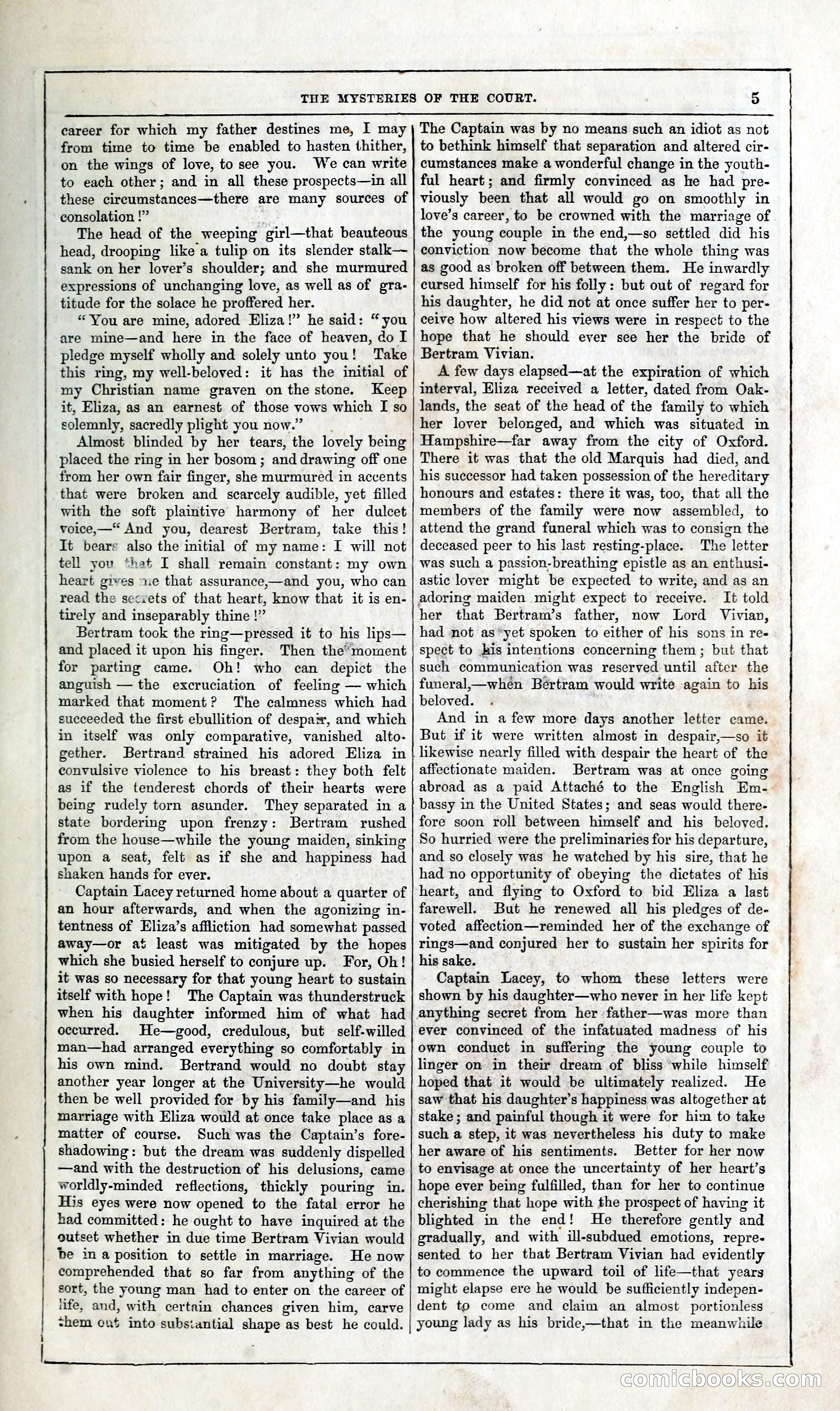
A restored page from Penny Dreadfuls, 1849. Page through the whole issue in the reader above.
📄 Transcribed text from this page (OCR, searchable)
Machine-transcribed from the original scan — historical spelling and the odd misread are preserved.
THE MYSTERIES OF THE COURT. 3) eareer for which my father destines me, I may from time to time be enabled to hasten thither, on the wings of love, to see you. We can write to each other; and in all these prospects—in all these circumstances—there are many sources of consolation !” The head of the weeping girl—that beauteous head, drooping like a tulip on its slender stalk— sank on her lover’s shoulder; and she murmured expressions of unchanging love, as well as of gra- titude for the solace he proffered her. “You are mine, adored Eliza!” he said: “you are mine—and here in the face of heaven, do I pledge myself wholly and solely unto you! Take this ring, my well-beloved: it has the initial of my Christian name graven on the stone. Keep it, Eliza, as an earnest of those vows which I so solemnly, sacredly plight you now.” Almost blinded by her tears, the lovely being placed the ring in her bosom ; and drawing off one from her own fair finger, she murmured in accents that were broken and scarcely audible, yet filled with the soft plaintive harmony of her dulcet voice,—“ And you, dearest Bertram, take this! It bears also the initial of my name: I will not tell you that I shall remain constant: my own heart gives 1e that assurance,—and you, who can read the secvets of that heart, know that it is en- tirely and inseparably thine !” Bertram took the ring—pressed it to his lips— and placed it upon his finger. Then the*moment for parting came. Oh! who can depict the anguish — the excruciation of feeling — which marked that moment? ‘The calmness which had succeeded the first ebullition of despas, and which in itself was only comparative, vanished alto- gether. Bertrand strained his adored Eliza in convulsive violence to his breast: they both felt as if the tenderest chords of their hearts were being rudely torn asunder. They separated in a state bordering upon frenzy: Bertram rushed from the house—while the young maiden, sinking upon a seat, felt as if she and happiness had shaken hands for ever. Captain Lacey returned home about a quarter of an hour afterwards, and when the agonizing in- tentness of Eliza’s affliction had somewhat passed away—or at least was mitigated by the hopes which she busied herself to conjure up. For, Oh! it was so necessary for that young heart to sustain itself with hope! The Captain was thunderstruck when his daughter informed him of what had occurred. He—good, credulous, but self-willed man—had arranged everything so comfortably in his own mind. Bertrand would no doubt stay another year longer at the University—he would then be well provided for by his family—and his marriage with Eliza would at once take place as a matter of course. Such was the Captain’s fore- shadowing: but the dream was suddenly dispelled —and with the destruction of his delusions, came worldly-minded reflections, thickly pouring in. His eyes were now opened to the fatal error he had committed: he ought to have inquired at the outset whether in due time Bertram Vivian would be in a position to settle in marriage. He now comprehended that so far from anything of the sort, the young man had to enter on the career of life, and, with certain chances given him, carve shem ont into subsiantial shape as best he could. The Captain was by no means such an idiot as not to bethink himself that separation and altered cir- cumstances make a wonderful change in the youth- ful heart; and firmly convinced as he had pre- viously been that all would go on smoothly in love’s career, to be crowned with the marriage of the young couple in the end,—so settled did his conviction now become that the whole thing was as good as broken off between them. He inwardly cursed himself for his folly: but out of regard for his daughter, he did not at once suffer her to per- ceive how altered his views were in respect to the hope that he should ever see her the bride of Bertram Vivian. A few days elapsed—at the expiration of which interval, Eliza received a letter, dated from Oak- lands, the seat of the head of the family to which her lover belonged, and which was situated in Hampshire—far away from the city of Oxford. There it was that the old Marquis had died, and his successor had taken possession of the hereditary honours and estates: there it was, too, that all the members of the family were now assembled, to attend the grand funeral which was to consien the deceased peer to his last resting-place. The letter was such a passion-breathing epistle as an enthusi- astic lover might be expected to write, and as an adoring maiden might expect to receive. It told her that Bertram’s father, now Lord Vivian, had not as“yet spoken to either of his sons in re- spect to kis intentions concerning them; but that such communication was reserved until after the funeral,—when Bertram would write again to his beloved. And in afew more days another letter came. But if it were written almost in despair,—so it likewise nearly filled with despair the heart of the affectionate maiden. Bertram was at once going abroad as a paid Attaché to the English Em- bassy in the United States; and seas would there- fore soon roll between himself and his beloved. So hurried were the preliminaries for his departure, and so closely was he watched by his sire, that he had no opportunity of obeying the dictates of his heart, and flying to Oxford to bid Eliza a last farewell. But he renewed all his pledges of de- voted affection—reminded her of the exchange of rings—and conjured her to sustain her spirits for his sake. Captain Lacey, to whom these letters were shown by his daughter—who never in her life kept anything secret from her father—was more than ever convinced of the infatuated madness of his own conduct in suffering the young couple to linger on in their dream of bliss ‘while himself hoped that it would be ultimately realized. He saw that his daughter’s happiness was altogether at stake; and painful though it were for him to take such a step, it was nevertheless his duty to make her aware of his sentiments. Better for her now to envisage at once the uncertainty of her heart’s hope ever being fulfilled, than for her to continue cherishing that hope with the prospect of having it blighted in the end! He therefore gently and gradually, and with ill-subdued emotions, repre- sented to her that Bertram Vivian had evidently to commence the upward toil of life—that years might elapse ere he would be sufficiently indepen- dent to come and claim an almost portionless young lady as his bride,—that in the meanwhile ——————— ——_————————————————— C (c©)