
Penny Dreadfuls, 1849 · page 12 of 394
The Mysteries of the Court of London — page 12: what you’re looking at
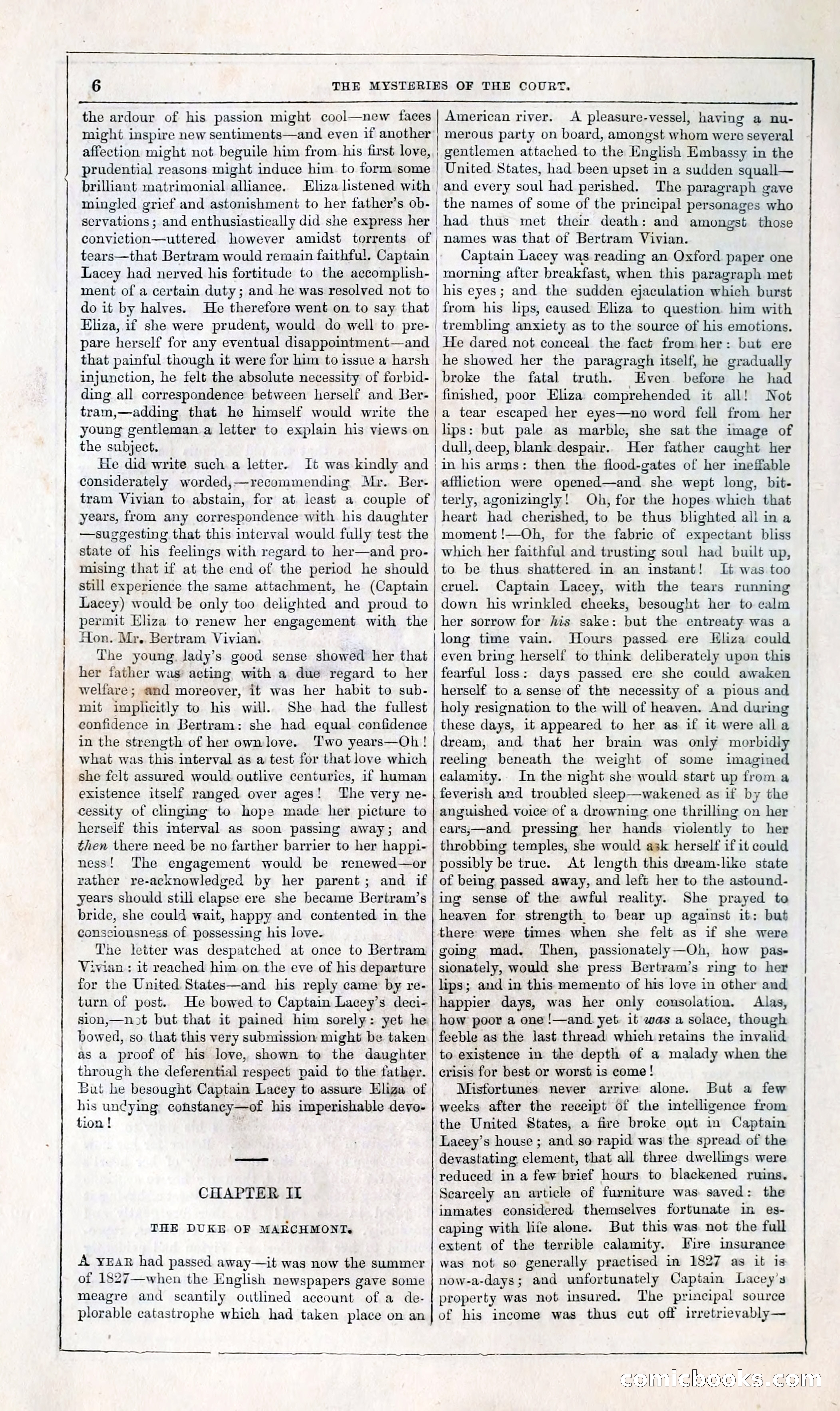
A restored page from Penny Dreadfuls, 1849. Page through the whole issue in the reader above.
📄 Transcribed text from this page (OCR, searchable)
Machine-transcribed from the original scan — historical spelling and the odd misread are preserved.
6 the ardour of his passion might cool—new faces | American river. might inspire new sentiments—and even if another affection might not beguile him from his first love, prudential reasons might induce him to form some brilliant matrimonial alliance. Elza hstened with mingled grief and astonishment to her father’s ob- servations ; and enthusiastically did she express her conviction—uttered however amidst torrents of tears—that Bertram would remain faithful. Captain Lacey had nerved his fortitude to the accomplish- ment of a certain duty; and he was resolved not to do it by halves. He therefore went on to say that Eliza, if she were prudent, would do well to pre- pare herself for any eventual disappoimtment—and that painful though it were for him to issue a harsh injunction, he felt the absolute necessity of forbid- ding all correspondence between herself and Ber- tram,—adding that he himself would write the young gentleman a letter to explain his views on the subject. He did write such a letter. It was kindly and considerately worded,—recommending Mr. Ber- tram Vivian to abstain, for at least a couple of years, from any correspondence with his daughter —suggesting that this interval would fully test the state of his feelings with regard to her—and pro- mising that if at the end of the period he should still experience the same attachment, he (Captain Lacey) would be only too delighted and proud to permit Eliza to renew her engagement with the Hon. Mr. Bertram Vivian. The young. lady’s good sense showed her that her father was acting with a due regard to her welfare; and moreover, it was her habit to sub- mit implicitly to his will. She had the fullest confidence in Bertram: she had equal confidence in the strength of her own love. Two years—Oh! what was this interval as a test for that love which she felt assured would outlive centuries, if human existence itself ranged over ages! ‘The very ne- cessity of clinging to hope made her picture to herself this interval as soon passing away; and then there need be no farther barrier to her happi- ness! The engagement would be renewed—or rather re-acknowledged by her parent; and if years should still elapse ere she became Bertram’s bride, she could wait, happy and contented in the consciousness of possessing his love. The letter was despatched at once to Bertram Vivian; it reached him on the eve of his departure for the United States—and his reply came by re- turn of post. He bowed to Captain Lacey’s deci- sion,—n t but that it pained him sorely: yet he bowed, so that this very submission might be taken as a proof of his love, shown to the daughter through the deferential respect paid to the father. But be besought Captain Lacey to assure Eliza of his undying cohstaney—of his imperishable devo- tion ! = CHAPTER IL THE DUKE OF MARCHMONT. A YEAR had passed away—it was now the summer of 1827—when the English newspapers gave some meagre and scantily outlined account of a de- plorable catastrophe which had taken place on an THE MYSTERIES OF THE COURT. A pleasure-vessel, having a nu- merous party on board, amongst whom were several gentlemen attached to the English Embassy in the United States, had been upset in a sudden squall— and every soul had perished. The paragraph gave the names of some of the principal personages who had thus met their death: and amongst those names was that of Bertram Vivian. Captain Lacey was reading an Oxford paper one morning after breakfast, when this paragraph met his eyes; and the sudden ejaculation which burst from his lips, caused Eliza to question him with trembling anxiety as to the source of his emotions. He dared not conceal the fact from her: but ere he showed her the paragragh itself, he gradually broke the fatal truth. Even before he had finished, poor Eliza: comprehended it all! Not a tear escaped her eyes—no word fell from her lips: but pale as marble, she sat the image of dull, deep, blank despair. Her father caught her in his arms: then the flood-gates of her ineffable affliction were opened—and she wept long, bit- terly, agonizingly! Oh, for the hopes which that heart had cherished, to be thus blighted all in a moment !—Oh, for the fabric of expectant bliss which her faithful and trusting soul had built up, to be thus shattered in an instant! It was too cruel. Captain Lacey, with the tears running down his wrinkled cheeks, besought her to calm her sorrow for fis sake: but the entreaty was a long time vain. Hours passed ere Eliza could even bring herself to think deliberately upon this fearful loss: days passed ere she could awaken herself to a sense of the necessity of a pious and holy resignation to the will of heaven. And during these days, it appeared to her as if it were alla dream, and that her brain was only morbidly reeling beneath the weight of some imagined calamity. In the night she would start up from a feverish and troubled sleep—wakened as if by the anguished voice of a drowning one thrilling on her ears,;—and pressing her hands violently to her throbbing temples, she would ask herself if it could possibly be true. At length this dream-like state of being passed away, and left her to the astound- ing sense of the awful reality. She prayed to heaven for strength to bear up against it: but there were times when she felt as if she were going mad. Then, passionately—Oh, how pas- sionately, would she press Bertram’s ring to her lips; and in this memento of his love in other and happier days, was her only consolation. Alas, how poor a one !—and. yet. it was a solace, though feeble as the last thread which retains the invalid to existence in the depth of a malady when the crisis for best or worst is come! Misfortumes never arrive alone. But a few weeks after the receipt of the intelligence from the United States, a fire broke ont in Captain Lacey’s house ; and so rapid was the spread of the devastating element, that all three dwellmgs were reduced in a few brief hours to blackened ruins, Searcely an article of furniture was saved: the inmates considered themselves fortunate in es- caping with life alone. But this was not the full extent of the terrible calamity. Fire insurance was not so generally practised in 1827 as it is now-a-days; and unfortunately Captain Lacey's property was not insured. The principal source of his income was thus cut off irretrievably— CO) NOOKS (c©)