
Penny Dreadfuls, 1849 · page 117 of 394
The Mysteries of the Court of London — page 117: what you’re looking at
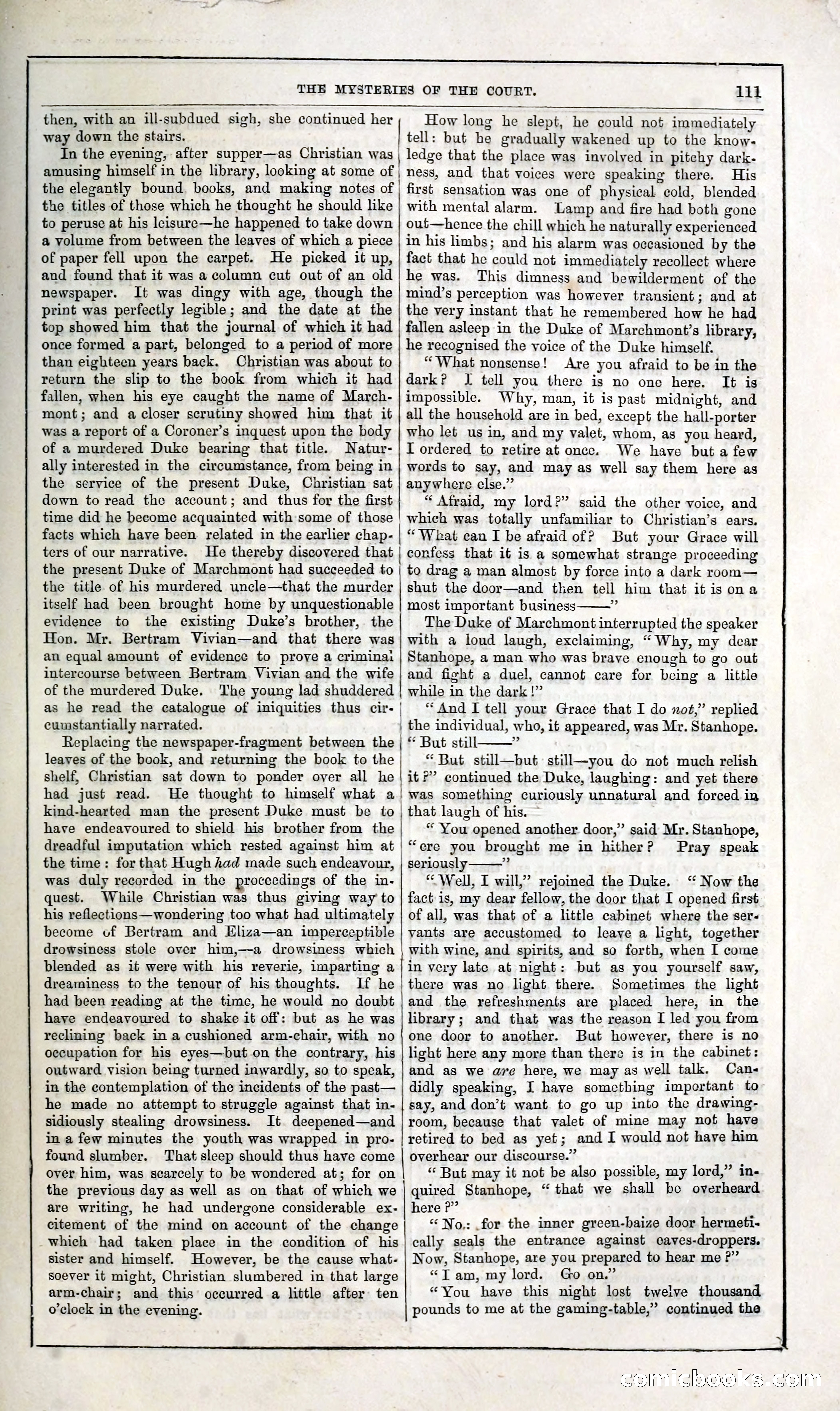
A restored page from Penny Dreadfuls, 1849. Page through the whole issue in the reader above.
📄 Transcribed text from this page (OCR, searchable)
Machine-transcribed from the original scan — historical spelling and the odd misread are preserved.
THE MYSTERIES OF THE COURT. then, with an ill-subdued sigh, she continued her way down the stairs. In the evening, after supper—as Christian was amusing himself in the library, looking at some of the elegantly bound. books, and making notes of the titles of those which he thought he should like to peruse at his leisure—he happened to take down a volume from between the leaves of which a piece of paper fell upon the carpet. He picked it up, and found that it was a column cut out of an old newspaper. It was dingy with age, though the print was perfectly legible; and the date at the top showed him that the journal of which it had once formed a part, belonged to a period of more than eighteen years back. Christian was about to return the slip to the book from which it had fallen, when his eye caught the name of March- mont; and acloser scrutiny showed him that it was a report of a Coroner’s inquest upon the body of a murdered Duke bearing that title. Natur- ally interested in the circumstance, from being in the service of the present Duke, Christian sat down to read the account; and thus for the first time did he become acquainted with some of those facts which have been related in the earlier chap- How long he slept, he could not immediately tell: but he gradually wakened up to the know- | ledge that the place was inyolyed in pitehy dark- ness, and that voices were speaking there. His first sensation was one of physical cold, blended with mental alarm. Lamp and fire had both gone out—hence the chill which he naturally experienced in his limbs; and his alarm was occasioned by the fact that he could not immediately recollect where he was. This dimness and bewilderment of the mind’s perception was however transient; and at the very instant that he remembered how he had fallen asleep in the Duke of Marchmont’s library, he recognised the voice of the Duke himself. “What nonsense! Are you afraid to be in the dark? I tell you there is no one here. It is impossible. Why, man, it is past midnight, and all the household are in bed, except the hall-porter who let us in, and my valet, whom, as you heard, I ordered to retire at once. We have but a few words to say, and may as well say them here as anywhere else.” “ Afraid, my lord?” said the other voice, and which was totally unfamiliar to Christian’s ears. “What can I be afraid of? But your Grace will ters of our narrative. He thereby discovered that | confess that it is a somewhat strange proceeding the present Duke of Marchmont had succeeded to the title of his murdered uncle—that the murder itself had been brought home by unquestionable evidence to the existing Duke’s brother, the Hon. Mr. Bertram Vivian—and that there was an equal amount of evidence to prove a criminai intercourse between Bertram Vivian and the wife of the murdered Duke. The young lad shuddered as he read the catalogue of iniquities thus cir- cumstantially narrated. Replacing the newspaper-fragment between the leaves of the book, and returning the book to the shelf, Christian sat down to ponder oyer all he had just read. He thought to himself what a kind-hearted man the present Duke must be to have endeavoured to shield his brother from the dreadful imputation which rested against him at the time: for that Hugh had made such endeavour, was duly recorded in the proceedings of the in- quest. While Christian was thus giving way to his reflections—wondering too what had ultimately become of Bertram and Eliza—an imperceptible drowsiness stole over him,—a drowsiness which blended as it were with his reverie, imparting a dreaminess to the tenour of his thoughts. If he had been reading at the time, he would no doubt haye endeavoured to shake it off: but as he was reclining back in a cushioned arm-chair, with no occupation for his eyes—but.on the contrary, his outward vision being turned inwardly, so to speak, in the contemplation of the incidents of the past— he made no attempt to struggle against that in- sidiously stealing drowsiness. It deepened—and in a few minutes the youth was wrapped in pro- found slumber. That sleep should thus have come over him, was scarcely to be wondered at; for on the previous day as well as on that of which we are writing, he had undergone considerable ex- citement of the mind on account of the change which had taken place in the condition of his sister and himself. However, be the cause what- Soever it might, Christian slumbered in that large arm-chair; and this occurred a little after ten o’clock in the evening. SNe to drag a man almost by force into a dark room— shut the door—and then tell him that it is ona most important business of The Duke of Marchmont interrupted the speaker with a loud laugh, exclaiming, “ Why, my dear Stanhope, a man who was brave enough to go out and fight a duel, cannot care for being a little while in the dark !” “And I tell your Grace that I do not,’ replied the individual, who, it appeared, was Mr. Stanhope. * But still = “ But still—but~ still~you do not much relish it P’ continued the Duke, laughing: and yet there was something curiously unnatural and forced in that laugh of his. ~ “ You opened another door,” said Mr. Stanhope, “ere you brought me in hither? Pray speak seriously * “Well, I will,” rejoimed the Duke. ‘ Now the fact is, my dear fellow, the door that I opened first of all, was that of a little cabinet where the ser- yants are accustomed to leave a licht, together with wine, and spirits, and so forth, when I come in very late at night: but as you yourself saw, there was no light there. Sometimes the light and the refreshments are placed here, in the library; and that was the reason I led you from one door to another. But however, there is no light here any more than there is in the cabinet: and as we are here, we may as well talk. Cans didly speaking, I have something important to say, and don’t want to go up into the drawing- room, because that valet of mine may not have retired to bed as yet; and I would not have him overhear our discourse.” “ But may it not be also possible, my lord,” in- quired Stanhope, “ that we shall be overheard here P” “‘ No,: .for the inner green-baize door hermeti- cally seals the entrance against eaves-droppers. Now, Stanhope, are you prepared to hear me P” “Tam, my lord. Go on.” “You have this night lost twelve thousand pounds to me at the gaming-table,” continued the 111 (C(O) S