
Penny Dreadfuls, 1849 · page 118 of 394
The Mysteries of the Court of London — page 118: what you’re looking at
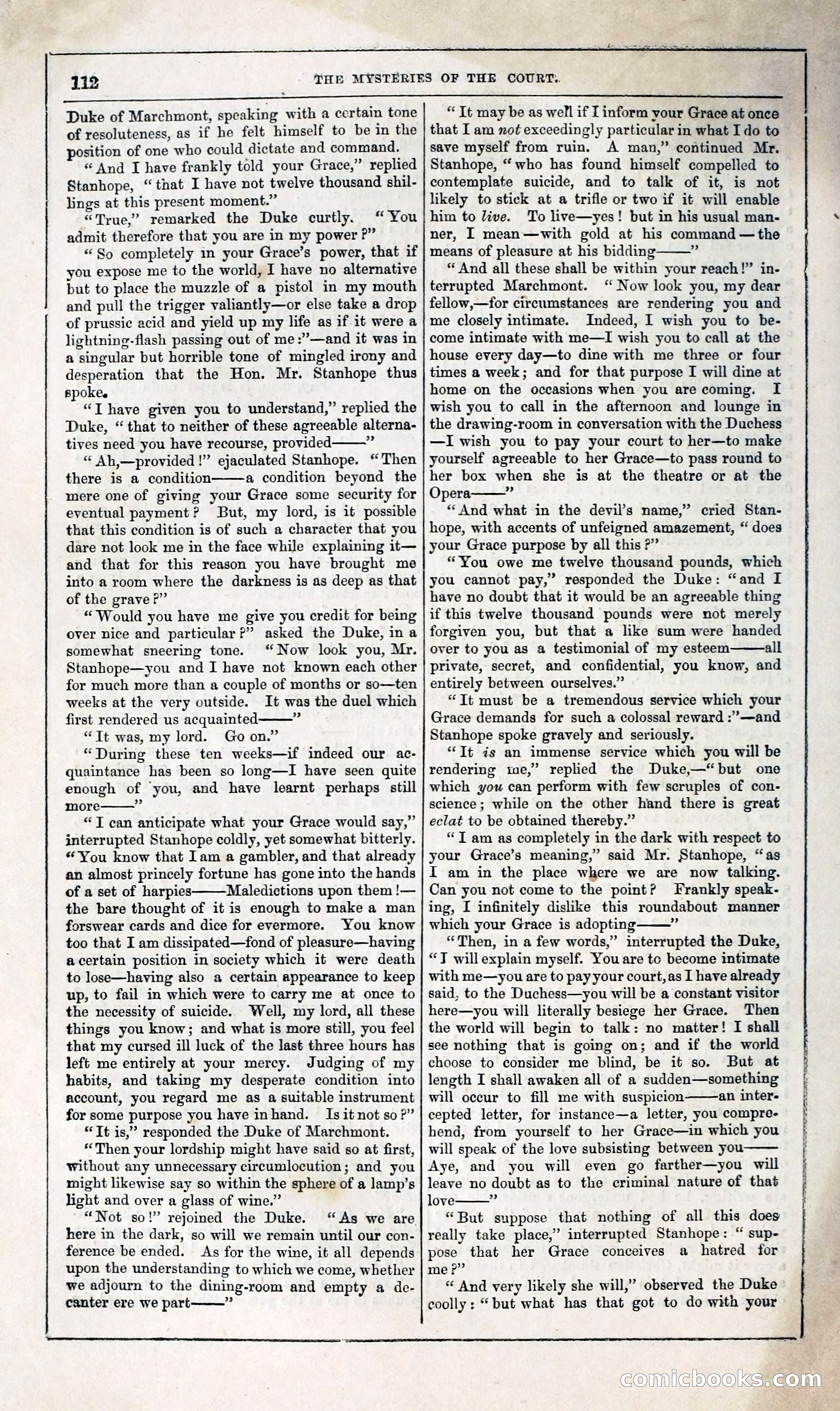
A restored page from Penny Dreadfuls, 1849. Page through the whole issue in the reader above.
📄 Transcribed text from this page (OCR, searchable)
Machine-transcribed from the original scan — historical spelling and the odd misread are preserved.
112 Duke of Marchmont, speaking with a certain tone of resoluteness, as if he felt himself to be in the position of one who could dictate and command. “ And I have frankly told your Grace,” replied Stanhope, “that I have not twelve thousand shil- lings at this present moment.” “True,” remarked the Duke curtly. admit therefore that you are in my power P” “So completely in your Grace’s power, that if you expose me to the world, I have no alternative but to place the muzzle of a pistol in my mouth and pull the trigger valiantly—or else take a drop of prussic acid and yield up my life as if if were a lightning-flash passing out of me :’—and it was in a singular but horrible tone of mingled irony and desperation that the Hon. Mr. Stanhope thus spoke. “T have given you to understand,” replied the Duke, “ that to neither of these agreeable alterna- tives need you have recourse, provided 2 “ Ah,—provided !” ejaculated Stanhope. “Then there is a condition a condition beyond the mere one of giving your Grace some security for eventual payment? But, my lord, is it possible that this condition is of such a character that you dare not look me in the face while explaining it— and that for this reason you have brought me into a room where the darkness is as deep as that of the grave ?” “Would you have me give you credit for being over nice and particular?” asked the Duke, in a somewhat sneering tone. ‘Now look you, Mr. Stanhope—you and I have not known each other for much more than a couple of months or so—ten weeks at the very outside. It was the duel which first rendered us acquainted 2 “It was, my lord. Go on.” “During these ten weeks—if indeed our ac- quaintance has been so long—I have seen quite enough of you, and have learnt perhaps still more if “JT can anticipate what your Grace would say,” interrupted Stanhope coldly, yet somewhat bitterly. “You know that Iam a gambler, and that already an almost princely fortune has gone into the hands of a set of harpies Maledictions upon them !— the bare thought of it is enough to make a man forswear cards and dice for evermore. You know too that I am dissipated—fond of pleasure—having acertain position in society which it were death to lose—having also a certain appearance to keep up, to fail in which were to carry me at once to the necessity of suicide. Well, my lord, all these things you know; and what is more still, you feel that my cursed ill luck of the last three hours has left me entirely at your mercy. Judging of my habits, and taking my desperate condition into account, you regard me as a suitable instrument for some purpose you have inhand. Isitnot so?” “It is,’ responded the Duke of Marchmont. “Then your lordship might have said so at first, without any unnecessary circumlocution; and you might likewise say so within the sphere of a lamp’s light and over a glass of wine.” “Not so!” rejoined the Duke. “As we are here in the dark, so will we remain until our con- ference be ended. As for the wine, it all depends upon the understanding to which we come, whether we adjourn to the dining-room and empty a de- canter ere we part t “You THE MYSTERIES OF THE COURT. “Tt may be as well if I inform your Grace at once that I am not exceedingly particular in what I do to save myself from ruin. A man,” continued Mr. Stanhope, “who has found himself compelled to contemplate suicide, and to talk of it, is not likely to stick at a trifle or two if it will enable him to live. To live—yes! but in his usual man- ner, I mean—with gold at his command — the means of pleasure at his bidding 1 “ And all these shall be within your reach!” in- terrupted Marchmont. ‘‘ Now look you, my dear fellow,—for circumstances are rendering you and me closely intimate. Indeed, I wish you to be- come intimate with me—I wish you to call at the house every day—to dine with me three or four times a week; and for that purpose I will dine at home on the occasions when you are coming. I wish you to call in the afternoon and lounge in the drawing-room in conversation with the Duchess —I wish you to pay your court to her—to make yourself agreeable to her Grace—to pass round to her box when she is at the theatre or at the Opera 4 “And what in the devil’s name,” cried Stan- hope, with accents of unfeigned amazement, “ does your Grace purpose by all this ?” “You owe me twelve thousand pounds, which you cannot pay,’ responded the Duke: “and I have no doubt that it would be an agreeable thing if this twelve thousand pounds were not merely forgiven you, but that a like sum were handed over to you as a testimonial of my esteem all private, secret, and confidential, you know, and entirely between ourselves.” “Tt must be a tremendous service which your Grace demands for such a colossal reward :’—and Stanhope spoke gravely and seriously. “Tt ¢s an immense service which you will be rendering ine,’ replied the Duke,—“but one which you can perform with few scruples of con- science ; while on the other hand there is great eclat to be obtained thereby.” “T am as completely in the dark with respect to your Grace’s meaning,” said Mr. Stanhope, “as I am in the place where we are now talking. Can you not come to the point? Frankly speak- ing, I infinitely dislike this roundabout manner which your Grace is adopting . “Then, in a few words,” interrupted the Duke, “J willexplain myself. You are tc become intimate with me—you are to pay your court, as I have already said, to the Duchess—you will be a constant visitor here—you will literally besiege her Grace. Then the world will begin to talk: no matter! I shall see nothing that is going on; and if the world choose to consider me blind, be it so. But at length I shall awaken all of a sudden—something will occur to fill me with suspicion——an inter- cepted letter, for instance—a letter, you compre- hend, from yourself to her Grace—in which you will speak of the love subsisting between you Aye, and you will even go farther—you will leave no doubt as to the criminal nature of that love - “But suppose that nothing of all this does really take place,” interrupted Stanhope: “ sup- pose that her Grace conceives a hatred for me P” “ And very likely she will,” observed the Duke coolly: “but what has that got to do with your CONNICLOOC S (e(0)