
Penny Dreadfuls, 1849 · page 120 of 394
The Mysteries of the Court of London — page 120: what you’re looking at
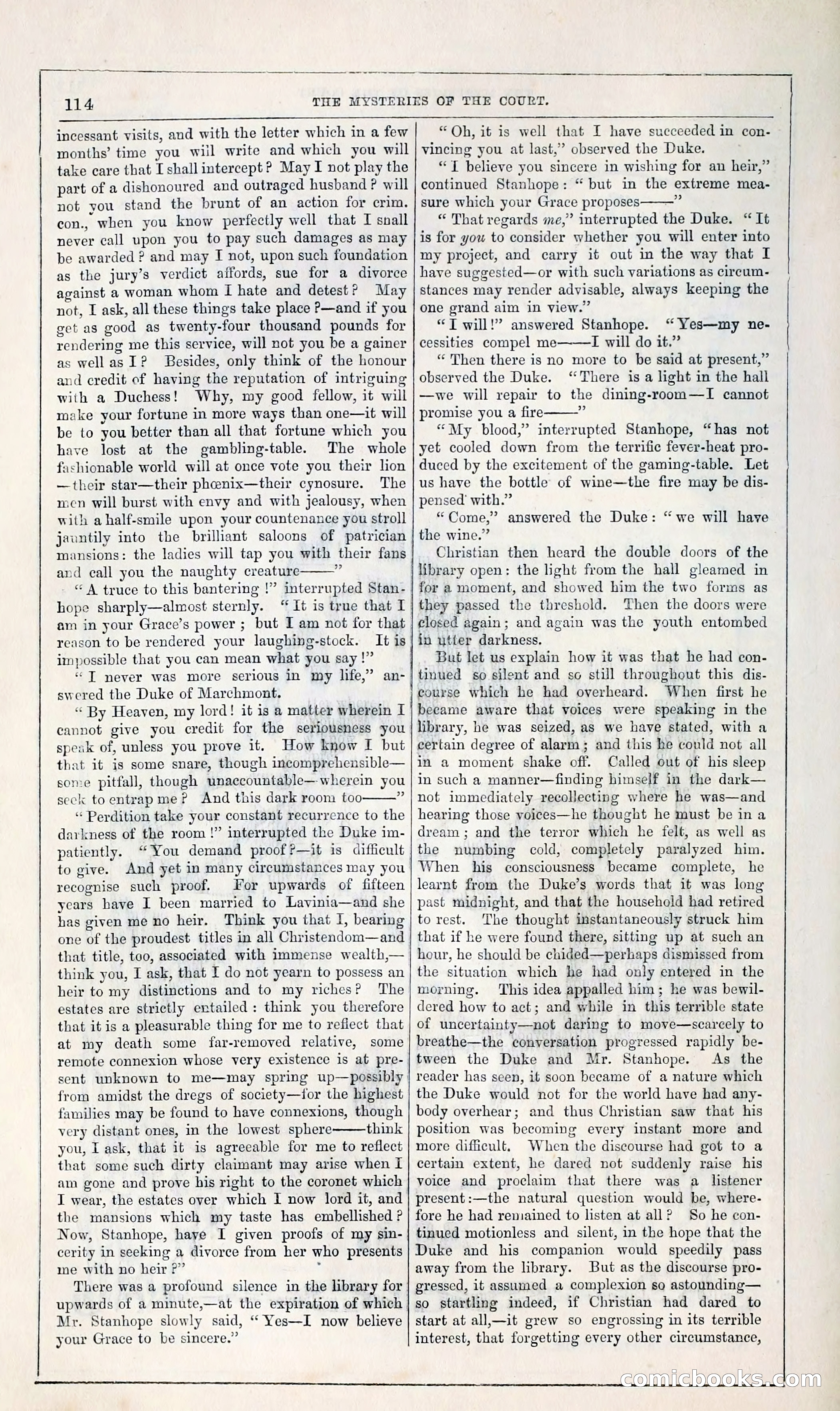
A restored page from Penny Dreadfuls, 1849. Page through the whole issue in the reader above.
📄 Transcribed text from this page (OCR, searchable)
Machine-transcribed from the original scan — historical spelling and the odd misread are preserved.
_—— = terete Seapets — a ee - -_—~ - —_- — 114 THE MYSTERIES OF THE COURT. abe nnn eaeemadata a atenanme aaa anaes iaerese ane oe Doan nen eet oe ec aes aes cnee neers ieee ana ea incessant visits, and with the letter which in a few “Oh, it is well that I have succeeded in con- months’ time you wiil write and which you will vincing you at last,’ observed the Duke. take care that [ shall intercept? May I not play the part of a dishonoured and outraged husband ? will not vou stand the brunt of an action for crim. con., when you know perfectly well that T snall never call upon you to pay such damages as may be awarded ? and may I not, upon such foundation as the jury’s verdict affords, sue for a divorce against a woman whom I hate and detest? May not, I ask, all these things take place P—and if you get as good as twenty-four thousand pounds for rendering me this service, will not you be a gainer as wellas I? Besides, only think of the honour and credit of having the reputation of intriguing with a Duchess! Why, my good fellow, it will make your fortune in more ways than one—it will be to you better than all that fortune which you have lost at the gambling-table. The whole fashionable world will at once vote you their lion —their star—their pheenix—their cynosure. The men will burst with envy and with jealousy, when with ahalf-smile upon your countenance you stroll jauntily into the brillant saloons of patrician mansions: the ladies will tap you with their fans and eall you the naughty creature fe “A truce to this bantering !” interrupted Stan- hope sharply—almost sternly. “It is true that I am in your Grace’s power ; but I am not for that reason to be rendered your laughing-stock. It is impossible that you can mean what you say !” “T never was more serious in my life,” an-. swered the Duke of Marchmont, “ By Heaven, my lord! it is a matter wherein I cannot give you credit for the seriousness you speak of, unless you prove it. How know I but that it is some snare, though incomprehensible— some pitfall, though unaccountable— wherein you seck toentrapmeP And this dark room too iH “ Perdition take your constant recurrence to the darkness of the room !” interrupted the Duke im- patiently. “You demand proof?—it is difficult to give. And yet in many circumstances may you recognise such proof. For upwards of fitteen years have I been married to Lavinia—and she has given me no heir. Think you that I, bearing one of the proudest titles in all Christendom—and that title, too, associated with immense wealth,— think you, I ask, that I do not yearn to possess an heir to my distinctions and to my riches? The estates are strictly entailed: think you therefore that itis a pleasurable thing for me to reflect that at my death some far-removed relative, some remote connexion whose very existence is at pre- sent unknown to me—may spring up—possibly | from amidst the dregs of society—for the highest families may be found to have connexions, though very distant ones, in the lowest sphere think you, 1 ask, that it is agreeable for me to reflect that some such dirty claimant may arise when I am gone and prove bis right to the coronet which I wear, the estates over which I now lord it, and the mansions which my taste has embellished P Now, Stanhope, haye I given proofs of my sin- cerity in seeking a divorce from her who presents me with no heir P?” : There was a profound silence in the library for upwards of a minute,—at the expiration of which. Mr. Stanhope slowly said, ‘‘ Yes—I now believe your Grace to be sincere.” “J believe you sincere in wishing for an heir,” continued Stanhope: “ but in the extreme mea- sure which your Grace proposes ce “ That regards me,’ interrupted the Duke. “ It is for you to consider whether you will enter into my project, and carry it out in the way that I have suggested—or with such variations as circum- stances may render advisable, always keeping the one grand aim in view.” “JT will!” answered Stanhope. ‘“ Yes—my ne- cessities compel me I will do it.” “ Then there is no more to be said at present,” observed the Duke. “There is a light in the hall —we will repair to the dining-room—I cannot promise you a fire si “My blood,” interrupted Stanhope, “has not yet cooled down from the terrific fever-heat pro- duced by the excitement of the gaming-table. Let us have the bottle of wine—the fire may be dis- pensed’ with.” “Come,” answered the Duke: “we will have the wine.” Christian then heard the double doors of the | library open: the light from the hall gleamed in for a moment, and showed him the two forms as they passed the threshold. Then the doors were closed again; and again was the youth entombed in utter darkness. But let us explain how it was that he had con- tinued so silent and so still throughout this dis- } course which be had overheard. When first he became aware that voices were speaking in the library, he was seized, as we have stated, with a certain degree of alarm; and this he could not all in a moment shake off. Called out of his sleep in such a manner—finding himself in the dark— not immediately recollecting where he was—and hearing those voices—he thought he must be in a dream ; and the terror which he felt, as well as the numbing cold, completely paralyzed him. When his consciousness became complete, he learnt from the Duke’s words that it was long past midnight, and that the household had retired to rest. The thought instantaneously struck him that if he were found there, sitting up at such an hour, he should be chided—perhaps dismissed from the situation which he had only entered in the morning. ‘This idea appalled him; he was bewil- dered how to act; and while in this terrible state of uncertainty—not daring to move—scarcely to breathe—the conversation progressed rapidly be- tween the Duke and Mr. Stanhope. As the reader has seen, it soon became of a nature which the Duke would not for the world have had any- body overhear; and thus Christian saw that his position was becoming every instant more and more difficult. When the discourse had got to a certain extent, he dared not suddenly raise his voice and proclaim that there was a listener present:—the natural question would be, where- fore he had reniained to listen at all? So he con- tinued motionless and silent, in the hope that the Duke and his companion would speedily pass away from the library. But as the discourse pro- gressed, it assumed a complexion so astounding— so startling indeed, if Christian had dared to start at all_—it grew so engrossing in its terrible interest, that forgetting every other circumstance,