
Penny Dreadfuls, 1849 · page 121 of 394
The Mysteries of the Court of London — page 121: what you’re looking at
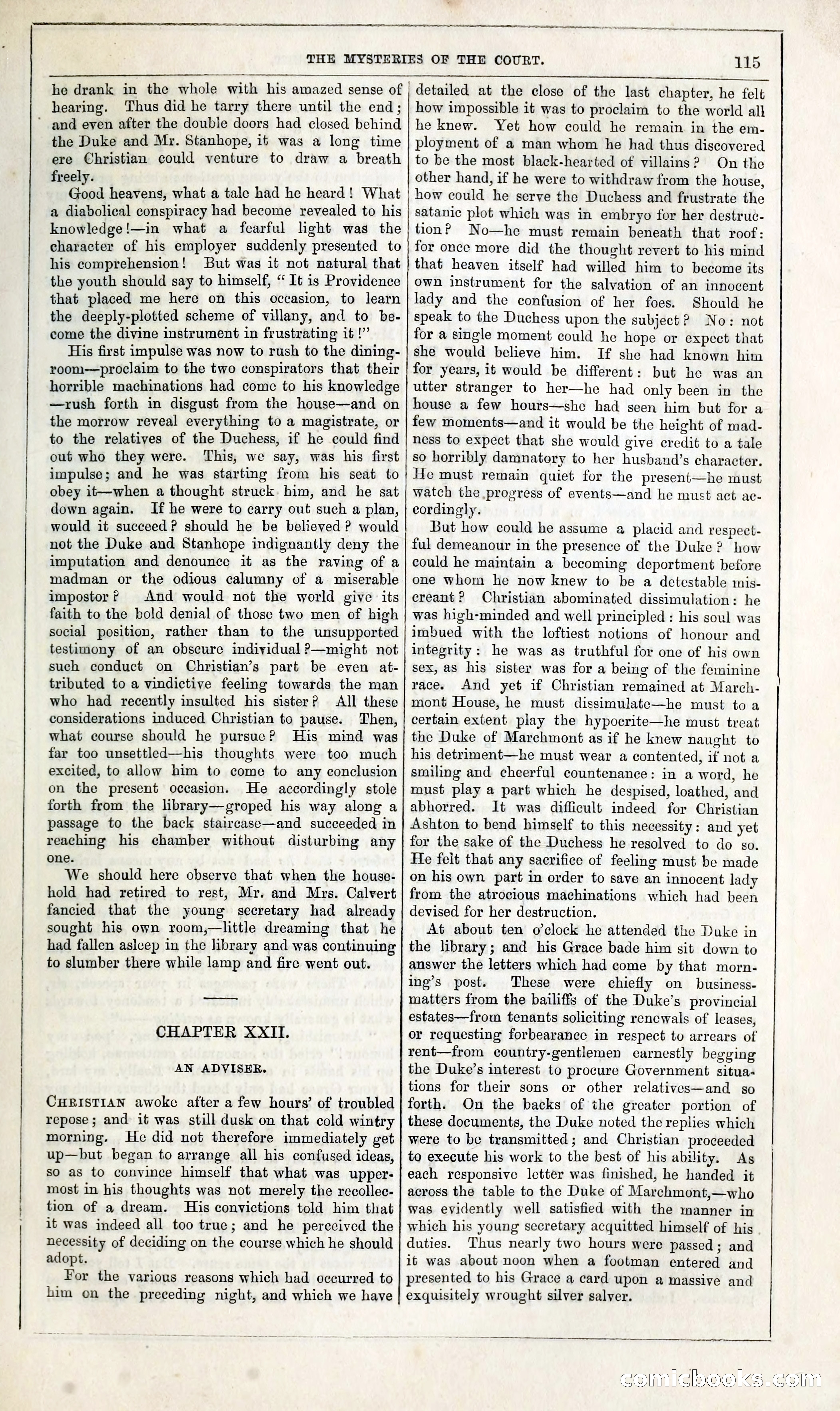
A restored page from Penny Dreadfuls, 1849. Page through the whole issue in the reader above.
📄 Transcribed text from this page (OCR, searchable)
Machine-transcribed from the original scan — historical spelling and the odd misread are preserved.
THE MYSTERIES OF THE COURT. he drank in the whole with his amazed sense of hearing. ‘Thus did he tarry there until the end; ’ and even after the double doors had closed behind the Duke and Mr. Stanhope, it was a long time ere Christian could venture to draw a breath freely. Good heavens, what a tale had he heard! What a diabolical conspiracy had become revealed to his knowledge!—in what a fearful hght was the character of his employer suddenly presented to his comprehension! But was it not natural that the youth should say to himself, “It is Providence that placed me here on this occasion, to learn the deeply-plotted scheme of villany, and to be- come the divine instrument in frustrating it!” His first impulse was now to rush to the dining- room—proclaim to the two conspirators that their horrible machinations had come to his knowledge —rush forth in disgust from the house—and on the morrow reveal everything to a magistrate, or to the relatives of the Duchess, if he could find out who they were. This, we say, was his first impulse; and he was starting from his seat to obey it—when a thought struck him, and he sat down again. If he were to carry out such a plan, would it succeed P should he be believed P would not the Duke and Stanhope indignantly deny the imputation and denounce it as the raving of a madman or the odious calumny of a miserable impostor? And would not the world give its faith to the bold denial of those two men of high social position, rather than to the unsupported testimony of an obscure individual ?—might not such conduct on Christian’s part be even at- tributed to a vindictive feeling towards the man who had recently insulted his sister? All these considerations induced Christian to pause. Then, what course should he pursue? His mind was far too unsettled—his thoughts were too much excited, to allow him to come to any conclusion on the present occasion. He accordingly stole forth from the library—groped his way along a passage to the back staircase—and succeeded in reaching his chamber without disturbing any one. We should here observe that when the house- hold had retired to rest, Mr. and Mrs. Calvert fancied that the young secretary had already sought his own room,—little dreaming that he had fallen asleep in the library and was continuing to slumber there while lamp and fire went out. eee CHAPTER XXII. AN ADVISER. CHRISTIAN awoke after a few hours’ of troubled repose; and it was still dusk on that cold wintry morning. He did not therefore immediately get up—but began to arrange all his confused ideas, so as to convince himself that what was upper- most in his thoughts was not merely the recollec- tion of a dream. His convictions told him that it was indeed all too true; and he perceived the necessity of deciding on the course which he should adopt. For the various reasons which had occurred to him on the preceding night, and which we have ioeetnetitlipe ate nen gee eae ae e e detailed at the close of the last chapter, he felt how impossible it was to proclaim to the world alk he knew. Yet how could he remain in the em- ployment of a man whom he had thus discovered to be the most black-hearted of villains? On the other hand, if he were to withdraw from the house, how could he serye the Duchess and frustrate the satanic plot which was in embryo for her destruc- tion? No—he must remain beneath that roof: for once more did the thought revert to his mind that heaven itself had willed him to become its own instrument for the salvation of an innocent lady and the confusion of her foes. Should he speak to the Duchess upon the subject P No: not for a single moment could he hope or expect that she would believe him. If she had known him for years, it would be different: but he was an utter stranger to her—he had only been in the house a few hours—she had seen him but for a few moments—and it would be the height of mad- ness to expect that she would give credit to a tale so horribly damnatory to her husband’s character. He must remain quiet for the present—he must watch the progress of events—and he must act ac- cordingly. But how could he assume a placid and respect- ful demeanour in the presence of the Duke? how could he maintain a becoming deportment before one whom he now knew to be a detestable mis- creant? Christian abominated dissimulation: he was high-minded and well principled : his soul was imbued with the loftiest notions of honour and integrity: he was as truthful for one of his own sex, as his sister was for a being of the feminine race. And yet if Christian remained at March- mont House, he must dissimulate—he must toa certain extent play the hypocrite—he must treat the Duke of Marchmont as if he knew naught to his detriment—he must wear a contented, if not a smiling and cheerful countenance: in a word, he must play a part which he despised, loathed, and abhorred. It was difficult indeed for Christian Ashton to bend himself to this necessity: and yet for the sake of the Duchess he resolved to do so. He felt that any sacrifice of feeling must be made on his own part in order to save an innocent lady from the atrocious machinations which had been devised for her destruction. At about ten o’clock he attended the Duke in the library; and his Grace bade him sit down to answer the letters which had come by that morn- ing’s post. These were chiefly on business- matters from the bailiffs of the Duke’s provincial estates—from tenants soliciting renewals of leases, or requesting forbearance in respect to arrears of rent—from country-gentlemen earnestly begging the Duke’s interest to procure Government situa- tions for their sons or other relatives—and so forth. On the backs of the greater portion of these documents, the Duke noted the replies which were to be transmitted; and Christian proceeded to execute his work to the best of his ability. As each responsive letter was finished, he handed it across the table to the Duke of Marchmont,—who was evidently well satisfied with the manner in which his young secretary acquitted himself of his duties. Thus nearly two hours were passed; and it was about noon when a footman entered and presented to his Grace a card upon a massive and exquisitely wrought silver salver. (C(O) Nn) G 0)(0)(0) S CO