
Penny Dreadfuls, 1849 · page 136 of 394
The Mysteries of the Court of London — page 136: what you’re looking at
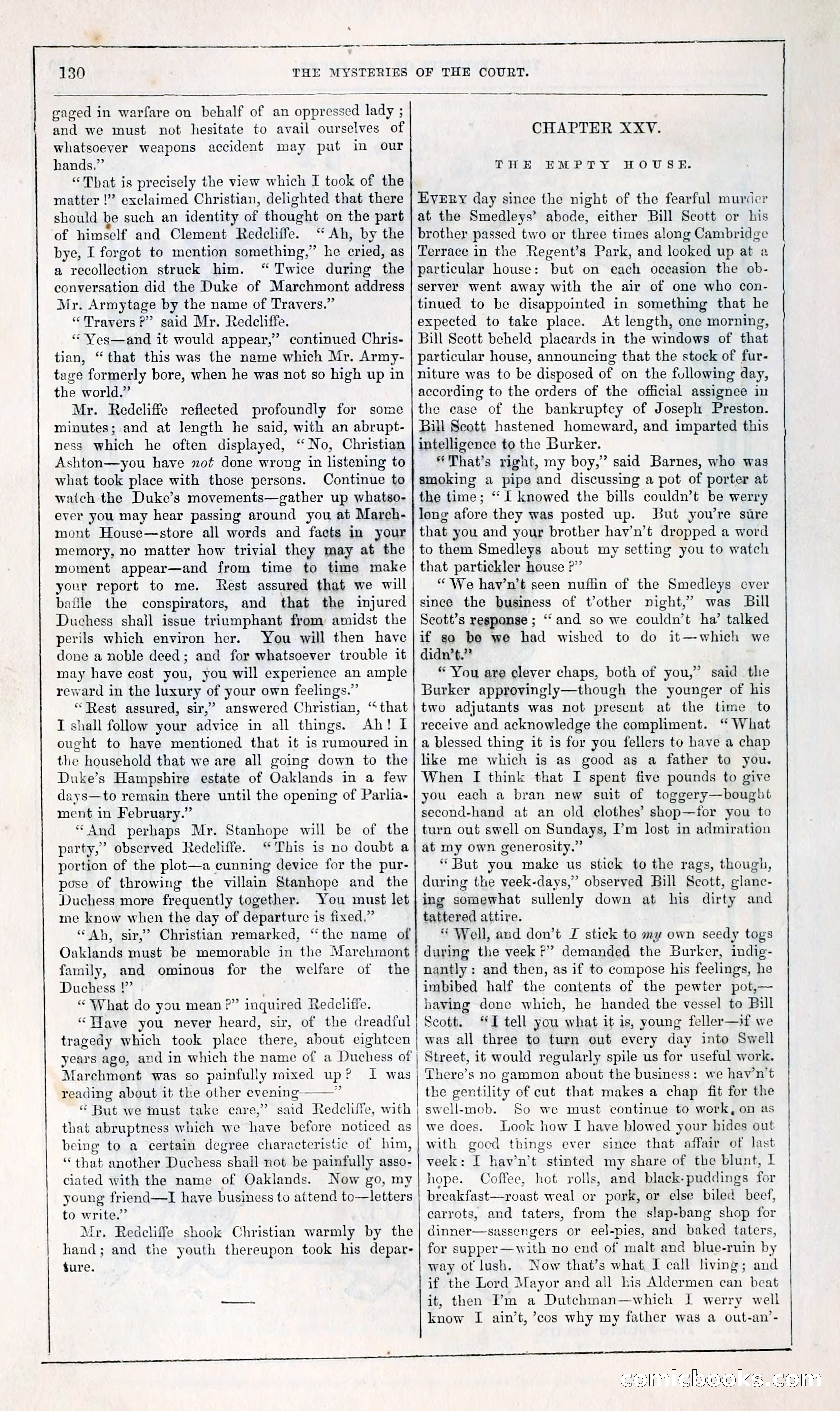
A restored page from Penny Dreadfuls, 1849. Page through the whole issue in the reader above.
📄 Transcribed text from this page (OCR, searchable)
Machine-transcribed from the original scan — historical spelling and the odd misread are preserved.
~ 130 THE MYSTERIES caged in warfare on behalf of an oppressed lady ; and we must not hesitate to avail ourselves of whatsoever weapons accident may put in our hands.” “That is precisely the view which I took of the matter !”? exclaimed Christian, delighted that there should be such an identity of thought on the part of himself and Clement Redcliffe. “Ah, by the bye, I forgot to mention something,’ he once, as a recollection struck him. “ Twice during the conversation did the Duke of Marchmont address Mr. Armytage by the name of Travers.” “Travers P” said Mr. Redcliffe. “ Yes—and it would appear,” continued Chris- tian, “that this was the name which Mr. Army- tage formerly bore, when he was not so high up in the world.” Mr. Redcliffe reflected profoundly for some minutes; and at length he said, with an abrupt- ness which he often displayed, “No, Christian Ashton—you have not done wrong in listening to what took place with those persons. Continue to watch the Duke’s movements—gather up whatso- ever you may hear passing around you at March- mont House—store all words and facts in your memory, no matter how trivial they may at the moment appear—and from time to time make your report to me. Rest assured that we will baflle the conspirators, and that the injured Duchess shail issue triumphant from amidst the perils which environ her. You will then have done a noble deed; and for whatsoever trouble it may have cost you, you will experience an ample reward in the luxury of your own feelings.” “Rest assured, sir,” answered Christian, “that I shall follow your advice in all things. Ah! I ought to have mentioned that it is rumoured in the household that we are all going down to the Duke’s Hampshire estate of Oaklands in a few days—to remain there until the opening of Parlia- ment in February.” “And perhaps Mr. Stanhope will be of the party,” observed Redcliffe. “This is no doubt a portion of the plot—a cunning device for the pur- pose of throwing the villain Stanhope and the Duchess more fr equently together. You must let me know when the day of departure is fixed.” ‘Ah, sir,’ Christian remarked, ‘the name of Oaklands must be memorable in the Marchmont family, and ominous for the welfare of the Duchess !” | “ What do you mean ?” inquired Redcliffe. “Have you never heard, sir, of the dreadful tragedy which took place there, about eighteen years ago, and in which the name of a Duchess of ‘Marehmont was so painfully mixed up? ut oa Reading about it the other evening «But we must take care,” a Redeliffe, with that abruptness which we have before noticed as being to a certain degree characteristic of him, “that another Backes) shall not be painfully asso- ciated with the name of Oaklands. Now go, my young friend—TI have business to attend to—letters to write.” Mr. Redeliffe shook Christian warmly by the hand; and the youth thereupon took his depar- gure. i A TS ne COP ee ae ae OF THE COURT. CHAPTER XXYV. THE EMPTY HOUSE. Every day since the night of the fearful murder at the Smedleys’ abode, either Bill Scott or his brother passed two or three times along Cambridge Terrace in the Regent’s Park, and looked up at a particular house: but on each occasion the ob- server went away with the air of one who con- tinued to be disappointed in something that he expected to take place. At length, one morning, Bill Scott beheld placards in the windows of that particular house, announcing that the stock of fur- niture was to be disposed of on the fullowing day, according to the orders of the official assignee in the case of the bankruptcy of Joseph Preston. Bill Scott hastened homeward, and imparted this intelligence to the Burker. *That’s right, my boy,’ said Barnes, who was smoking a pipe and discussing a pot of porter at the time; “I knowed the bills couldn’t be werry long afore they was posted up. But you're sure that you and your brother hav’n’t dropped a word to them Smedleys about my setting you to watch that partickler house ?” “We hav’n’t seen nuffin of the Smedleys ever since the business of t’other night,” was Bill Scott’s response ; “and so we couldn’t ha’ talked if so be we had wished to do it—which we didn’t.” “ You are clever chaps, both of you,” said thie Burker approvingly—though the younger of his two adjutants was not present at the time to receive and acknowledge the compliment. “ What a blessed thing it is for you fellers to have a chap like me which is as good as a father to you. When I think that I spent five pounds to give you each a bran new suit of toggery—bought second-hand at an old clothes’ shop—for you to turn out swell on Sundays, I’m lost in admiration at my own generosity.” “But you make us stick to the rags, though, during the veek-days,” observed Bill Scott, glanc- ing somewhat sullenly down at his dirty and tattered attire. * Well, and don’t I stick to my own seedy togs during the veek ?” demanded the Burker, indig- nantly: and then, as if to compose his feelings, he imbibed half the contents of the pewter pot,— having done which, he handed the vessel to Bull Scott. “I tell you what it is, young feller—if we was all three to turn out every day into Swell Street, it would regularly spile us for useful work. There’s no gammon about the business: we havn't the eentility of cut that makes a chap fit for the swell-mob. So we must continue to work, on as we does. Look how I have blowed your hides out with good things ever since that affair of last veek: I hav’n’t stinted my share of the blunt, 1 hope. Coffee, hot rolls, and black-puddings for breakfast—roast weal or pork, or else biled beef, carrots, and taters, from the slap-bang shop for dinner—sassengers or eel-pies, and baked taters, for supper—with no end of malt and blue-ruin by way of lush. Now that’s what, I call living; and if the Lord Mayor and all his Aldermen can beat it, then I’m a Dutchman—which I werry well know I ain’t, ’cos why my father was a out-an’- im VNOO|KS (©)