
Penny Dreadfuls, 1849 · page 137 of 394
The Mysteries of the Court of London — page 137: what you’re looking at
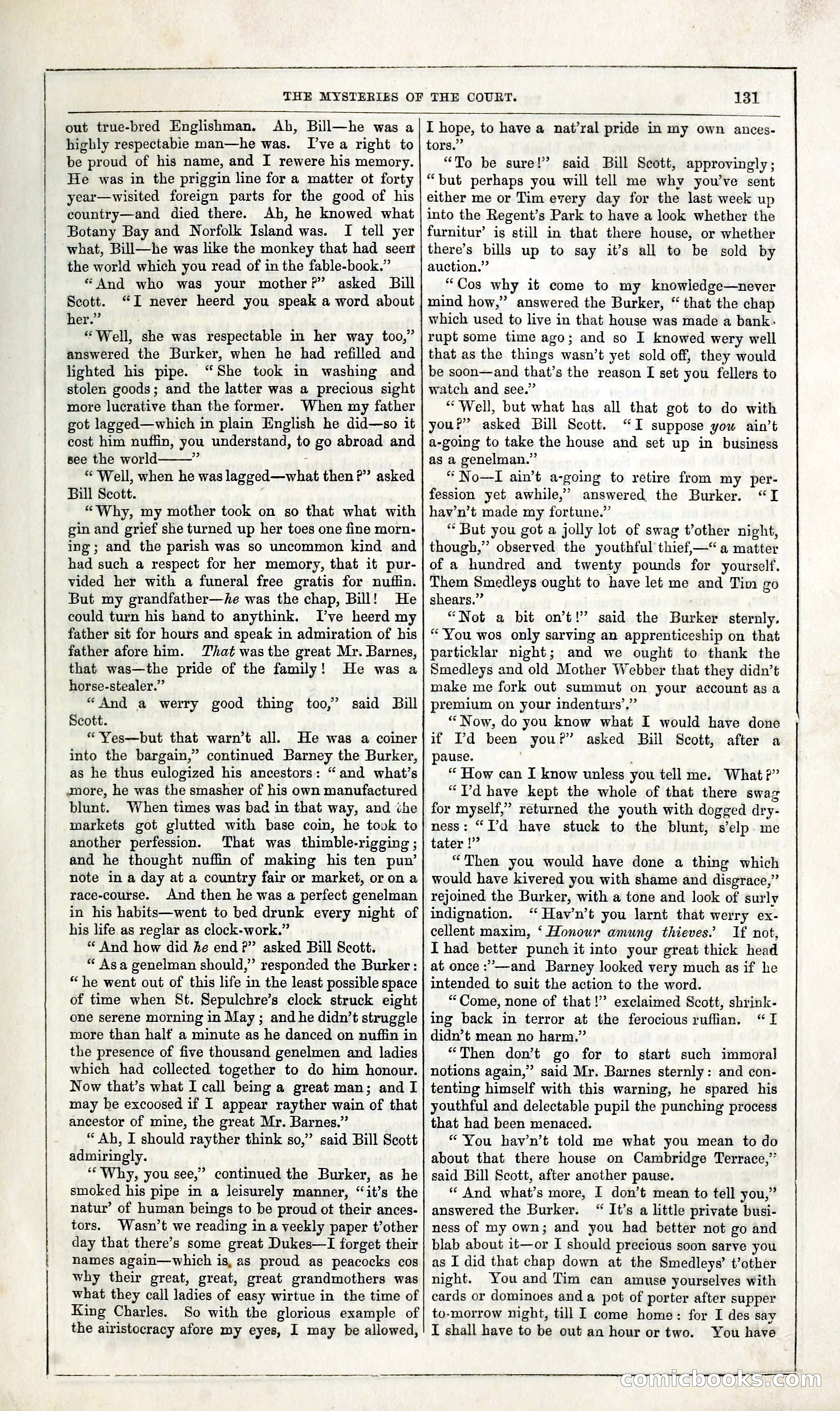
A restored page from Penny Dreadfuls, 1849. Page through the whole issue in the reader above.
📄 Transcribed text from this page (OCR, searchable)
Machine-transcribed from the original scan — historical spelling and the odd misread are preserved.
Ee THE MYSTERIES OF THE COURT. highly respectabie man—he was. I’ve a right to be proud of his name, and I rewere his memory. He was in the priggin line for a matter ot forty year—wisited foreign parts for the good of his country—and died there. Ah, he knowed what Botany Bay and Norfolk Island was. I tell yer what, Bill—he was like the monkey that had seer the world which you read of in the fable-book.” “And who was your mother?” asked Bill Scott. “I never heerd you speak a word about her.” “Well, she was respectable in her way too,” answered the Burker, when he had refilled and lighted his pipe. “She took in washing and stolen goods; and the latter was a precious sight more lucrative than the former. When my father got lagged—which in plain English he did—so it cost him nuffin, you understand, to go abroad and see the world a * Well, when he was lagged—what then ?”’ asked Bill Scott. “Why, my mother took on so that what with gin and grief she turned up her toes one fine morn- ing; and the parish was so uncommon kind and had such a respect for her memory, that it pur- vided her with a funeral free gratis for nuffin. But my grandfather—he was the chap, Bill! He could turn his hand to anythink. ITve heerd my father sit for hours and speak in admiration of his father afore him. That was the great Mr. Barnes, that was—the pride of the family! He was a horse-stealer.” “And a werry good thing too,’ said Bill Scott. “‘Yes—but that warn’t all. He was a coiner into the bargain,” continued Barney the Burker, as he thus eulogized his ancestors: “and what’s more, he was the smasher of his own manufactured blunt. When times was bad in that way, and the markets got glutted with base coin, he tovk to another perfession. That was thimble-rigging ; and he thought nuffin of making his ten puw’ note in a day at a country fair or market, or on a race-course. And then he was a perfect genelman in his habits—went to bed drunk every night of his life as reglar as clock-work.” “ And how did he end ?” asked Bill Scott. “ Asa genelman should,” responded the Burker : “he went out of this life in the least possible space of time when St. Sepulchre’s clock struck eight one serene morning in May ; and he didn’t struggle more than half a minute as he danced on nuffin in the presence of five thousand genelmen and ladies which had collected together to do him honour. Now that’s what I call being a great man; and I may be excoosed if I appear rayther wain of that ancestor of mine, the great Mr. Barnes.” “ Ah, I should rayther think so,” said Bill Scott admiringly. “Why, you see,” continued the Burker, as he smoked his pipe in a leisurely manner, “it’s the natur’ of human beings to be proud ot their ances- tors. Wasn’t we reading in a veekly paper t’other day that there’s some great Dukes—lI forget their names again—which is, as proud as peacocks cos why their great, great, great grandmothers was what they call ladies of easy wirtue in the time of King Charles. So with the glorious example of the airistocracy afore my eyes, I may be allowed, a ee eee PNT ee ee CON MANILG OL ONO 131 ——s SEE EEE pes out true-bred Englishman. Ah, Bill—he was a|I hope, to have a nat’ral pride in my own ances- tors.” “To be sure!” said Bill Scott, approvingly ; “but perhaps you will tell me why you've sent either me or Tim every day for the last week up into the Regent’s Park to have a look whether the furnitur’ is still in that there house, or whether there’s bills up to say it’s all to be sold by auction.” “Cos why it come to my knowledge—never mind how,” answered the Burker, “ that the chap which used to live in that house was made a bank: rupt some time ago; and so I knowed wery well that as the things wasn’t yet sold off, they would be soon—and that’s the reason I set you fellers to watch and see.” “Well, but what has all that got to do with your” asked Bull Scott. “I suppose yow ain’t a-going to take the house and set up in business as a genelman.” “ No—I ain’t a-going to retire from my per- fession yet awhile,’ answered the Burker. “I hav’n’t made my fortune.” “ But you got a jolly lot of swag t’other night, though,” observed the youthful thief,—“ a matter of a hundred and twenty pounds for yourself. Them Smedleys ought to have let me and Tim go shears.” “Not a bit on’t!” said the Burker sternly. “You wos only sarving an apprenticeship on that particklar night; and we ought to thank the Smedleys and old Mother Webber that they didn’t make me fork out summut on your account as a premium on your indenturs’,” “Now, do you know what I would have done if I'd been you?” asked Biil Scott, after a pause. : “ How can I know unless you tell me. What?” “Yd have kept the whole of that there swaz for myself,” returned the youth with dogged dry- ness: “Pd have stuck to the blunt, s’elp me tater !” “Then you would have done a thing which would have kivered you with shame and disgrace,” rejoined the Burker, with a tone and look of surly indignation. ‘ Hav’n’t you larnt that werry ex- cellent maxim, ‘ Honour amung thieves.” If not, J had better punch it into your great thick head at once :’—and Barney looked very much as if he intended to suit the action to the word. “Come, none of that!” exclaimed Scott, shrink- ing back in terror at the ferocious ruffian. “I didn’t mean no harm,” “Then don’t go for to start such immoral notions again,” said Mr. Barnes sternly: and con- tenting himself with this warning, he spared his youthful and delectable pupil the punching process that had been menaced. * You hav’n’t told me what you mean to do about that there house on Cambridge Terrace,” said Bill Scott, after another pause. ‘“ And what’s more, I don’t mean to tell you,” answered the Burker. “ It’s a little private busi- ness of my own; and you had better not go and blab about it—or I should precious soon sarve you as I did that chap down at the Smedleys’ t’other night. You and Tim can amuse yourselves with cards or dominoes and a pot of porter after supper to-morrow night, till I come home: for I des say I shall have to be out an hour or two. You have <Sya(EO)