
Penny Dreadfuls, 1849 · page 139 of 394
The Mysteries of the Court of London — page 139: what you’re looking at
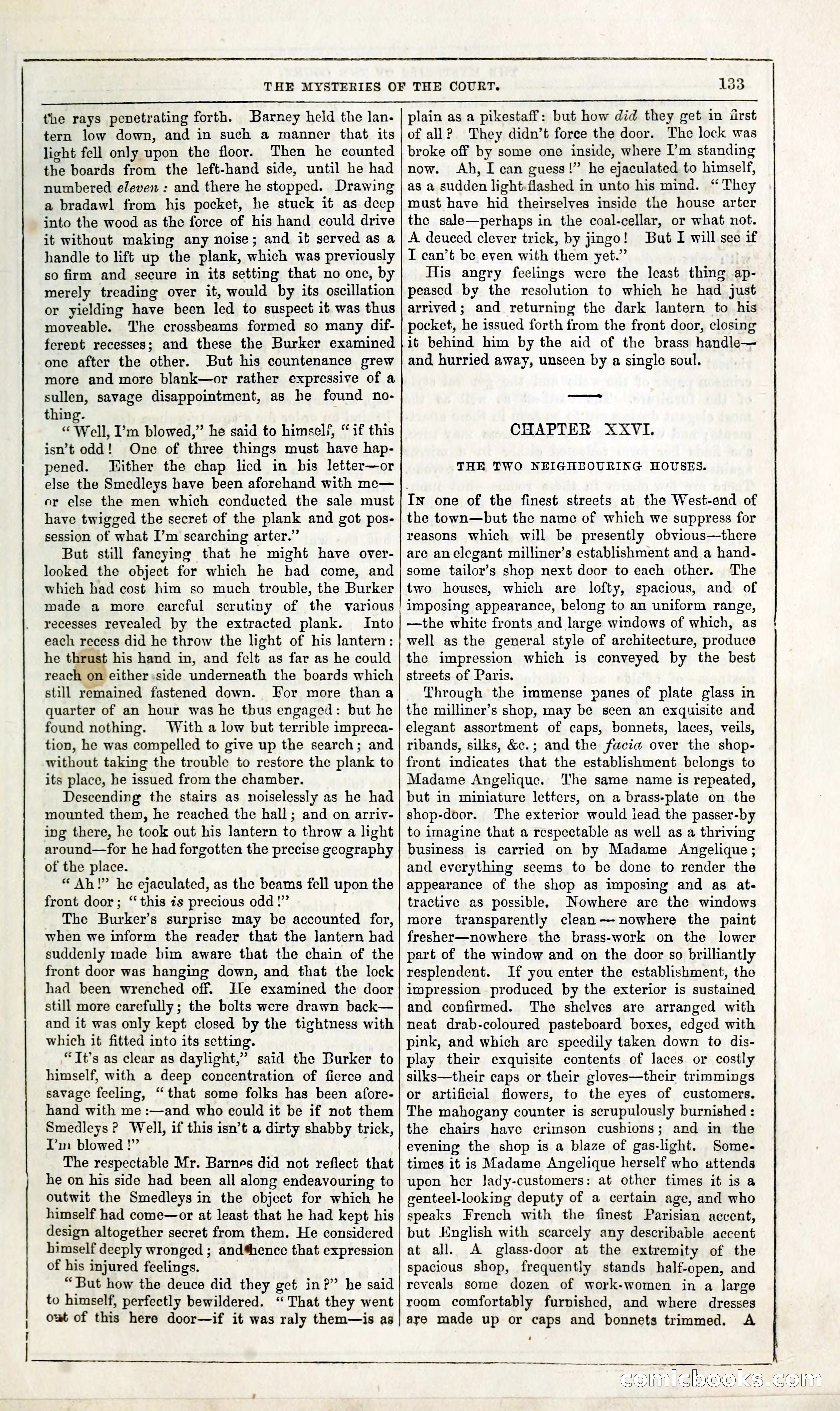
A restored page from Penny Dreadfuls, 1849. Page through the whole issue in the reader above.
📄 Transcribed text from this page (OCR, searchable)
Machine-transcribed from the original scan — historical spelling and the odd misread are preserved.
THE MYSTERIES OF THE COURT. 133 i ee the rays penetrating forth. Barney held the Jan- tern low down, and in such a manner that its light fell only upon the floor. Then he counted the boards from the left-hand side, until he had numbered eleven : and there he stopped. Drawing a bradawl from his pocket, he stuck it as deep into the wood as the force of his hand could drive it without making any noise; and it served as a handle to lift up the plank, which was previously so firm and secure in its setting that no one, by merely treading over it, would by its oscillation or yielding have been led to suspect it was thus moveable. The crossbeams formed so many dif- ferent recesses; and these the Burker examined one after the other. But his countenance grew more and more blank—or rather expressive of a sullen, savage disappointment, as he found no- thing. “ Well, I’m blowed,” he said to himself, “ if this isn’t odd! One of three things must have hap- pened. Hither the chap lied in his letter—or else the Smedleys have been aforehand with me— or else the men which conducted the sale must have twigged the secret of the plank and got pos- session of what I’m searching arter.” But still fancying that he might have over- looked the object for which he had come, and which had cost him so much trouble, the Burker made a more careful scrutiny of the various recesses revealed by the extracted plank. Into each recess did he throw the light of his lantern: he thrust his hand in, and felt as far as he could reach on either side underneath the boards which still remained fastened down. For more than a quarter of an hour was he thus engaged: but he found nothing. With a low but terrible impreca- tion, he was compelled to give up the search; and without taking the trouble to restore the plank to its place, he issued from the chamber. Descending the stairs as noiselessly as he had mounted them, he reached the hall; and on arriv- ing there, he took out his lantern to throw a light around—for he had forgotten the precise geography of the place. “ Ah!” he ejaculated, as the beams fell upon the front door; “this is precious odd!” The Burker’s surprise may be accounted for, when we inform the reader that the lantern had suddenly made him aware that the chain of the front door was hanging down, and that the lock had been wrenched off. He examined the door still more carefully; the bolts were drawn back— and it was only kept closed by the tightness with which it fitted into its setting. “It’s as clear as daylight,” said the Burker to himself, with a deep concentration of fierce and savage feeling, “that some folks has been afore- hand with me :—and who could it be if not them Smedleys? Well, if this isn’t a dirty shabby trick, I’m blowed !” | The respectable Mr. Barnes did not reflect that he on his side had been all along endeavouring to outwit the Smedleys in the object for which he himself had come—or at least that he had kept his design altogether secret from them. He considered himself deeply wronged ; and#hence that expression of his injured feelings. “But how the deuce did they get in?” he said to himself, perfectly bewildered. “That they went owt of this here door—if it was raly them—is as plain as a pikestaff: but how did they get in iirst of all? They didn’t force the door. The lock was broke off by some one inside, where I’m standing now. Ah, I can guess!” he ejaculated to himself, as a sudden light-flashed in unto his mind. “They must have hid theirselves inside the house arter the sale—perhaps in the coal-cellar, or what not. A deuced clever trick, by jingo! But I will see if I can’t be even with them yet.” His angry feclings were the least thing ap- peased by the resolution to which he had just arrived; and returning the dark lantern to his pocket, he issued forth from the front door, closing it behind him by the aid of the brass handle— and hurried away, unseen by a single soul. ED CHAPTER XXVI. THE TWO NEIGHBOURING HOUSES. In one of the finest streets at the West-end of the town—but the name of which we suppress for reasons which will be presently obvious—there are anelegant milliner’s establishment and a hand- some tailor’s shop next door to each other. The two houses, which are lofty, spacious, and of imposing appearance, belong to an uniform range, —the white fronts and large windows of which, as well as the general style of architecture, produce the impression which is conveyed by the best streets of Paris. Through the immense panes of plate glass in the milliner’s shop, may be seen an exquisite and elegant assortment of caps, bonnets, laces, veils, ribands, silks, &c.; and the facia over the shop- front indicates that the establishment belongs to Madame Angelique. The same name is repeated, but in miniature letters, on a brass-plate on the shop-door. The exterior would iead the passer-by to imagine that a respectable as well as a thriving business is carried on by Madame Angelique ; and everything seems to be done to render the appearance of the shop as imposing and as at- tractive as possible. Nowhere are the windows more transparently clean— nowhere the paint fresher—nowhere the brass-work on the lower part of the window and on the door so brilliantly resplendent. If you enter the establishment, the impression produced by the exterior is sustained and confirmed. The shelves are arranged with neat drab-coloured pasteboard boxes, edged with pink, and which are speedily taken down to dis- play their exquisite contents of laces or costly silks—their caps or their gloves—their trimmings or artificial flowers, to the eyes of customers. The mahogany counter is scrupulously burnished : the chairs have crimson cushions; and in the evening the shop is a blaze of gas-light. Some- times it is Madame Angelique herself who attends upon her lJady-customers: at other times it is a genteel-looking deputy of a certain age, and who speaks French with the finest Parisian accent, but English with scarcely any describable accent at all. A glass-door at the extremity of the spacious shop, frequently stands half-open, and reveals some dozen of work-women in a large room comfortably furnished, and where dresses are made up or caps and bonnets trimmed. A a -_— —— ee (C(O)IAN) 0)(0)(0) S (C(O)