
Penny Dreadfuls, 1849 · page 138 of 394
The Mysteries of the Court of London — page 138: what you’re looking at
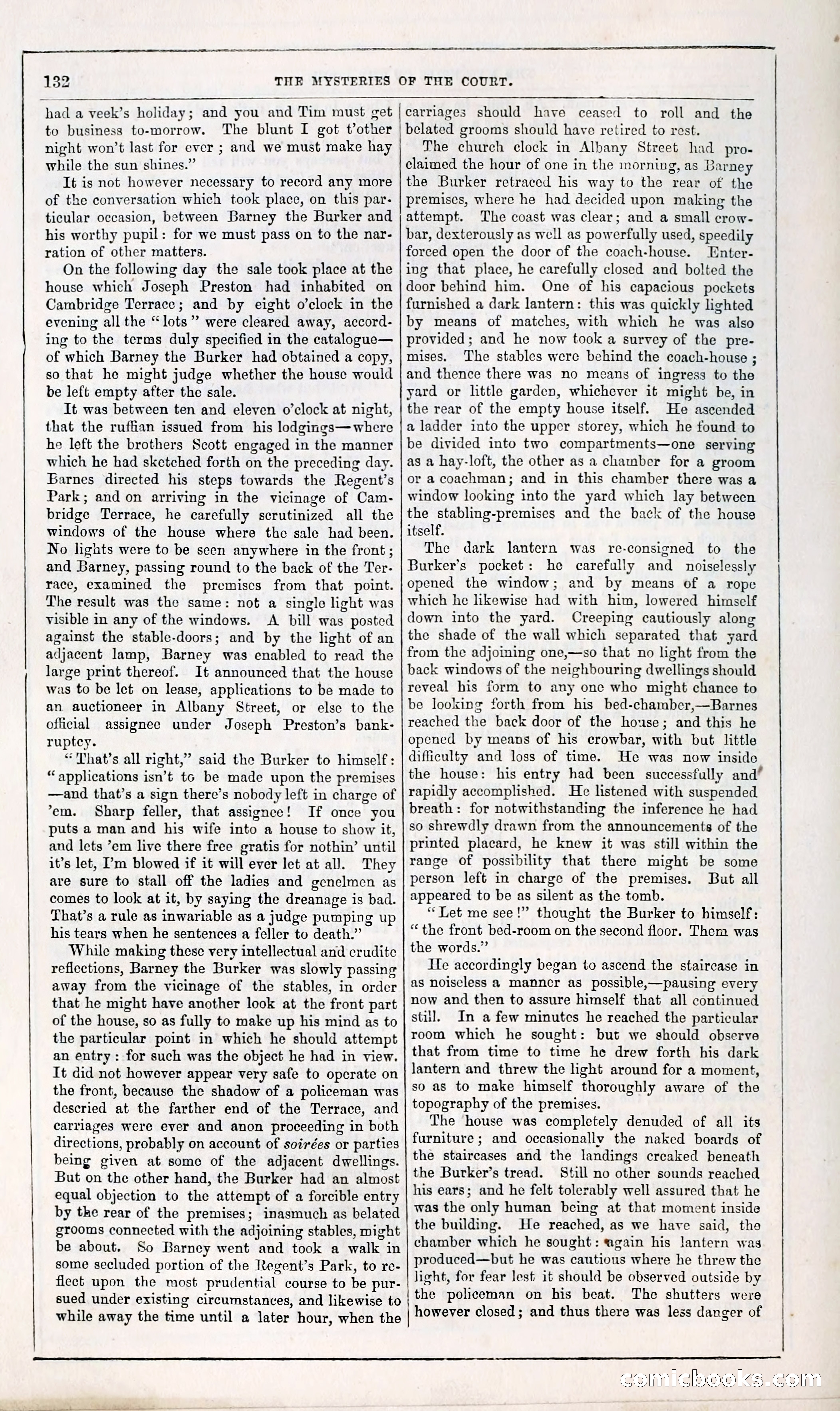
A restored page from Penny Dreadfuls, 1849. Page through the whole issue in the reader above.
📄 Transcribed text from this page (OCR, searchable)
Machine-transcribed from the original scan — historical spelling and the odd misread are preserved.
me ee re > ee RT Nm nr a THE MYSTERIES OF THE COURT. had a veek’s holiday; and you and Tim must get to business to-morrow. The blunt I got t’other night won’t last for ever ; and we must make hay while the sun shines.” It is not however necessary to record any more of the conversation which took place, on this par- ticular occasion, between Barney the Burker and his worthy pupil: for we must pass on to the nar- ration of other matters. On the following day the sale took place at the house which Joseph Preston had inhabited on Cambridge Terrace; and by eight o’clock in the evening all the “lots” were cleared away, accord- ing to the terms duly specified in the catalogue— of which Barney the Burker had obtained a copy, so that he might judge whether the house would be left empty after the sale. It was between ten and eleven o'clock at night, that the ruffian issued from his lodgings—where he left the brothers Scott engaged in the manner which he had sketched forth on the preceding day. Barnes directed his steps towards the Regent’s Park; and on arriving in the vicinage of Cam- bridge Terrace, he carefully scrutinized all the windows of the house where the sale had been. No lights were to be seen anywhere in the front ; and Barney, passing round to the back of the Ter- race, examined the premises from that point. The result was the same: not a single light was visible in any of the windows. A bill was posted against the stable-doors; and by the light of an adjacent lamp, Barney was enabled to read the large print thereof. It announced that the house was to be let on lease, applications to be made to an auctioneer in Albany Street, or else to the official assignee under Joseph Preston’s bank- ruptcy. “That’s all right,” said the Burker to himself: “applications isn’t tc be made upon the premises —and that’s a sign there’s nobody left in charge of °em. Sharp feller, that assignee! If once you puts a man and his wife into a house to show it, and lets ’em live there free gratis for nothin’ until it’s let, I’m blowed if it will ever let at all. They are sure to stall off the ladies and genelmen as comes to look at it, by saying the dreanage is bad. That’s a rule as inwariable as a judge pumping up his tears when he sentences a feller to death.” While making these very intellectual and erudite reflections, Barney the Burker was slowly passing away from the vicinage of the stables, in order that he might have another look at the front part of the house, so as fully to make up his mind as to the particular point in which he should attempt an entry : for such was the object he had in view. It did not however appear very safe to operate on the front, because the shadow of a policeman was descried at the farther end of the Terrace, and carriages were ever and anon proceeding in both directions, probably on account of soirées or parties being given at some of the adjacent dwellings. But on the other hand, the Burker had an almost equal objection to the attempt of a forcible entry by tke rear of the premises; inasmuch as belated grooms connected with the adjoining stables, might be about. So Barney went and took a walk in some secluded portion of the Regent’s Park, to re- flect upon the most prudential course to be pur- sued under existing circumstances, and likewise to while away the time until a later hour, when the carriages should have ceased to roll and the belated grooms should have retired to rest. The church clock in Albany Street had pro- claimed the hour of one in the morning, as Barney the Burker retraced his way to the rear of the premises, where he had decided upon making the attempt. The coast was clear; and a small crow- bar, dexterously as well as powerfully used, speedily forced open the door of the coach-house. Enter- ing that place, he carefully closed and bolted the door behind him. One of his capacious pockets furnished a dark lantern: this was quickly lighted by means of matches, with which he was also provided; and he now took a survey of the pre- mises. The stables were behind the coach-house ; and thence there was no means of ingress to the yard or little garden, whichever it might be, in the rear of the empty house itself. He ascended a ladder into the upper storey, which he found to be divided into two compartments—one serving as a hay-loft, the other as a chamber for a groom or a coachman; and in this chamber there was a window looking into the yard which lay between the stabling-premises and the back of the house itself. The dark lantern was re-consigned to the Burker’s pocket: he carefully and _noiselessly opened the window; and by means of a rope which he likewise had with him, lowered himself down into the yard. Creeping cautiously along the shade of the wall which separated that yard from the adjoining one,—so that no light from the back windows of the neighbouring dwellings should reveal his form to any one who might chance to be looking forth from his bed-chamber,—Barnes reached the back door of the house; and this he opened by means of his crowbar, with but little difficulty and loss of time. He was now inside the house: his entry had been successfully and* rapidly accomplished. He listened with suspended breath: for notwithstanding the inference he had so shrewdly drawn from the announcements of the printed placard, he knew it was still within the range of possibility that there might be some person left in charge of the premises. But all appeared to be as silent as the tomb. “Let me see!” thought the Burker to himself: ‘the front bed-room on the second floor. Them was the words.” He accordingly began to ascend the staircase in as noiseless a manner as possible,—pausing every now and then to assure himself that all continued still. In a few minutes he reached the particular room which he sought: but we should observe that from time to time he drew forth his dark lantern and threw the light around for a moment, so as to make himself thoroughly aware of the topography of the premises. The house was completely denuded of all its furniture ; and occasionally the naked boards of the staircases and the landings creaked beneath the Burker’s tread. Still no other sounds reached his ears; and he felt tolerably well assured that he was the only human being at that moment inside the building. He reached, as we have said, the chamber which he sought: gain his lantern was produced—but he was cautious where he threw the light, for fear lest it should be observed outside by the policeman on his beat. The shutters were however closed; and thus there was less danger of Go 0)(0)6) S CO)