
Penny Dreadfuls, 1849 · page 147 of 394
The Mysteries of the Court of London — page 147: what you’re looking at
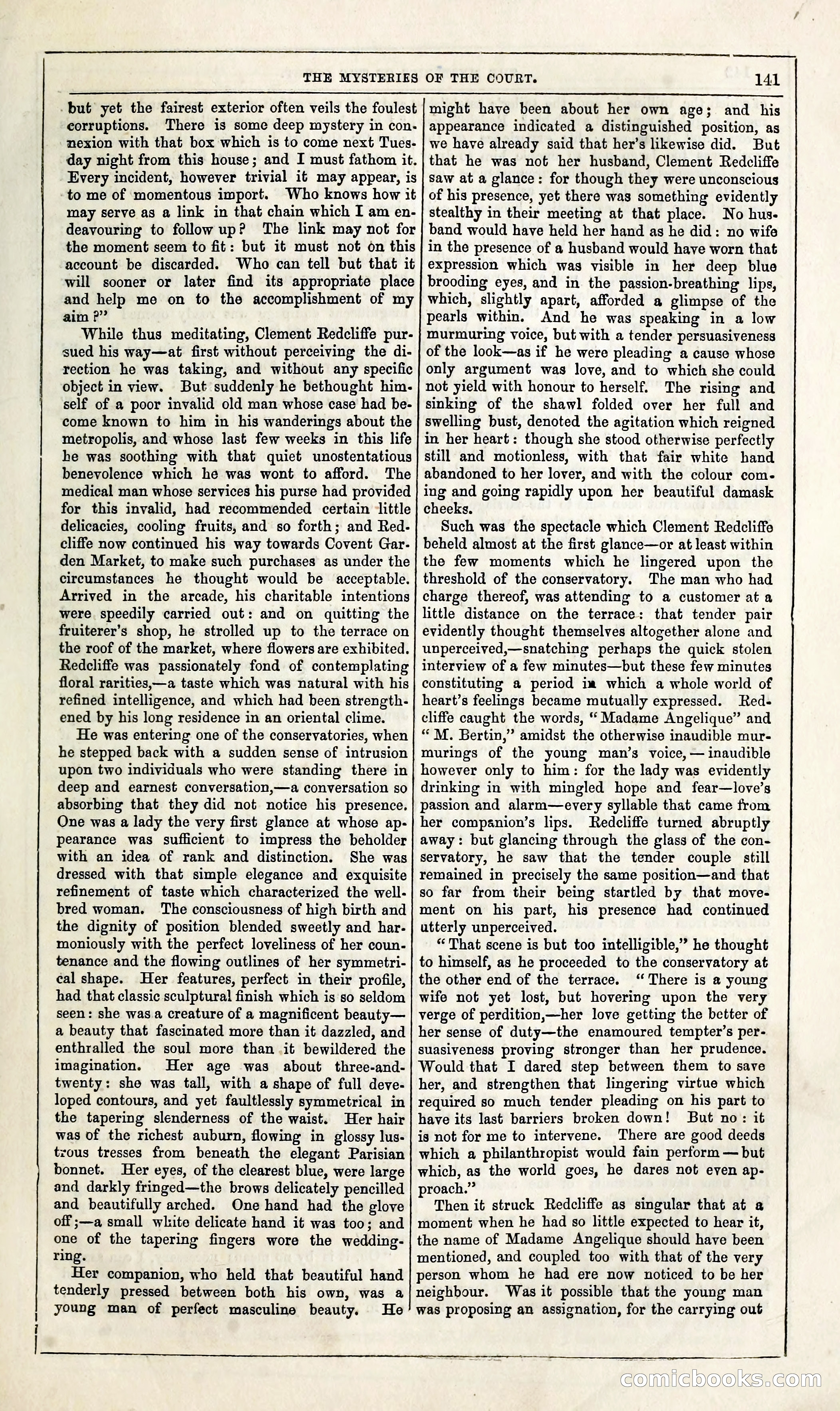
A restored page from Penny Dreadfuls, 1849. Page through the whole issue in the reader above.
📄 Transcribed text from this page (OCR, searchable)
Machine-transcribed from the original scan — historical spelling and the odd misread are preserved.
THE MYSTERIES OF THE COURT. i i eT 141 but yet the fairest exterior often veils the foulest corruptions. There is some deep mystery in con- mexion with that box which is to come next Tues- day night from this house; and I must fathom it. Every incident, however trivial if may appear, is to me of momentous import. Who knows how it may serve as @ link in that chain which I am en- deavouring to follow up? The link may not for the moment seem to fit: but it must not On this account be discarded. Who can tell but that it will sooner or later find its appropriate place and help me on to the accomplishment of my aim P” | While thus meditating, Clement Redcliffe pur- sued his way—at first without perceiving the di- rection he was taking, and without any specific object in view. But suddenly he bethought him- self of a poor invalid old man whose case had be- come known to him in his wanderings about the metropolis, and whose last few weeks in this life he was soothing with that quiet unostentatious benevolence which he was wont to afford. The medical man whose services his purse had provided for this invalid, had recommended certain ‘little delicacies, cooling fruits, and so forth; and Red- cliffe now continued his way towards Covent Gar- den Market, to make such purchases as under the circumstances he thought would be acceptable. Arrived in the arcade, his charitable intentions were speedily carried out: and on quitting the fruiterer’s shop, he strolled up to the terrace on the roof of the market, where flowers are exhibited. Redcliffe was passionately fond of contemplating floral rarities,—a taste which was natural with his refined intelligence, and which had been strength- ened by his long residence in an oriental clime. He was entering one of the conservatories, when he stepped back with a sudden sense of intrusion upon two individuals who were standing there in deep and earnest conversation,—a conversation so absorbing that they did not notice his presence. One was a lady the very first glance at whose ap- pearance was sufficient to impress the beholder with an idea of rank and distinction. She was dressed with that simple elegance and exquisite refinement of taste which characterized the well- bred woman. The consciousness of high birth and the dignity of position blended sweetly and har. moniously with the perfect loveliness of her coun- tenance and the flowing outlines of her symmetri- eal shape. Her features, perfect in their profile, had that classic sculptural finish which is so seldom seen: she was.a creature of a magnificent beauty— a beauty that fascinated more than it dazzled, and enthralled the soul more than it bewildered the Imagination. Her age was about three-and- twenty: she was tall, with a shape of full deve- loped contours, and yet faultlessly symmetrical in the tapering slenderness of the waist. Her hair was of the richest auburn, flowing in glossy lus- zous tresses from beneath the elegant Parisian bonnet. Her eyes, of the clearest blue, were large and darkly fringed—the brows delicately pencilled and beautifully arched. One hand had the glove off ;—a small white delicate hand it was too; and one of the tapering fingers wore the wedding- ring. Her companion, who held that beautiful hand tenderly pressed between both his own, was a young man of perfect masculine beauty. He might have been about her own age; and his appearance indicated a distinguished position, as we have already said that her’s likewise did. But that he was not her husband, Clement Redcliffe saw at a glance: for though they were unconscious of his presence, yet there was something evidently stealthy in their meeting at that place. No hus- band would have held her hand as he did: no wife in the presence of a husband would have worn that expression which was visible in her deep blue brooding eyes, and in the passion-breathing lips, which, slightly apart, afforded a glimpse of the pearls within. And he was speaking in a low murmuring voice, but with a tender persuasiveness of the look—as if he were pleading a cause whose only argument was love, and to which she could not yield with honour to herself. The rising and sinking of the shawl folded over her full and swelling bust, denoted the agitation which reigned in her heart: though she stood otherwise perfectly still and motionless, with that fair white hand abandoned to her lover, and with the colour com. ing and going rapidly upon her beautiful damask cheeks. Such was the spectacle which Clement Redcliffe beheld almost at the first glance—or at least within the few moments which he lingered upon the threshold of the conservatory. The man who had charge thereof, was attending to a customer at a little distance on the terrace: that tender pair evidently thought themselves altogether alone and unperceived,—snatching perhaps the quick stolen interview of a few minutes—but these few minutes constituting a period ia which a whole world of heart’s feelings became mutually expressed. Red- cliffe caught the words, “ Madame Angelique” and “M. Bertin,” amidst the otherwise inaudible mur- murings of the young man’s voice, — inaudible however only to him: for the lady was evidently drinking in with mingled hope and fear—love’s passion and alarm—every syllable that came from her companion’s lips. Redcliffe turned abruptly away: but glancing through the glass of the con- servatory, he saw that the tender couple still remained in precisely the same position—and that so far from their being startled by that move- ment on his part, his presence had continued utterly unperceived. “That scene is but too intelligible,” he thought to himself, as he proceeded to the conservatory at the other end of the terrace. ‘“ There is a young wife not yet lost, but hovering upon the very verge of perdition,—her love getting the better of her sense of duty—the enamoured tempter’s per- suasiveness proving stronger than her prudence. Would that I dared step between them to save her, and strengthen that lingering virtue which required so much tender pleading on his part to have its last barriers broken down! But no: it is not for me to intervene. There are good deeds which a philanthropist would fain perform — but which, as the world goes, he dares not even ap- proach.” Then it struck Redcliffe as singular that at a moment when he had so little expected to hear it, the name of Madame Angelique should have been mentioned, and coupled too with that of the very person whom he had ere now noticed to be her neighbour. Was it possible that the young man was proposing an assignation, for the carrying out ——— (C 6)(0)(0) cS (C(O) (C(O)