
Penny Dreadfuls, 1849 · page 148 of 394
The Mysteries of the Court of London — page 148: what you’re looking at
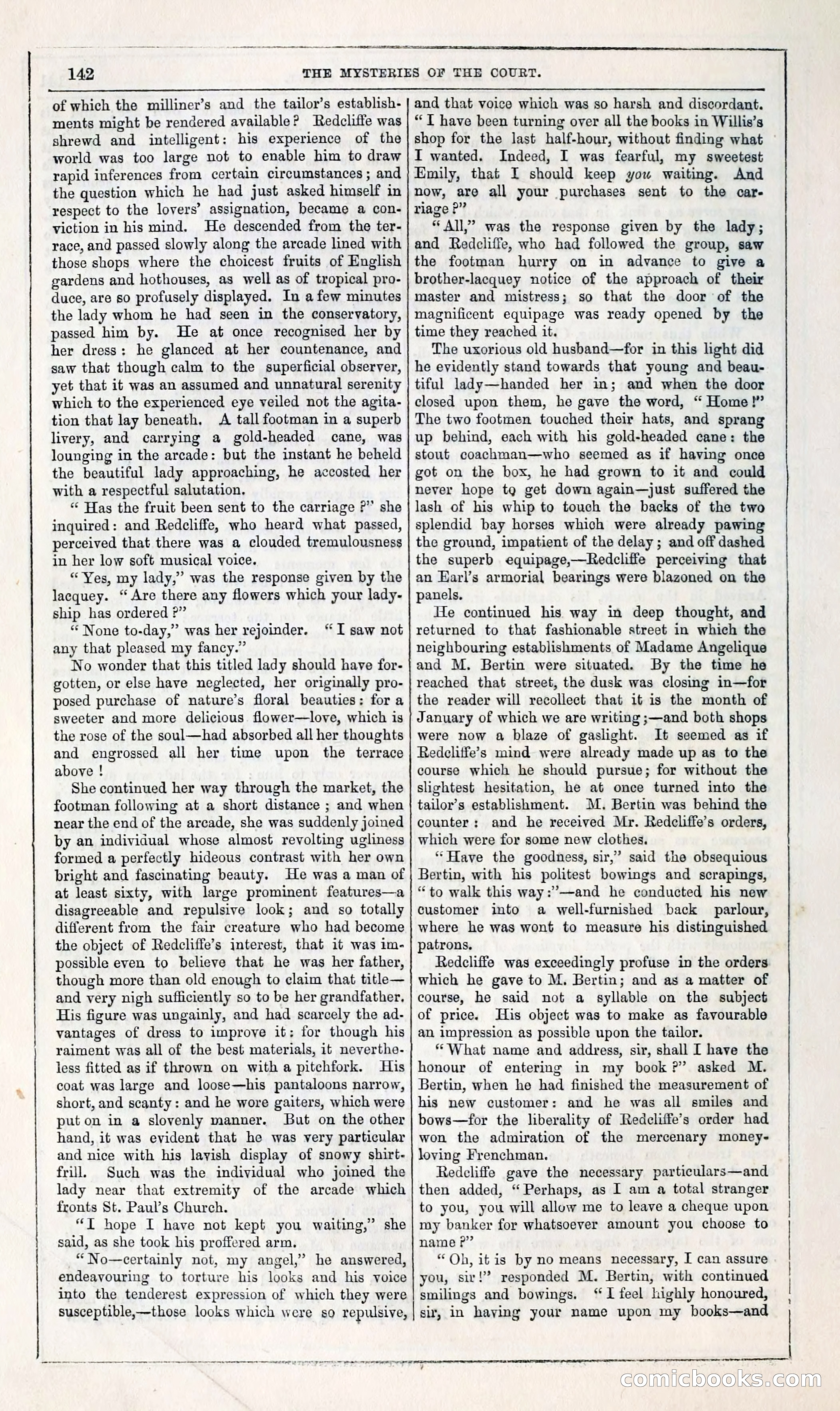
A restored page from Penny Dreadfuls, 1849. Page through the whole issue in the reader above.
📄 Transcribed text from this page (OCR, searchable)
Machine-transcribed from the original scan — historical spelling and the odd misread are preserved.
142 of which the milliner’s and the tailor’s establish- ments might be rendered available? Redclifte was shrewd and intelligent: his experience of the world was too large not to enable him to draw rapid inferences from certain circumstances ; and the question which he had just asked himself in respect to the lovers’ assignation, became a con- viction in his mind. He descended from the ter- race, and passed slowly along the arcade lined with those shops where the choicest fruits of English gardens and hothouses, as well as of tropical pro- duce, are so profusely displayed. In afew minutes the lady whom he had seen in the conservatory, passed him by. He at once recognised her by her dress: he glanced at her countenance, and saw that though calm to the superficial observer, yet that it was an assumed and unnatural serenity which to the experienced eye veiled not the agita- tion that lay beneath. A tall footman in a superb livery, and carrying a gold-headed cane, was lounging in the arcade: but the instant he beheld the beautiful lady approaching, he accosted her with a respectful salutation. “ Has the fruit been sent to the carriage ?”’ she inquired: and Redcliffe, who heard what passed, perceived that there was a clouded tremulousness in her low soft musical voice. “Yes, my lady,’ was the response given by the lacquey. “Are there any flowers which your lady- ship has ordered ?” “None to-day,” was her rejoinder. any that pleased my fancy.” No wonder that this titled lady should have for- gotten, or else have neglected, her originally pro- posed purchase of nature’s floral beauties: fora sweeter and more delicious flower—love, which is the rose of the soul—had absorbed all her thoughts and engrossed all her time upon the terrace above ! She continued her way through the market, the footman following at a short distance ; and when near the end of the arcade, she was suddenly joined by an individual whose almost revolting ugliness formed a perfectly hideous contrast with her own bright and fascinating beauty. He was a man of at least sixty, with large prominent features—a disagreeable and repulsive look; and so totally different from the fair creature who had become the object of Redcliffe’s interest, that 1t was im- possible even to believe that he was her father, though more than old enough to claim that title— and very nigh sufficiently so to be her grandfather, His figure was ungainly, and had scarcely the ad- vantages of dress to improve it: for though his raiment was all of the best materials, it neverthe- less fitted as if thrown on witha pitchfork. His coat was large and loose—his pantaloons narrow, short, and scanty : and he wore gaiters, which were put on in a slovenly manner. ut on the other hand, it was evident that he was very particular and nice with his layish display of snowy shirt- frill. Such was the individual who joined the lady near that extremity of the arcade which fronts St. Paul’s Church. “T hope I have not kept you waiting,” said, as she took his proffered arm. “No—certainly not, my angel,” he answered, endeavouring to torture his looks and his voice into the tenderest expression of which they were susceptible,—those looks which were so repulsive, * IT saw not she Ee ee 8 Ee er er Se THE MYSTERIES OF THE COURT. and that voice which was so harsh and discordant. “T have been turning over all the books in Willis’s shop for the last half-hour, without finding what I wanted. Indeed, I was fearful, my sweetest Emily, that I should keep yow waiting. And now, are all your purchases sent to the car- riage P” “ All,’ was the response given by the lady; and Redcliffe, who had followed the group, saw the footman hurry on in advance to give a brother-lacquey notice of the approach of their master and mistress; so that the door of the magnificent equipage was ready opened by the time they reached it. The uxorious old husband—for in this light did he evidently stand towards that young and beau- tiful lady—handed her in; and when the door closed upon them, he gave the word, “ Home!” The two footmen touched their hats, and sprang up behind, each with his gold-headed cane: the stout coachman—who seemed as if having once got on the box, he had grown to it and could never hope tg get down again—just suffered the lash of his whip to touch the backs of the two splendid bay horses which were already pawing the ground, impatient of the delay ; and off dashed the superb equipage,—Redcliffe perceiving that an Earl’s armorial bearings were blazoned on the panels, He continued his way in deep thought, and returned to that fashionable street in which the neighbouring establishments of Madame Angelique and M. Bertin were situated. By the time he reached that street, the dusk was closing in—for the reader will recollect that it is the month of January of which we are writing ;—and both shops were now a blaze of gaslight. It seemed as if Redclitfe’s mind were already made up as to the course which he should pursue; for without the slightest hesitation, he at once turned into the tailor’s establishment. M. Bertin was behind the counter; and he received Mr. Redcliffe’s orders, which were for some new clothes. “Have the goodness, sir,” said the obsequious Bertin, with his politest bowings and scrapings, “to walk this way:’—and he conducted his new customer into a well-furnished back parlour, where he was wont to measure his distinguished patrons, Redcliffe was exceedingly profuse in the orders which he gave to M. Bertin; and as a matter of course, he said not a syllable on the subject of price. His object was to make as favourable an impression as possible upon the tailor. * What name and address, sir, shall I have the honour of entering in my book?” asked M. Bertin, when he had finished the measurement of his new customer: and he was all smiles and bows—for the liberality of Redcliffe’s order had won the admiration of the mercenary money- loving Frenchman. Redcliffe gave the necessary particulars—and then added, “ Perhaps, as I am a total stranger to you, you will allow me to leave a cheque upon my banker for whatsoever amount you choose to name P” “Oh, it is by no means necessary, I can assure you, sir!” responded M. Bertin, with continued smilings and bowings. “I feel highly honoured, sir, in haying your name upon my books—and — ee ere / COMME OOo (C <S