
Penny Dreadfuls, 1849 · page 160 of 394
The Mysteries of the Court of London — page 160: what you’re looking at
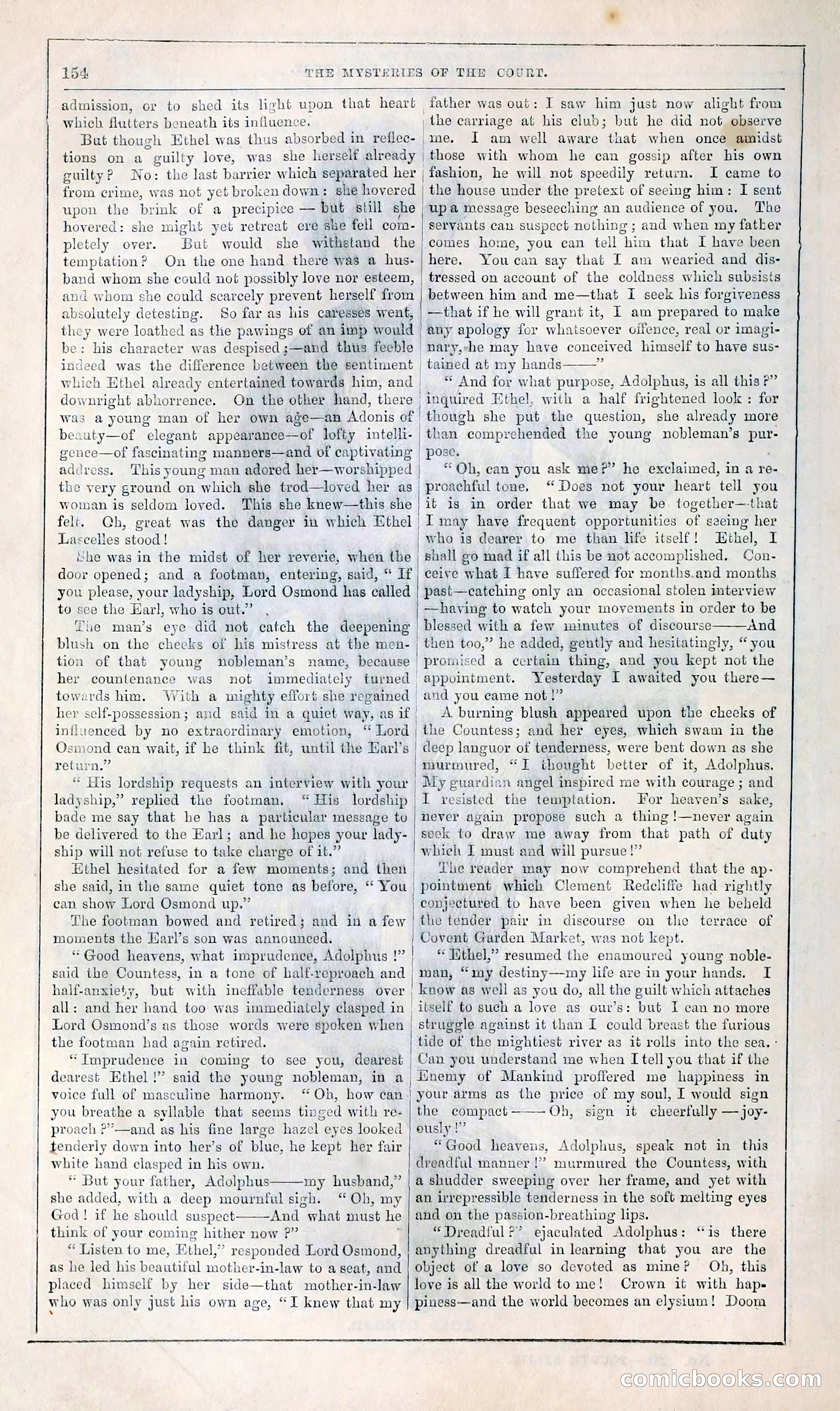
A restored page from Penny Dreadfuls, 1849. Page through the whole issue in the reader above.
📄 Transcribed text from this page (OCR, searchable)
Machine-transcribed from the original scan — historical spelling and the odd misread are preserved.
ee ee ee. 154 admission, or to shed its light upon that heart which flutters beneath its influence. But though Ethel was thus absorbed in reflec- | tions on a guilty love, guilty P from crime, was not yct broken down: she hovered upon the brink of a precipice — but still she hovered: she might yet retreat ere she fell com- pletely over. Bat would she withstand the temptation? On the one hand there was a hus- band whom she could not possibly love nor esteem, and whom she could scarcely prevent herself from absolutely detesting. So far as lis caressés went, they were loathed as the pawings of an imp would | be: his character was despised ;—and thus feeble | indeed was the difference between the sentiment | which Ethel already entertained towards him, and | inquired Ethel, with a half frightened look : for downright abhorrence. On the other hand, there was beauty—of elegant appearance—of lofty intelli- of fascinating manners—and of captivating | gence ada iress. the very ground on ‘which she trod—loved her as woman is seldom loved. This she knew—this she feli. Lascelles stood! he was in the midst of her reverie, door opened ; when the THE MYSTERIES OF THE | the carriage at his club; No: the last barrier which separated her | fashion, he will not speedily return. a young man of her own age—an Adonis of | though she put the question, This young man adored her—worshipped | Ch, great was the danger in which Ethel and a footman, entering, said, “ if COURT. IT saw him just now alight from but he did nous observe am well aware that when once amidst Qo tather was out: me I was she herself already | those with whom he can gossip after his own I came to the house under the pretext of seeing him: I sent up a message beseeching an audience of you. The servants can suspect nothing ; ; and when my fatker comes home, you can tell ‘him that I have been here. You can say that I am wearied and dis- tressed on account of the coldness which subsisis between him and me—that I seek his forgiveness —that if he will grant it, I am prepared to make any apology for whatsoever offence, real or imagi- nary,-he may have conceived himself to have sus- tained at my hands——” “ And for what purpose, Adolphus, is all this P” she already more than comprehended the young nobleman’s Pee pose. “Oh, can you ask me?” he exclaimed, in a re- proachful tone. “Does not your heart tell you it is in order that we may be together—-that I may have frequent opportunities of sseing her who is dearer to me than life itself! Hthel, I shall go mad if all this be not accomplished. Con- ceive what [ have suffered for months.and months you please, your ladyship, Lord Osmond has called past—ecatching only an occasional stolen interview to see the Harl, who is out.” ‘Tie man’s eye did not catch the deepening | blessed with a few minutes of discourse —having to watch your movements in order to be And blush on the cheeks of his mistress at the men- | then too,” he added, gently and hesitatingly, “you nobleman’s name, because not tion of that young her countenance was towards him, influenced by no extraordinary emotion, immediately turned appointment. With a mighty effort she regained | her self-possession; and said in a quiet way, as if | “ Lord | the Countess; promised a certain thing, and you kept not the Yesterday I awaited you there— and you came not !” A burning blush appeared upon the checks of and her eyes, which swam in the wee can wait, if he think fit, until the Harl’s : deep languor of tenderness, were bent down as she a retu ladyship,” replied the footman. “ His lordship | bade me say that he has a particular message to be delivered to the Earl; and he hopes your lady- ship will not refuse to take charge of it.” Kthel hesitated for a few moments; and then she said, in the same quiet tone as before, ‘ You can show Lord Osmond up.” The footman bowed and retired; and in a few | | Covent Garden Market, was not kept. moments the Harl’s son was announced. “ Good heavens, what imprudence, Adolphus !” said the Countess, in a tone of balf-reproach and | half-anxiety, but with ineffable tenderness over | all : Lord Osmond’s as those words were spoken when the footman had again retired. “Tmprudence in coming to see you, dearest dearest Ethel!” said the young nobleman, in a voice full of masculine harmony. “Oh, how can you breathe a syllable that seems tinged with re- proach ?’—and as his fine large hazel eyes looked tenderly down into her’s of blue, he kept her fair white hand clasped in his own. * But your father, Adolphus my husband,” she added, with a deep mournful sigh. “Oh, my God! if he should suspect And what must he think of your coming hither now ?” “ Listen to me, Ethel,’ ’ responded Lord Osmond, as he led his beautiful mother-in-law to a seat, and placed himself by her side—that mother-in-law who was only just his own age, “I knew that my ‘ and her hand too was immediately clasped in | ilself to such a love as out’s murmured, “I thought better of it, Adolphus. S His lordship requests an interview with your | My guardian angel inspired me with courage ; and 'I vesisted the {pp tation. For heaven’s sake, never again propose such a thing !—never again seek to draw me away from that path of duty whieh I must and will pursue!” the reader may now comprehend that the ap- | pointment which Clement Redcliffe had rightly conjectured to have been given when he beheld the tender pair in discourse on the terrace of “ Hthel,” resumed the enamoured young noble- man, “my destiny-—-my life ave in your hands. I know as well as you do, all the euilt which attaches : but I can no more struggle against it than I could breast the furious tide of the mightiest river as it rolls into the sea. : Can you understand me when I tell you that if the | Hnemy of Mankind proffered me happiness in your arms as the price of my soul, I would sign the compact Oh, sign it cheerfully —joy- eusly !” “Good heavens, Adolphus, speak not in this dveadful manner !” murmured the Countess, with a shudder sweeping over her frame, and yet with an irrepressible tenderness in the soft melting eyes and on the passion-breathing lips. “Dreadful ?’ ejaculated Adolphus: “is there anything dreadful in learning that you are the object of a love so devoted as mine? Oh, this love is all the world to me! Crown it with hap- piness—and the world becomes an elysium! Doom 0)(0)(0) (C (CO) (E@)