
Penny Dreadfuls, 1849 · page 161 of 394
The Mysteries of the Court of London — page 161: what you’re looking at
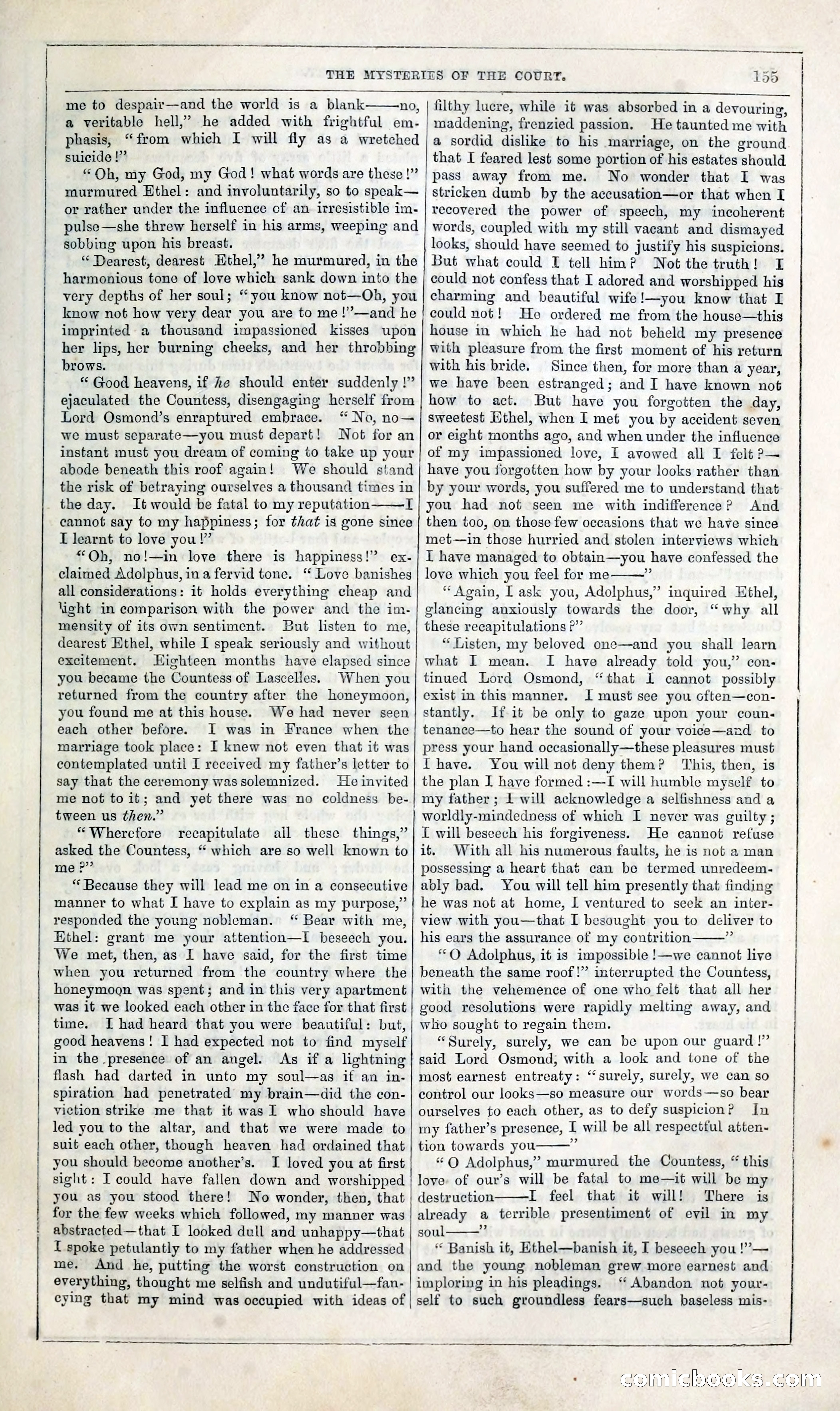
A restored page from Penny Dreadfuls, 1849. Page through the whole issue in the reader above.
📄 Transcribed text from this page (OCR, searchable)
Machine-transcribed from the original scan — historical spelling and the odd misread are preserved.
Reem ee sd THE MYSTERIES OF THE COURT. 155 me to despair—and the world is a blank no, a veritable hell,’ he added with frightful em- phasis, “from which I will fly as a wretched |?? suicide ! “Oh, my God, my God! what words are these!” murmured Ethel: and involuntarily, so to speak— or rather under the influence of an irresistible im- pulse —she threw herself in his arms, weeping and sobbing upon his breast. ‘Dearest, dearest Ethel,” he murmured, in the harmonious tone of love which sank down into the very depths of her soul; “you know not—Oh, you know not how very dear you are to me!’’—and he imprinted a thousand impassioned kisses upon her lips, her burning cheeks, and her throbbing brows. “ Good heavens, if he should enter suddenly !” ejaculated the Countess, disengaging herself from Lord Osmond’s enraptured embrace. “ No, no— we must separate—you must depart! Not for an instant must you dream of coming to take up your abode beneath this roof again! We should stand the risk of betraying ourselves a thousand times in the day. It would be fatal to my reputation I cannot say to my happiness; for that is gone since I learnt to love you!” “Oh, no!—in love there is happiness!” ex- claimed Adolphus, ina fervid tone. “ Love banishes all considerations: it holds everything cheap and light in comparison with the power and the im- mensity of its own sentiment. But listen to me, dearest Ethel, while I speak seriously and without excitement. Hichteen months have elapsed since you became the Countess of Lascelles. When you returned from the country after the honeymoon, you found me at this house. We had never seen each other before. I was in France when the marriage took place: I knew not even that it was contemplated until I received my father’s letter to say that the ceremony wassolemnized. He invited me not to it; and yet there was no coldness be- tween us then.” “Wherefore recapitulate ail these things,” asked the Countess, “ which are so well known to me ?”’ “Because they will lead me on in a consecutive manner to what I have to explain as my purpose,” responded the young nobleman. ‘“ Bear with me, Ethel: grant me your attention—I beseech you. We met, then, as I have said, for the first time when you returned from the country where the honeymoon was spent; and in this very apartment was it we looked each other in the face for that first time. I had heard that you were beautiful: but, good heavens! I had expected not to find myself in the presence of an angel. As if a lightning flash had darted in unto my soul—as if an in- spiration had penetrated my brain—did the con- viction strike me that it was L who should have led you to the altar, and that we were made to suit each other, though heaven had ordained that you should become another’s. I loved you at first sight: I could have fallen down and worshipped you as you stood there! No wonder, then, that for the few weeks which followed, my manner was abstracted—that L looked dull and uahappy—that { spoke petulantly to my father when he addressed me. And he, putting the worst construction on everything, thought me selfish and undutiful—fan- cying that my mind was occupied with ideas of filthy luere, while it was absorbed in a devouring, maddening, frenzied passion. He taunted me with a sordid dislike to his marriage, on the ground that I feared lest some portion of his estates ‘should pass away from me. No wonder that I was stricken dumb by the accusation—or that when I recovered the power of speech, my incoherent words, coupled with my still vacant and dismayed looks, should have seemed to justify his suspicions. But what could I tell him? Not the truth! I could not confess that I adored and worshipped his charming and beautiful wife!—you know that I could not! He ordered me from the house—this house in which he had not beheld my presence with pleasure from the first moment of his return with his bride. Since then, for more than a year, we have been estrangeed; and I have known not how to act. But have you forgotten the day, sweetest Kthel, when I met you by accident seven or eight months ago, and when under the influence of my impassioned love, I avowed all I felt ?— have you forgotten how by your looks rather than by your words, you suffered me to understand that you had not seen me with indifference? And then too, on. those few occasions that we have since met—in ‘those hurried and stolen interviews which I have managed to obtain—you have confessed the love which you feel for me % “Again, I ask you, Adolphus,” inquired Ethel, glancing anxiously towards the door, “why all these recapitulations P” “Listen, my beloved one—and you shall learn what I mean. I hau already told you,” con- tinued Lord Osmond, “that I cannot possibly exist in this manner. I must see you often—con- stantly. fit be only to gaze upon your coun- tenance—to hear the sound of your voice—and to press your hand occasionally—these pleasures must {have. You will not deny them? This, then, is the plan I have formed :—I will humble myself to my father; lL will acknowledge a selfishness and a worldly-mindedness of which I never was guilty ; I will beseech his forgiveness. He cannot refuse it. With all his numerous faults, he is not a man possessing a heart that can be termed unredeem- ably bad. You will tell him presently that finding he was not at home, I ventured to seek an inter- view with you—that I besought you to deliver to his ears the assurance of my contrition 2 “QO Adolphus, it is impossible !—we cannot live beneath the same roof!” interrupted the Countess, with the vehemence of one who felt that all her eood resolutions were rapidly melting away, and who sought to regain them. “Surely, surely, we can be upon our guard !” said Lord Osmond; with a look and tone of the most earnest entreaty: “surely, surely, we can so control our looks—so measure our words—so bear ourselves to each other, as to defy suspicion? I[n my father’s presence, L will be all respectful atten- tion towards you + “© Adolphus,” murmured the Countess, “ this love of our’s will be fatal to me—it will be my destruction I feel that it will! There is already a terrible presentiment of evil in my 32 soul Banish it, Hthel—banish it, I beseech you !”— and the young nobleman grew more earnest and imploring in his pleadings. “Abandon not your- self to such groundless fears—such baseless mis- (Ee) VNOOLKS (C(O)