
Penny Dreadfuls, 1849 · page 233 of 394
The Mysteries of the Court of London — page 233: what you’re looking at
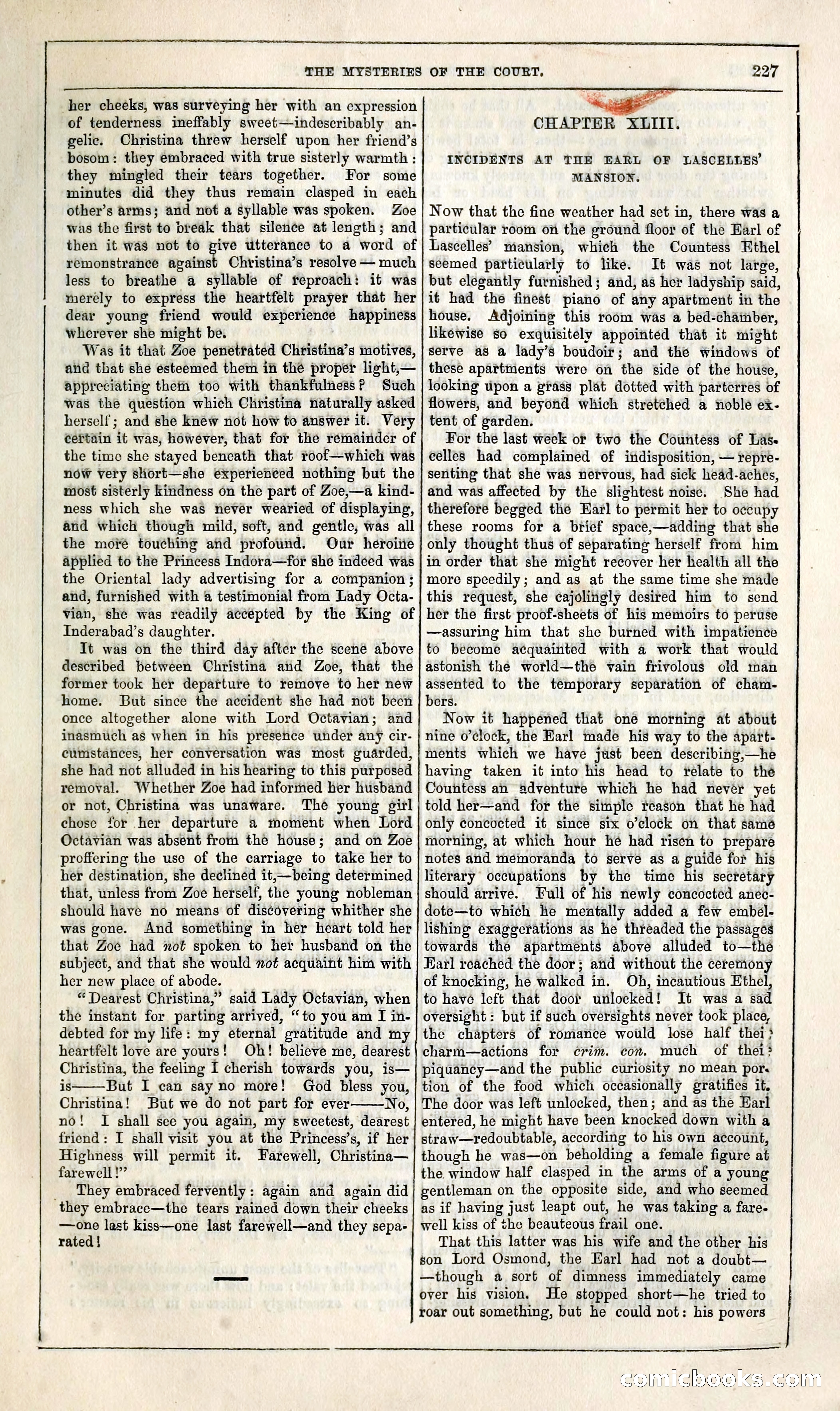
A restored page from Penny Dreadfuls, 1849. Page through the whole issue in the reader above.
📄 Transcribed text from this page (OCR, searchable)
Machine-transcribed from the original scan — historical spelling and the odd misread are preserved.
THE MYSTERIES OF THE COURT, her cheeks, was surveying her with an expression of tenderness ineffably sweet—indescribably an- gelic. Christina threw herself upon her friend’s bosom: they embraced with true sisterly warmth : they mingled their tears together. For some minutes did they thus remain clasped in each other’s arms; and not a syllable was spoken. Zoe was the first to break that silence at length; and then it was not to pive utterance to a word of remonstrance avainst Christina’s resolve — much less to breathe a syllable of reproach: it was merely to express the heartfelt prayer that her dear young friend would experience happiness wherever she micht be. Was it that Zoe penettated Christina’s motives, and that she esteemed them in the proper light,— appreciating them too with thankfulnessP Such was the question which Christina naturally asked herself ; and she knew not how to answer it. Very the time she stayed beneath that roof—which was now very short—she experienced nothing but the most sisterly kindness on the part of Zoe,—a kind- ness which she was never wearied of displaying, and which though mild, soft, and gentle, was all the moré touching and profound. Our heroiiie applied to the Princess Indora—for she indeed was the Oriental lady advertising for a companion ; and, furnished with a testimonial from Lady Octa- Inderabad’s daughter. It was on the third day after the scene above described between Christina and Zoe, that the former took her departure to remove to her new home. But since the accident she had not been once altogether alone with Lord Octavian; and inasmuch as when in his presence under any cir- cumstances, her conversation was most guarded, she had not alluded in his heating to this purposed removal. Whether Zoe had informed her husband or not, Christina was unaware. The young girl chose for her departure a moment when Lord Octavian was absent from the house; and on Zoe proffering the use of the carriage to take her to should have no means of discovering whither she was gone. that Zoe had not spoken to her husband on the subject, and that she would not acquaint him with her new place of abode. “ Dearest Christina,” said Lady Octavian, when the instant for parting arrived, “to you am I in- debted for my life: my eternal gratitude and my heartfelt love are yours! Oh! believe me, dearest Christina, the feeling I cherish towards you, is— is But I can say no more! God bless you, Christina! But we do not part for ever No, no! I shall see you again, my sweetest, dearest friend: I shall visit you at the Princess’s, if her Highness will permit it. Farewell, Christina— farewell!” _ They embraced fervently: again and again did they embrace—the tears rained down their cheeks —one last kiss—one last farewell—and they sepa- rated | I Eee -—_—_———_—e@O Ly certain ‘tt was, however, that for the remainder of vian, she was readily accepted by the King of her destination, she declined it,—being determined that, unless from Zoe herself, the young nobleman And something in her heart told her CHAPTER XLIII. INCIDENTS AT THE EARL OF LASCELLES’ MANSION. Now that the fine weather had set in, there was a particular room on the ground floor of the Earl of Lascelles mansion, which the Countess Ethel seemed particularly to like. It was not large, but elegantly furnished; and, as her ladyship said, it had the finest piano of any apartment in the house. Adjoining this room was a bed-chainber, likewise so exquisitely appointed that it might serve as a lady’s boudoir; and the windows of these apartments were on the side of the house, looking upon a grass plat dotted with parterres of flowers, and beyond which stretched a noble ex- tent of garden. For the last week or two the Countess of Las. eelles had complained of indisposition, — repre- senting that she was nervous, had sick head-acheés, and was affected by the slightest noise. She had therefore begged the Earl to permit her to occupy these rooms for a brief space,—adding that she only thought thus of separating herself from him in order that she might recover her health all the more speedily; and as at the same time she made this request, she cajolingly desired him to send her the first proof-sheets of his memoirs to peruse —assuring him that she burned with impatience to become acquainted with a work that would astonish the wotld—the vain frivolous old man assented to the temporary separation of cham- bers. Now it happened that one morning at about nine o’¢lock, the Karl made his way to the apart- ments which we have just been describing,—he having taken it into his head to relate to the Countess an adventure which he had never yet told her—and for the simple reason that he had only concocted it since six o’clock on that samé morning, at which hour he had risen to prepare notes and memoranda to serve as a guide for his literary occupations by the time his secretary should arrive. Full of his newly concocted anec- dote—to which he mentally added a few embél- lishing exaggerations as he threaded the passages towards the apartments above alluded to—the Earl reached the door; aiid without the ceremony of knocking, he walked in. Oh, incautious Ethel, to have left that door unlocked! It was a sad oversight: but if such oversights never took place, the chapters of romance would lose half thei; charm—actions for ¢rim. con. much of thei? piquancy—and the public curiosity no mean por. tion of the food which occasionally gratifies it. The door was left unlocked, then; and as the Earl entered, he might have been knocked down with a btraw-—redoubtable, according to his own account, though he was—on beholding a female figure at the window half clasped in the arms of a young gentleman on the opposite side, and who seemed as if having just leapt out, he was taking a fare- well kiss of the beauteous frail one. That this latter was his wife and the other his son Lord Osmond, the Earl had not a doubt— —though a sort of dimness immediately came over his vision. He stopped short—he tried to roar out something, but he could not: his powers (C(O) 0)(0)(0) KS (c©)