
Penny Dreadfuls, 1849 · page 234 of 394
The Mysteries of the Court of London — page 234: what you’re looking at
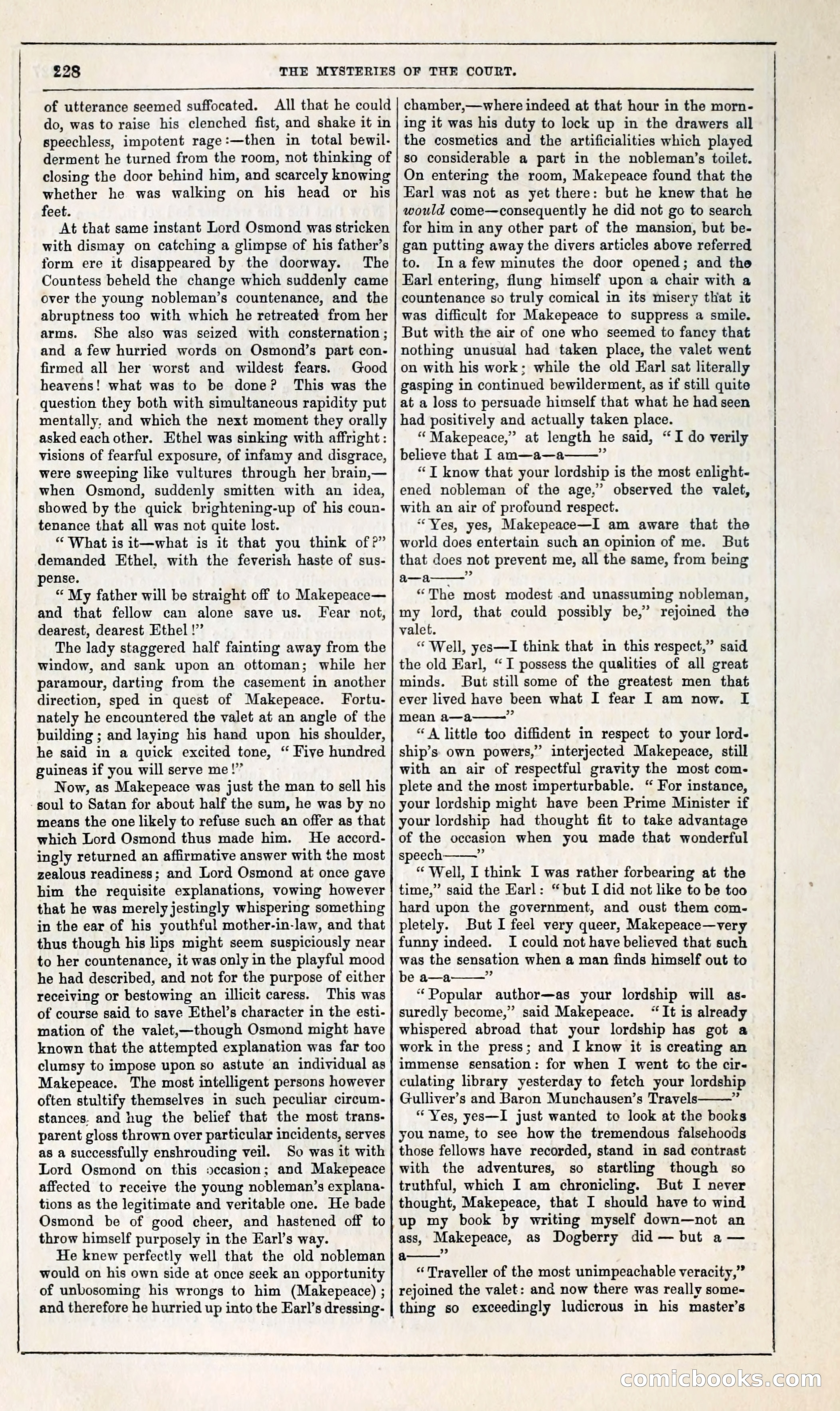
A restored page from Penny Dreadfuls, 1849. Page through the whole issue in the reader above.
📄 Transcribed text from this page (OCR, searchable)
Machine-transcribed from the original scan — historical spelling and the odd misread are preserved.
228 THE MYSTERIES OF THE COURT. of utterance seemed suffocated. All that he could do, was to raise his clenched fist, and shake it in speechless, impotent rage:—then in total bewil- derment he turned from the room, not thinking of closing the door behind him, and scarcely knowing whether he was walking on his head or his feet. At that same instant Lord Osmond was stricken with dismay on catching a glimpse of his father’s form ere it disappeared by the doorway. The Countess beheld the change which suddenly came over the young nobleman’s countenance, and the abruptness too with which he retreated from her arms. She also was seized with consternation ; and afew hurried words on Osmond’s part con- firmed all her worst and wildest fears. Good heavens! what was to be done? This was the question they both with simultaneous rapidity put mentally. and which the next moment they orally asked each other. Ethel was sinking with affright : visions of fearful exposure, of infamy and disgrace, were sweeping like vultures through her brain,— when Osmond, suddenly smitten with an idea, showed by the quick brightening-up of his coun- tenance that all was not quite lost. “ What is it—what is it that you think of?” demanded Ethel, with the feverish haste of sus- pense. “ My father will be straight off to Makepeace— and that fellow can alone save us. Fear not, dearest, dearest Ethel !” The lady staggered half fainting away from the window, and sank upon an ottoman; while her paramour, darting from the casement in another direction, sped in quest of Makepeace. Fortu- nately he encountered the valet at an angle of the building ; and laying his hand upon his shoulder, he said in a quick excited tone, “ Five hundred guineas if you will serve me!” Now, as Makepeace was just the man to sell his soul to Satan for about half the sum, he was by no means the one likely to refuse such an offer as that which Lord Osmond thus made him. He accord- ingly returned an affirmative answer with the most zealous readiness; and Lord Osmond at once gave him the requisite explanations, vowing however that he was merely jestingly whispering something in the ear of his youthful mother-in-law, and that thus though his lips might seem suspiciously near to her countenance, it was only in the playful mood he had described, and not for the purpose of either receiving or bestowing an illicit caress. This was of course said to save Ethel’s character in the esti- mation of the valet,—though Osmond might have known that the attempted explanation was far too clumsy to impose upon so astute an individual as Makepeace. The most intelligent persons however often stultify themselves in such peculiar circum- stances. and hug the belief that the most trans- parent gloss thrown over particular incidents, serves as a successfully enshrouding veil. So was it with Lord Osmond on this »ccasion; and Makepeace affected to receive the young nobleman’s explana- tions as the legitimate and veritable one. He bade Osmond be of good cheer, and hastened off to throw himself purposely in the Earl’s way. He knew perfectly well that the old nobleman would on his own side at once seek an opportunity of unbosoming his wrongs to him (Makepeace) ; and therefore he hurried up into the Earl’s dressing- chamber,—where indeed at that hour in the morn- ing it was his duty to lock up in the drawers all the cosmetics and the artificialities which played so considerable a part in the nobleman’s toilet. On entering the room, Makepeace found that the Earl was not as yet there: but he knew that he would come—consequently he did not go to search for him in any other part of the mansion, but be- gan putting away the divers articles above referred to. Ina few minutes the door opened; and the Earl entering, flung himself upon a chair with a countenance so truly comical in its misery that it was difficult for Makepeace to suppress a smile. But with the air of one who seemed to fancy that nothing unusual had taken place, the valet went on with his work; while the old Earl sat literally gasping in continued bewilderment, as if still quite at a loss to persuade himself that what he had seen had positively and actually taken place. “Makepeace,” at length he said, “I do verily believe that I am—a—a + “T know that your lordship is the most enlight- ened nobleman of the age,” observed the valet, with an air of profound respect. “Yes, yes, Makepeace—I am aware that the world does entertain such an opinion of me. But that does not prevent me, all the same, from being a—a 93> “The most modest and unassuming nobleman, my lord, that could possibly be,” rejoined the valet. | “ Well, yes—I think that in this respect,” said the old Earl, “TI possess the qualities of all great minds. But still some of the greatest men that ever lived have been what I fear I am now. I mean a—a rE “A little too diffident in respect to your lord- ship’s own powers,” interjected Makepeace, still with an air of respectful gravity the most com- plete and the most imperturbable. “ For instance, your lordship might have been Prime Minister if your lordship had thought fit to take advantage of the occasion when you made that wonderful speech 4 “ Well, I think I was rather forbearing at the time,” said the Earl: “but I did not like to be too hard upon the government, and oust them com- pletely. But I feel very queer, Makepeace—very funny indeed. I could not have believed that such was the sensation when a man finds himself out to be a—a < “Popular author—as your lordship will as- suredly become,” said Makepeace. “It is already whispered abroad that your lordship has got a work in the press; and I know it is creating an immense sensation: for when I went to the cir- culating library yesterday to fetch your lordship Gulliver’s and Baron Munchausen’s Travels re “Yes, yes—I just wanted to look at the books you name, to see how the tremendous falsehoods those fellows have recorded, stand in sad contrast with the adventures, so startling though so truthful, which I am chronicling. But I never thought, Makepeace, that I should have to wind up my book by writing myself down—not an ass, Makepeace, as Dogberry did — but a — a +P] “Traveller of the most unimpeachable veracity,” rejoined the valet: and now there was really some- thing so exceedingly ludicrous in his master’s EO JOO S (C©)