
Penny Dreadfuls, 1849 · page 251 of 394
The Mysteries of the Court of London — page 251: what you’re looking at
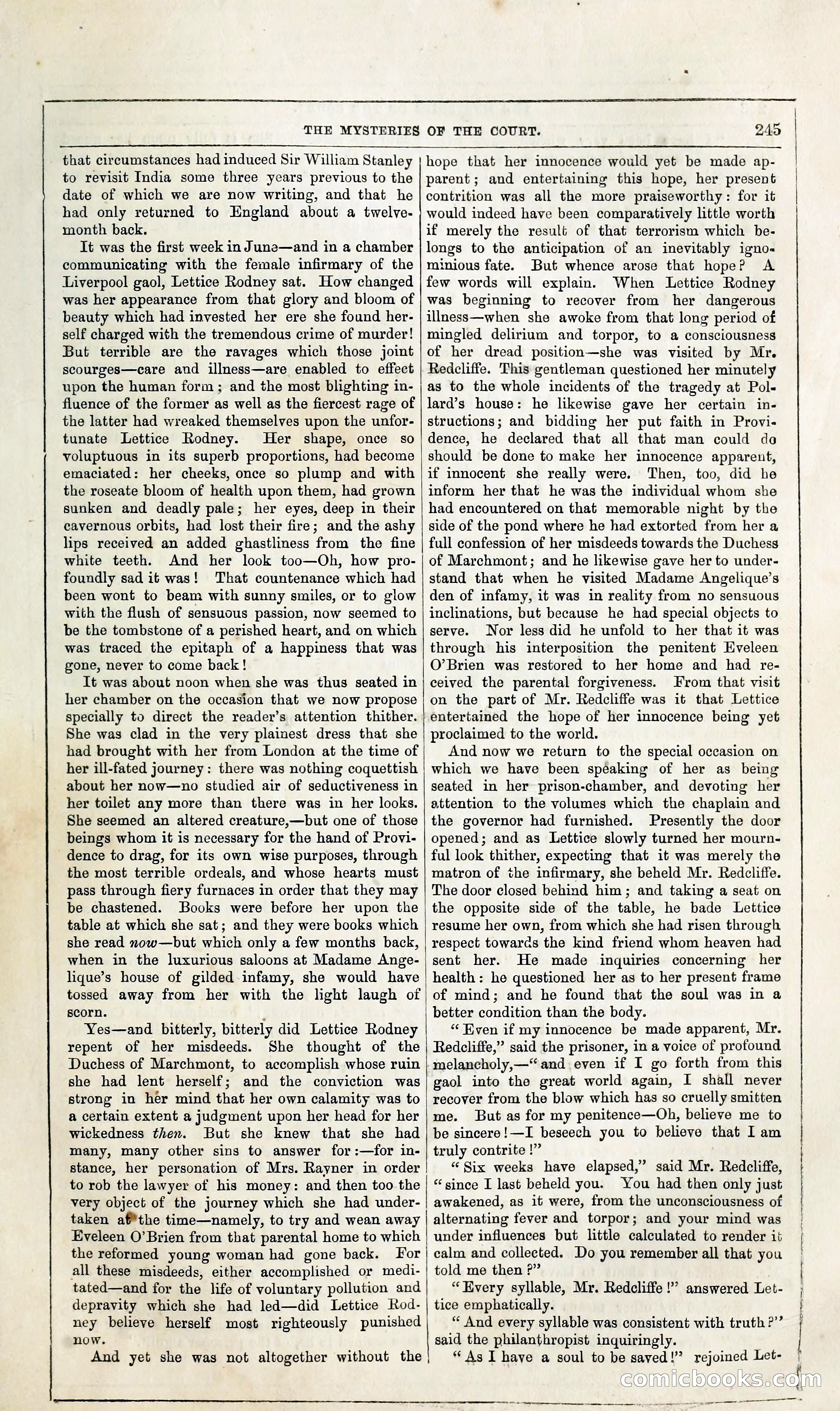
A restored page from Penny Dreadfuls, 1849. Page through the whole issue in the reader above.
📄 Transcribed text from this page (OCR, searchable)
Machine-transcribed from the original scan — historical spelling and the odd misread are preserved.
THE MYSTERIES —_, OF THE COURT. QA that circumstances had induced Sir William Stanley to revisit India some three years previous to the date of which we are now writing, and that he had only returned to England about a twelve- month back. It was the first week in June—and in a chamber communicating with the female infirmary of the Liverpool gaol, Lettice Rodney sat. How changed was her appearance from that glory and bloom of beauty which had invested her ere she found her- self charged with the tremendous crime of murder! But terrible are the ravages which those joint scourges—care and illness—are enabled to effect upon the human form; and the most blighting in- fluence of the former as well as the fiercest rage of the latter had wreaked themselves upon the unfor- tunate Lettice Rodney. Her shape, once so voluptuous in its superb proportions, had become emaciated: her cheeks, once so plump and with the roseate bloom of health upon them, had grown sunken and deadly pale; her eyes, deep in their cavernous orbits, had lost their fire; and the ashy lips received an added ghastliness from the fine white teeth. And her look too—Oh, how pro- foundly sad it was! That countenance which had been wont to beam with sunny smiles, or to glow with the flush of sensuous passion, now seemed to be the tombstone of a perished heart, and on which was traced the epitaph of a happiness that was gone, never to come back! It was about noon when she was thus seated in her chamber on the occasion that we now propose specially to direct the reader’s attention thither. She was clad in the very plainest dress that she had brought with her from London at the time of her ill-fated journey: there was nothing coquettish about her now—no studied air of seductiveness in her toilet any more than there was in her looks. She seemed an altered creature,—but one of those beings whom it is necessary for the hand of Provi- dence to drag, for its own wise purposes, through the most terrible ordeals, and whose hearts must pass through fiery furnaces in order that they may be chastened. Books were before her upon the table at which she sat; and they were books which she read now—but which only a few months back, when in the luxurious saloons at Madame Ange- lique’s house of gilded infamy, she would have tossed away from her with the light laugh of scorn. Yes—and bitterly, bitterly did Lettice Rodney repent of her misdeeds. She thought of the Duchess of Marchmont, to accomplish whose ruin she had lent herself; and the conviction was strong in her mind that her own calamity was to a certain extent a judgment upon her head for her wickedness then. But she knew that she had many, many other sins to answer for :—for in- stance, her personation of Mrs. Rayner in order to rob the lawyer of his money: and then too the | very object of the journey which she had under- taken af*the time—namely, to try and wean away Eveleen O’Brien from that parental home to which the reformed young woman had gone back. For all these misdeeds, either accomplished or medi- tated—and for the life of voluntary pollution and depravity which she had led—did Lettice Rod- ney believe herself most righteously punished now. And yet she was not altogether without the | hope that her innocence would yet be made ap- parent; and entertaining this hope, her present contrition was all the more praiseworthy: for it would indeed have been comparatively little worth if merely the result of that terrorism which be- longs to the anticipation of an inevitably igno- minious fate. But whence arose that hopeP A few words will explain. When Lettice Rodney was beginning to recover from her dangerous illness—when she awoke from that long period of mingled delirium and torpor, to a consciousness of her dread position—she was visited by Mr. Redcliffe. This gentleman questioned her minutely as to the whole incidents of the tragedy at Pol- lard’s house: he likewise gave her certain in- structions; and bidding her put faith in Provi- dence, he declared that all that man could do should be done to make her innocence apparent, if innocent she really were. Then, too, did he inform her that he was the individual whom she had encountered on that memorable night by the side of the pond where he had extorted from her a full confession of her misdeeds towards the Duchess of Marchmont; and he likewise gave her to under- stand that when he visited Madame Angelique’s den of infamy, it was in reality from no sensuous inclinations, but because he had special objects to serve. Nor less did he unfold to her that it was through his interposition the penitent Hveleen O’Brien was restored to her home and had re- ceived the parental forgiveness. From that visit on the part of Mr. Redcliffe was it that Lettice entertained the hope of her innocence being yet proclaimed to the world. And now we return to the special occasion on which we have been spéaking of her as being seated in her prison-chamber, and devoting her attention to the volumes which the chaplain and the governor had furnished. Presently the door opened; and as Lettice slowly turned her mourn- ful look thither, expecting that it was merely the matron of the infirmary, she beheld Mr. Redcliffe. The door closed behind him; and taking a seat on the opposite side of the table, he bade Lettice resume her own, from which she had risen through respect towards the kind friend whom heaven had sent her. He made inquiries concerning her health: he questioned her as to her present frame of mind; and he found that the soul was in a better condition than the body. ‘“‘Hiven if my innocence be made apparent, Mr. Redcliffe,” said the prisoner, in a voice of profound melancholy,—“ and even if I go forth from this gaol into the great world again, I shall never recover from the blow which has so cruelly smitten me. But as for my penitence—Oh, believe me to be sincere! —I beseech you to believe that I am truly contrite !” “Six weeks have elapsed,’ said Mr. Redcliffe, “since I last beheld you. You had then only just awakened, as it were, from the unconsciousness of alternating fever and torpor; and your mind was under influences but little calculated to render it | calm and collected. Do you remember all that you told me then ?” “Every syllable, Mr. Redcliffe!” answered Let- tice emphatically. “ And every syllable was consistent with truth ?’’ said the philanthropist inquiringly. As I have a soul to be saved!” rejoined Let- | | | ee een ee eee ee ERR ey een = saggy os COMNICLDOOKS a —— EE RS -——— com