
Penny Dreadfuls, 1849 · page 252 of 394
The Mysteries of the Court of London — page 252: what you’re looking at
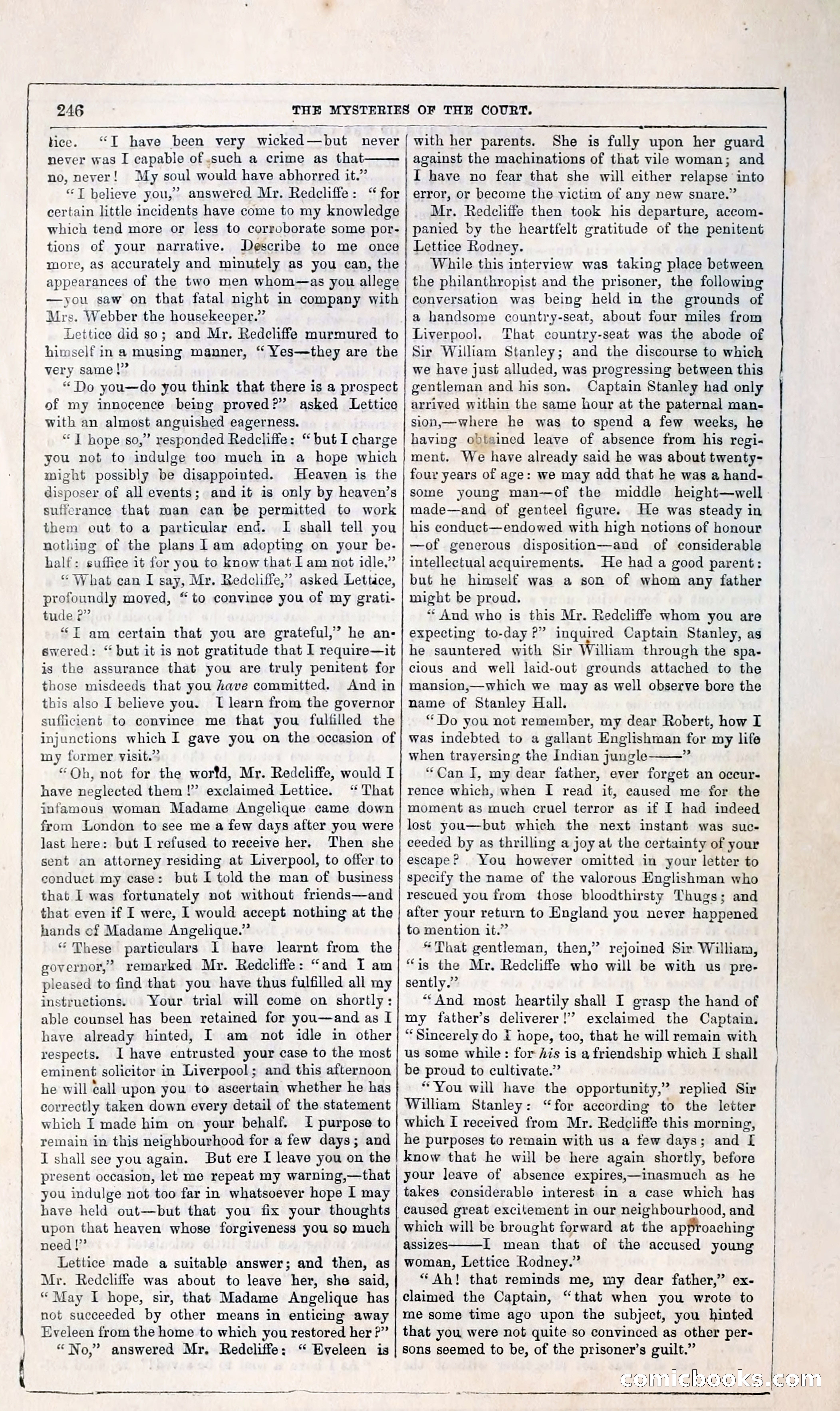
A restored page from Penny Dreadfuls, 1849. Page through the whole issue in the reader above.
📄 Transcribed text from this page (OCR, searchable)
Machine-transcribed from the original scan — historical spelling and the odd misread are preserved.
nn i SSS THE MYSTERIES OF THE COURT. 246 -_— TO tice. “I have been very wicked—but never never was I capable of .such a crime as that——— no, never! My soul would have abhorred it.” “T believe you,’ answered Mr. Redcliffe: “ for certain little incidents have come to my knowledge which tend more or less to corroborate some por- tions of your narrative. Describe to me once more, as accurately and minutely as you can, the appearances of the two men whom—as you allege —you saw on that fatal night in company with Mrs. Webber the housekeeper.” Lettice did so; and Mr. Redcliffe murmured to himself in a musing manner, ‘“‘ Yes—they are the very same!” “Do you—do you think that there is a prospect of my innocence being proved?’ asked Lettice with an almost anguished eagerness. “IT hope so,” responded Redcliffe: “but I charge you not to indulge too much in a hope which might possibly be disappointed. Heaven is the disposer of all events; andit is only by heaven’s sufferance that man can be permitted to work them out to a particular end. I shall tell you nothing of the plans 1 am adopting on your be- half: suffice it for you to know that I am not idle.” “ What can I say, Mr. Redcliffe,” asked Lettace, profoundly moved, “to convince you of my grati- tude ?” “T am certain that you are grateful,” he an- swered: “but it is not gratitude that I require—it is the assurance that you are truly penitent for those misdeeds that you have committed. And in this also I believe you. LI learn from the governor sufficient to convince me that you fulfilled the injunctions which I gave you on the occasion of my former visit.” “Oh, not for the wortd, Mr. Redcliffe, would I have neglected them!” exclaimed Lettice. “That infamous woman Madame Angelique came down from London to see me a few days after you were last here: but I refused to receive her. Then she sent an attorney residing at Liverpool, to offer to conduct my case: but I told the man of business that 1 was fortunately not without friends—and that even if I were, I would accept nothing at the hands of Madame Angelique.” § These particulars 1 have learnt from the governor,” remarked Mr. Redcliffe: “and I am pleased to find that you have thus fulfilled all my instructions. Your trial will come on shortly: able counsel has been retained for you—and as I have already hinted, IT am not idle in other respects. I have entrusted your case to the most eminent solicitor in Liverpool; and this afternoon he will call upon you to ascertain whether he has correctly taken down every detail of the statement which I made him on your behalf. IL purpose to remain in this neighbourhood for a few days; and I shall see you again. But ere I leave you on the present occasion, let me repeat my warning,—that you indulge not too far in whatsoever hope I may have held out—but that you fix your thoughts | upon that heaven whose forgiveness you so much need |” Lettice made a suitable answer; and then, as Mr. Redcliffe was about to leave her, she said, “May I hope, sir, that Madame Angelique has not succeeded by other means in enticing away Eveleen from the home to which you restored her ?” “No,” answered Mr, Redcliffe: “ Eveleen is — teers “ ate with her parents. She is fully upon her guard against the machinations of that vile woman; and I have no fear that she will either relapse into error, or become the victim of any new snare.” Mr. Redcliffe then took his departure, accom- panied by the heartfelt gratitude of the penitent Lettice Rodney. While this interview was taking place between the philanthropist and the prisoner, the following conversation was being held in the grounds of a handsome country-seat, about four miles from Liverpool. That country-seat was the abode of Sir William Stanley; and the discourse to which we have just alluded, was progressing between this gentleman and his son. Captain Stanley had only arrived within the same hour at the paternal man- sion,—where he was to spend a few weeks, he having obtained leave of absence from his regi- ment. We have already said he was about twenty- four years of age: we may add that he was a hand- some young man—of the middle height—well made—and of genteel figure. He was steady in his conduct—endowed with high notions of honour —of generous disposition—and of considerable intellectual acquirements. He had a good parent: but he himself was a son of whom any father might be proud. “And who is this Mr. Redcliffe whom you are expecting to-day?” inquired Captain Stanley, as he sauntered with Sir William through the spa- cious and well laid-out grounds attached to the mansion,—which we may as well observe bore the name of Stanley Hall. “Do you not remember, my dear Robert, how I was indebted to a gallant Englishman for my life when traversing the Indian jungle 7 “Can I, my dear father, ever forget an occurs rence which, when I read it, caused me for the moment as much cruel terror as if I had indeed lost you—but which the next instant was suc- ceeded by as thrilling a joy at the certainty of your escape? You however omitted in your letter to specify the name of the valorous Englishman who rescued you from those bloodthirsty Thugs; and after your return to England you never happened to mention it.” “That gentleman, then,” rejoined Sir William, “is the Mr. Redcliffe who will be with us pre- sently.” ““And most heartily shall I grasp the hand of my father’s deliverer!’’ exclaimed the Captain. “Sincerely do I hope, too, that he will remain with us some while: for his is a friendship which I shall be proud to cultivate.” * You will have the opportunity,” replied Sir William Stanley: “for according to the letter which I received from Mr. Redcliffe this morning, he purposes to remain with us a tew days; and [ know that he will be here again shortly, before your leave of absence expires,—inasmuch as he takes considerable interest in a case which has caused great excitement in our neighbourhood, and which will be brought forward at the approaching assizes I mean that of the accused young woman, Lettice Rodney.” “Ah! that reminds me, my dear father,” ex- claimed the Captain, “that when you wrote to me some time ago upon the subject, you hinted that you were not quite so convinced as other per- sons seemed to be, of the prisoner’s guilt.” (COMMUCE 0)(0)(0) S ee ete (>) SS =|