
Penny Dreadfuls, 1849 · page 253 of 394
The Mysteries of the Court of London — page 253: what you’re looking at
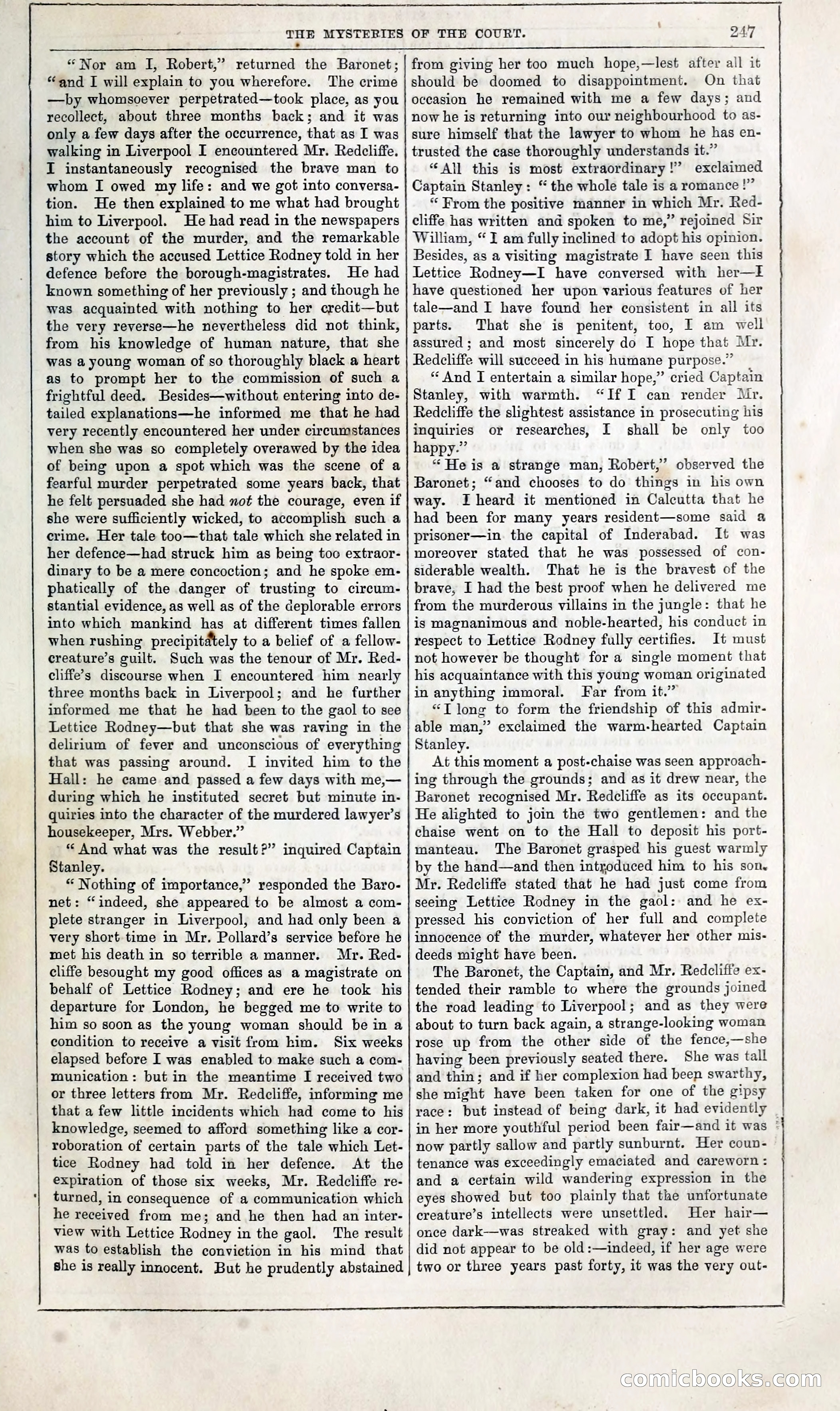
A restored page from Penny Dreadfuls, 1849. Page through the whole issue in the reader above.
📄 Transcribed text from this page (OCR, searchable)
Machine-transcribed from the original scan — historical spelling and the odd misread are preserved.
THE MYSTERIES OF THE COURT. Ld 24:7 ‘Nor am I, Robert,’ returned the Baronet; ‘and I will explain to you wherefore. The crime —by whomsoever perpetrated—took place, as you recollect, about three months back; and it was only a few days after the occurrence, that as I was walking in Liverpool I encountered Mr. Redcliffe. I instantaneously recognised the brave man to whom I owed my life: and we got into conversa- tion. He then explained to me what had brought him to Liverpool. He had read in the newspapers the account of the murder, and the remarkable story which the accused Lettice Rodney told in her defence before the borough-magistrates. He had known something of her previously ; and though he was acquainted with nothing to her credit—but the very reverse—he nevertheless did not think, from his knowledge of human nature, that she was a young woman of so thoroughly black a heart as to prompt her to the commission of such a frightful deed. Besides—without entering into de- tailed explanations—he informed me that he had very recently encountered her under circumstances when she was so completely overawed by the idea of being upon a spot which was the scene of a fearful murder perpetrated some years back, that he felt persuaded she had not the courage, even if she were sufficiently wicked, to accomplish such a crime. Her tale too—that tale which she related in her defence—had struck him as being too extraor- dinary to be a mere concoction; and he spoke em- phatically of the danger of trusting to circum- stantial evidence, as well as of the ceplorable errors into which mankind has at different times fallen when rushing precipitdtely to a belief of a fellow- creature’s guilt. Such was the tenour of Mr. Red- cliffe’s discourse when I encountered him nearly three months back in Liverpool; and he further informed me that he had been to the gaol to see Lettice Rodney—but that she was raving in the delirium of fever and unconscious of everything that was passing around. I invited him to the Hall: he came and passed a few days with me,— during which he instituted secret but minute in- quiries into the character of the murdered lawyer’s housekeeper, Mrs. Webber.” “And what was the result?” inquired Captain Stanley. * Nothing of importance,” responded the Baro- net: “indeed, she appeared to be almost a com- plete stranger in Liverpool, and had only been a very short time in Mr, Pollard’s service before he met his death in so terrible a manner. Mr. Red- cliffe besought my good offices as a magistrate on behalf of Lettice Rodney; and ere he took his departure for London, he begged me to write to him so soon as the young woman should be in a condition to receive a visit from kim. Six weeks elapsed before I was enabled to make such a com- munication: but in the meantime I received two or three letters from Mr. Redcliffe, informing me that a few little incidents which had come to his knowledge, seemed to afford something like a cor- roboration of certain parts of the tale which Let- tice Rodney had told in her defence. At the expiration of those six weeks, Mr. Redcliffe re- turned, in consequence of a communication which he received from me; and he then had an inter- view with Lettice Rodney in the gaol. The result was to establish the conviction in his mind that she is really innocent. But he prudently abstained from giving her too much hope,—lest after all it should be doomed to disappointment. On that occasion he remained with me a few days; and now he is returning into our neighbourhood to as- sure himself that the lawyer to whom he has en- trusted the case thoroughly understands it.” “All this is most extraordinary!’ exclaimed Captain Stanley: “ the whole tale is a romance !” “ From the positive manner in which Mr. Red- cliffe has written and spoken to me,” rejoined Sir William, “ I am fully inclined to adopt his opinion. Besides, as a visiting magistrate I have seen this Lettice Rodney—I have conversed with her—t have questioned her upon various features of her tale—and I have found her consistent in all its parts. That she is penitent, too, I am well assured ; and most sincerely do I hope that Mr. Redcliffe will succeed in his humane purpose.” “ And I entertain a similar hope,” cried Captain Stanley, with warmth. “If I can render Mr. Redcliffe the slightest assistance in prosecuting his inquiries or researches, I shall be only too happy.” “ He is a strange man, Robert,’ observed the Baronet; “and chooses to do things in his own way. lL heard it mentioned in Calcutta that he had been for many years resident—some said @ prisoner—in the capital of Inderabad. It was moreover stated that he was possessed of con- siderable wealth. That he is the bravest of the brave, I had the best proof when he delivered me from the murderous villains in the jungle: that he is magnanimous and noble-hearted, his conduct in respect to Lettice Rodney fully certifies. It must not however be thought for a single moment that his acquaintance with this young woman originated in anything immoral. Far from it.” “T long to form the friendship of this admir- able man,” exclaimed the warm-hearted Captain Stanley. At this moment a post-chaise was seen approach- ing through the grounds; and as it drew near, the Baronet recognised Mr. Redcliffe as its occupant. He alighted to join the two gentlemen: and the chaise went on to the Hall to deposit his port- manteau. The Baronet grasped his guest warmly by the hand—and then intyoduced him to his son. Mr. Redcliffe stated that he had just come from seeing Lettice Rodney in the gaol: and he ex- pressed his conviction of her full and complete innocence of the murder, whatever her other mis- deeds might have been. The Baronet, the Captain, and Mr. Redcliffe ex- tended their ramble to where the grounds joined the road leading to Liverpool; and as they were about to turn back again, a strange-looking woman rose up from the other side of the fence,—she having been previously seated there. She was tall and thin; and if her complexion had been swarthy, she might have been taken for one of the gipsy race: but instead of being dark, it had evidently in her more youthful period been fair—and it was ‘| now partly sallow and partly sunburnt. Her coun- tenance was exceedingly emaciated and careworn: and a certain wild wandering expression in the eyes showed but too plainly that the unfortunate creature’s intellects were unsettled. Her hair— once dark—was streaked with gray: and yet she did not appear to be old:—indeed, if her age were two or three years past forty, it was the very out- Go 0)(0)6) S (C©)