
Penny Dreadfuls, 1849 · page 257 of 394
The Mysteries of the Court of London — page 257: what you’re looking at
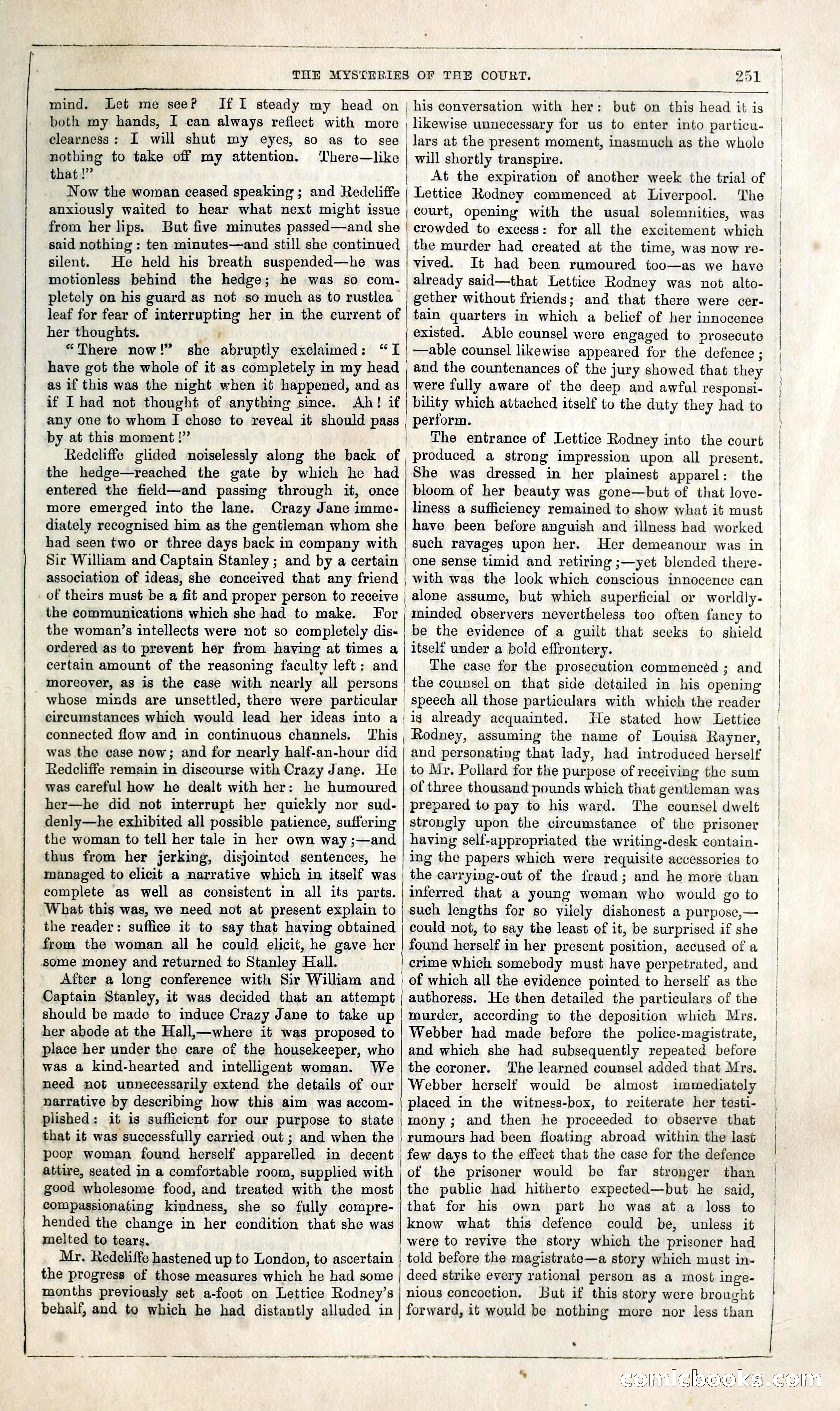
A restored page from Penny Dreadfuls, 1849. Page through the whole issue in the reader above.
📄 Transcribed text from this page (OCR, searchable)
Machine-transcribed from the original scan — historical spelling and the odd misread are preserved.
THE MYSTERIES OF THE COURT. mind. Let me see? IfI steady my head on both my hands, I can always reflect with more clearness: I will shut my eyes, so as to see nothing to take off my attention. There—like that!” Now the woman ceased speaking; and Redcliffe | anxiously waited to hear what next might issue from her lips. But five minutes passed—and she said nothing : ten minutes—and still she continued silent. He held his breath suspended—he was motionless behind the hedge; he was so com. pletely on his guard as not so much as to rustlea leaf for fear of interrupting her in the current of her thoughts. ot “There now!” she abruptly exclaimed: “I have got the whole of it as completely in my head as if this was the night when it happened, and as if I had not thought of anything since. Ah! if any one to whom I chose to reveal it should pass by at this moment!” Redcliffe glided noiselessly along the back of the hedge—reached the gate by which he had entered the field—and passing through it, once more emerged into the lane. Crazy Jane imme- diately recognised him as the gentleman whom she had seen two or three days back in company with Sir William and Captain Stanley; and by a certain association of ideas, she conceived that any friend of theirs must be a fit and proper person to receive the communications which she had to make. For the woman’s intellects were not so completely dis- ordered as to prevent her from having at times a certain amount of the reasoning faculty left; and moreover, as is the case with nearly all persons _ whose minds are unsettled, there were particular circumstances which would lead her ideas into a his conversation with her: but on this head it is likewise unnecessary for us to enter into particu- lars at the present moment, inasmuch as the whole will shortly transpire. At the expiration of another week the trial of Lettice Rodney commenced at Liverpool. The court, opening with the usual solemnities, was crowded to excess: for all the excitement which the murder had created at the time, was now re- vived. It had been rumoured too—as we have already said—that Lettice Rodney was not alto- gether without friends; and that there were cer- tain quarters in which a belief of her innocence existed. Able counsel were engaged to vrosecute —able counsel likewise appeared for the defence ; and the countenances of the jury showed that they were fully aware of the deep and awful responsi- bility which attached itself to the duty they had to perform. The entrance of Lettice Rodney into the court produced a strong impression upon all present. She was dressed in her plainest apparel: the bloom of her beauty was gone—but of that love- liness a sufficiency remained to show what it must have been before anguish and illness had worked such ravages upon her. Her demeanour was in one sense timid and retiring ;—yet blended there- with was the look which conscious innocence can alone assume, but which superficial or worldly- minded observers nevertheless too often fancy to be the evidence of a guilt that seeks to shield itself under a bold effrontery. The case for the prosecution commenced ; and the counsel on that side detailed in his opening speech all those particulars with which the reader ig already acquainted. He stated how Lettice connected flow and in continuous channels. This | Rodney, assuming the name of Louisa Rayner, was the case now; and for nearly half-an-hour did Redcliffe remain in discourse with Crazy Jane. He was careful how he dealt with her: he humoured her—he did not interrupt her quickly nor sud- denly—he exhibited all possible patience, suffering the woman to tell her tale in her own way ;—and thus from her jerking, disjointed sentences, he managed to elicit a narrative which in itself was complete as well as consistent in all its parts. What this was, we need not at present explain to the reader: suffice it to say that having obtained from the woman all he could elicit, he gave her some money and returned to Stanley Hall. After a long conference with Sir William and Captain Stanley, it was decided that an attempt should be made to induce Crazy Jane to take up her abode at the Hall,—where it was proposed to place her under the care of the housekeeper, who was a kind-hearted and intelligent woman. We need not unnecessarily extend the details of our narrative by describing how this aim was accom- plished: it is sufficient for our purpose to state that it was successfully carried out ; and when the poor woman found herself apparelled in decent attire, seated in a comfortable room, supplied with good wholesome food, and treated with the most compassionating kindness, she so fully compre- hended the change in her condition that she was melted to tears. Mr. Redcliffe hastened up to London, to ascertain the progress of those measures which he had some months previously set a-foot on Lettice Rodney’s behalf, and to which he had distantly alluded in er DD rn eer and personating that lady, had introduced herself to Mr. Pollard for the purpose of receiving the sum of three thousand pounds which that gentleman was prepared to pay to his ward. The counsel dwelt strongly upon the circumstance of the prisoner having self-appropriated the writing-desk contain- ing the papers which were requisite accessories to the carrying-out of the fraud; and he more than inferred that a young woman who would go to such lengths for so vilely dishonest a purpose,— could not, to say the least of it, be surprised if she found herself in her present position, accused of a crime which somebody must have perpetrated, and of which all the evidence pointed to herself as the authoress. He then detailed the particulars of the murder, according to the deposition which Mrs. Webber had made before the police-magistrate, and which she had subsequently repeated before the coroner. The learned counsel added that Mrs. Webber herself would be almost immediately placed in the witness-box, to reiterate her testi- mony; and then he proceeded to observe that rumours had been floating abroad within the last few days to the effect that the case for the defence of the prisoner would be far stronger than the public had hitherto expected—but he said, that for his own part he was at a loss to know what this defence could be, unless it were to revive the story which the prisoner had told before the magistrate—a story which must in- deed strike every rational person as a most inge- nious concoction. But if this story were brought forward, it would be nothing more nor less than . me eer _ * (C(O)IAN) (C 0)(0)(0) ‘S CO)