
Penny Dreadfuls, 1849 · page 258 of 394
The Mysteries of the Court of London — page 258: what you’re looking at
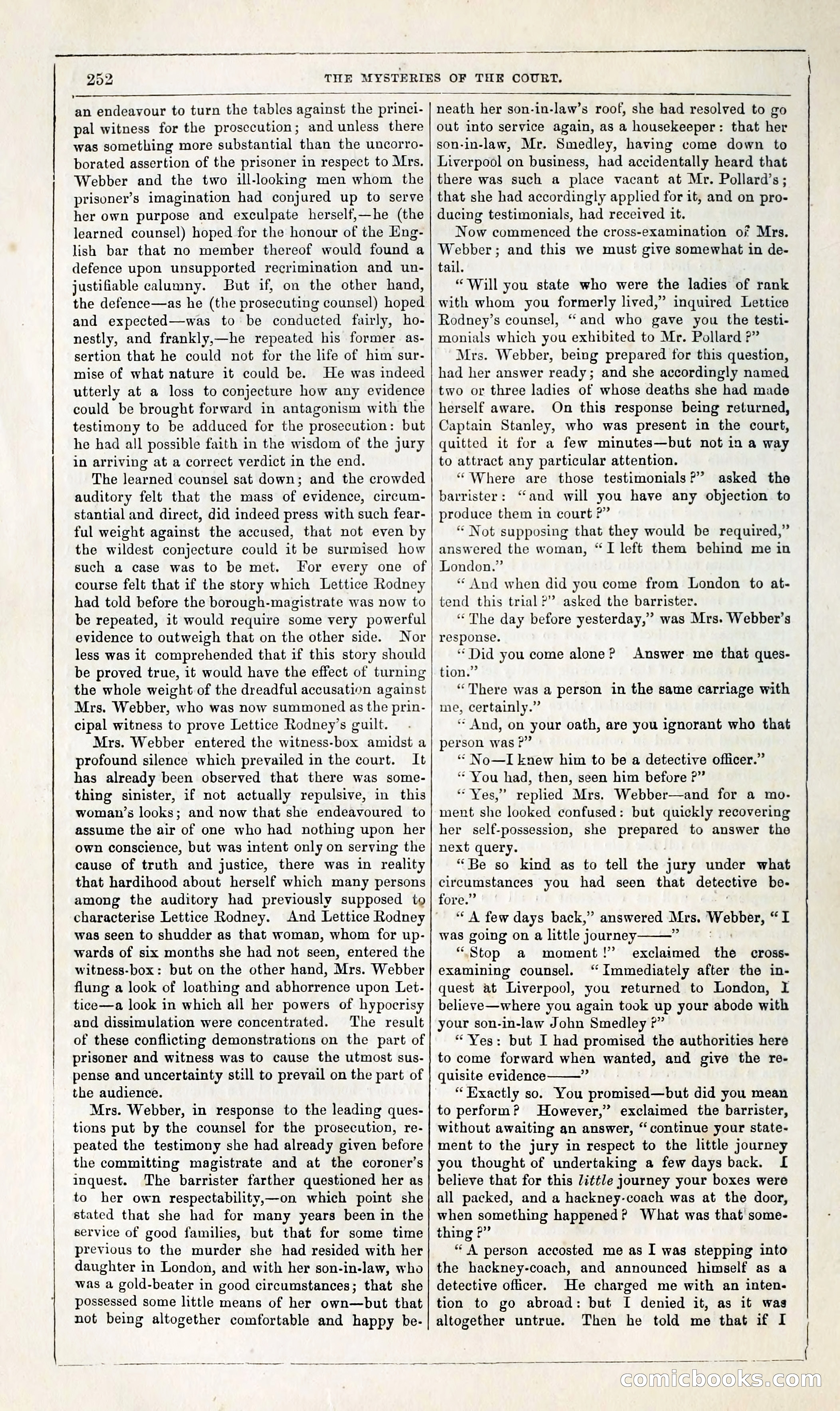
A restored page from Penny Dreadfuls, 1849. Page through the whole issue in the reader above.
📄 Transcribed text from this page (OCR, searchable)
Machine-transcribed from the original scan — historical spelling and the odd misread are preserved.
a anes 252 , an endeavour to turn the tables against the princi- pal witness for the prosecution; and unless there was something more substantial than the uncorro- borated assertion of the prisoner in respect to Mrs. Webber and the two ill-looking men whom the prisoner’s imagination had conjured up to serve her own purpose and exculpate herself,—he (the learned counsel) hoped for the honour of the Eng- lish bar that no member thereof would found a defence upon unsupported recrimination and un- justifiable calumny. But if, on the other hand, the defence—as he (the prosecuting counsel) hoped and expected—was to be conducted fairly, ho- nestly, and frankly,—he repeated his former as- sertion that he could not for the life of him sur- mise of what nature it could be. He was indeed utterly at a loss to conjecture how any evidence could be brought forward in antagonism with the testimony to be adduced for the prosecution: but he had all possible faith in the wisdom of the jury in arriving at a correct verdict in the end. The learned counsel sat down; and the crowded auditory felt that the mass of evidence, circum- stantial and direct, did indeed press with such fear- ful weight against the accused, that not even by the wildest conjecture could it be surmised how such a case was to be met. For every one of course felt that if the story which Lettice Rodney had told before the borough-magistrate was now to be repeated, it would require some very powerful evidence to outweigh that on the other side. Nor less was it comprehended that if this story should be proved true, it would have the effect of turning the whole weight of the dreadful accusation against Mrs. Webber, who was now summoned as the prin- cipal witness to prove Lettice Rodney’s guilt. Mrs. Webber entered the witness-box amidst a profound silence which prevailed in the court. It has already been observed that there was some- thing sinister, if not actually repulsive, in this woman’s looks; and now that she endeavoured to assume the air of one who had nothing upon her own conscience, but was intent only on serving the cause of truth and justice, there was in reality that hardihood about herself which many persons among the auditory had previously supposed to characterise Lettice Rodney. And Lettice Rodney | was seen to shudder as that woman, whom for up- wards of six months she had not seen, entered the witness-box: but on the other hand, Mrs. Webber flung a look of loathing and abhorrence upon Let- tice—a look in which all her powers of hypocrisy and dissimulation were concentrated. The result of these conflicting demonstrations on the part of prisoner and witness was to cause the utmost sus- pense and uncertainty still to prevail on the part of the audience. Mrs. Webber, in response to the leading ques- tions put by the counsel for the prosecution, re- peated the testimony she had already given before the committing magistrate and at the coroner’s inquest. The barrister farther questioned her as to her own respectability,—on which point she stated that she had for many years been in the service of good families, but that for some time previous to the murder she had resided with her daughter in London, and with her son-in-law, who was a gold-beater in good circumstances; that she possessed some little means of her own—but that not being altogether comfortable and happy be- TILE MYSTERIES OF THE COURT. neath her son-in-law’s roof, she had resolved to go out into service again, as a housekeeper: that her son-in-law, Mr. Smedley, having come down to Liverpool on business, had accidentally heard that there was such a place vacant at Mr. Pollard’s; that she had accordingly applied for it, and on pro- ducing testimonials, had received it. Now commenced the cross-examination of Mrs. Webber; and this we must give somewhat in de- tail. “Will you state who were the ladies of rank with whom you formerly lived,” inquired Lettice Rodney’s counsel, “and who gave you the testi- monials which you exhibited to Mr. Pollard ?” Mrs. Webber, being prepared for this question, had her answer ready; and she accordingly named two or three ladies of whose deaths she had made herself aware. On this response being returned, Captain Stanley, who was present in the court, quitted it for a few minutes—but not in a way to attract any particular attention. ‘Where are those testimonials?” asked the barrister: “and will you have any objection to produce them in court ?” “ Not supposing that they would be required,” answered the woman, “I left them behind me in London.” “ And when did you come from London to at- tend this trial?” asked the barrister. “The day before yesterday,’ was Mrs. Webber's response. ‘Did you come alone? Answer me that ques- tion.” “There was a person in the same carriage with me, certainly.” ‘And, on your oath, are you ignorant who that person was ?” ‘“ No—I knew him to be a detective officer.” “ You had, then, seen him before P” “Yes,” replied Mrs. Webber—and for a mo- ment she looked confused: but quickly recovering her self-possession, she prepared to answer the next query. “Be so kind as to tell the jury under what circumstances you had seen that detective be- fore.” | ‘‘ A few days back,” answered Mrs. Webber, “I was going on a little journey A 3 “Stop a moment!’ exclaimed the cross- examining counsel. “Immediately after the in- quest at Liverpool, you returned to London, IL believe—where you again took up your abode with your son-in-law John Smedley ?” “Yes: but I had promised the authorities here to come forward when wanted, and give the re- quisite evidence *) “Exactly so. You promised—but did you mean to perform? However,” exclaimed the barrister, without awaiting an answer, “ continue your state- ment to the jury in respect to the little journey you thought of undertaking a few days back. I believe that for this little journey your boxes were all packed, and a hackney-coach was at the door, when something happened? What was that some- thing ?” “A person accosted me as I was stepping into the hackney-coach, and announced himself as a detective officer. He charged me with an inten- tion to go abroad: but I denied it, as it was altogether untrue. Then he told me that if I —" CORNICOOOKS CO) => an) oe S}