
Penny Dreadfuls, 1849 · page 273 of 394
The Mysteries of the Court of London — page 273: what you’re looking at
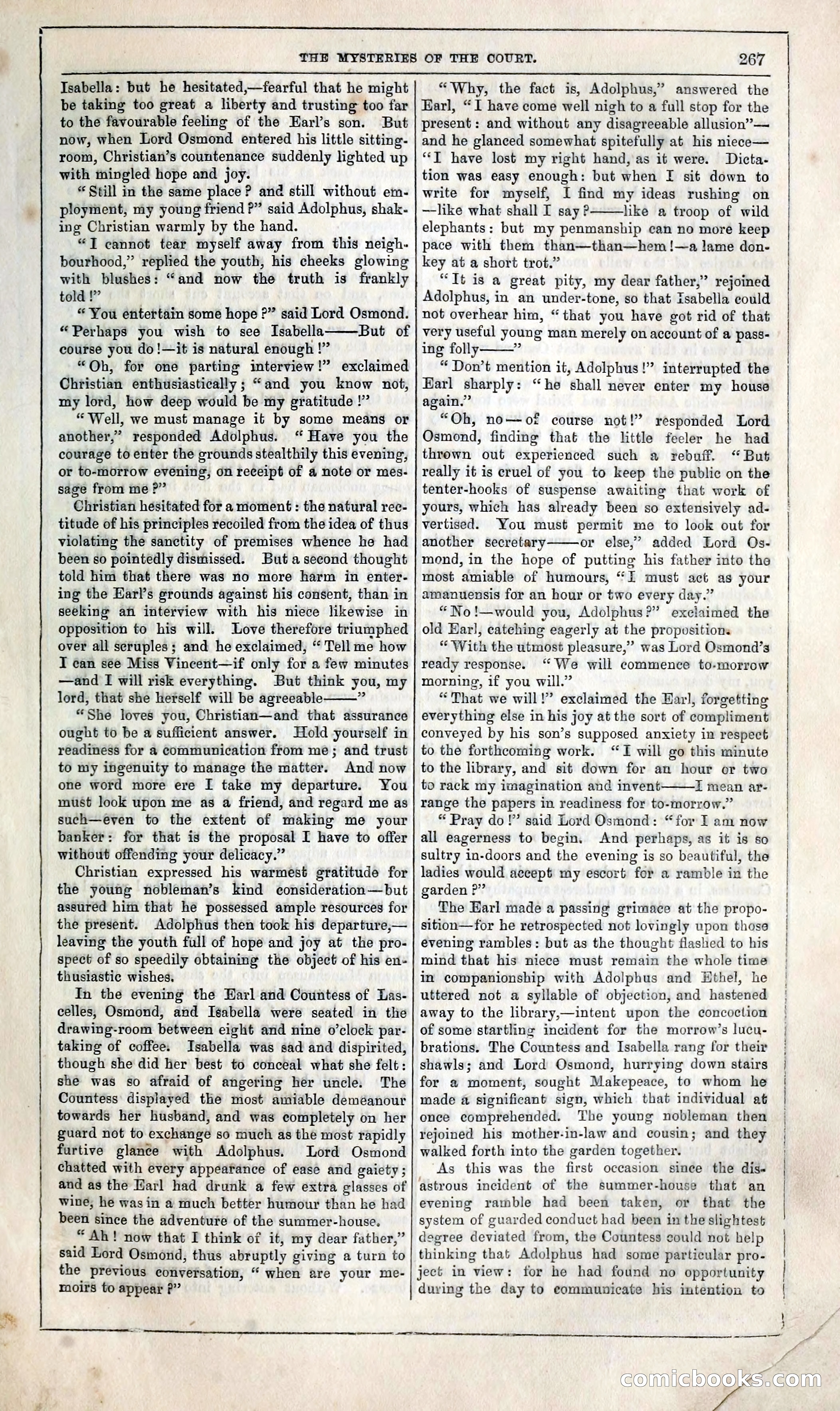
A restored page from Penny Dreadfuls, 1849. Page through the whole issue in the reader above.
📄 Transcribed text from this page (OCR, searchable)
Machine-transcribed from the original scan — historical spelling and the odd misread are preserved.
THE MYSTERIES OF THE COURT. 267 Isabella: but he hesitated,—fearful that he might be taking too great a liberty and trusting too far to the favourable feeling of the Earl’s son. But now, when Lord Osmond entered his little sitting- room, Christian’s countenance suddenly lighted up with mingled hope and joy. “ Still in the same place? and still without em- ployment, my young friend P” said Adolphus, shak- ing Christian warmly by the hand. “T cannot tear myself away from this neigh. bourhood,” replied the youth, his cheeks glowing with blushes: “and now the truth is frankly told !” “ You entertain some hope ?” said Lord Osmond. “Perhaps you wish to see Isabella But of course you do!—it is natural enough !” “Oh, for one parting interview!” exclaimed Christian enthusiastically ; “and you know not, my lord, how deep would be my gratitude !” “Well, we must manage it by some means or another,” responded Adolphus. ‘“ Have you the courage to enter the crounds stealthily this evening, or to-morrow evening, on receipt of a note or mes- sage from me ?” Christian hesitated for a moment : the natural ree- titude of his principles recoiled from the idea of thus violating the sanctity of premises whence he had been so pointedly dismissed. Buta second thought told him that there was no more harm in enter- ing the Earls grounds against his consent, than in seeking afi interview with his niece likewise in opposition to his will. Love therefore triumphed over all scruples; and he exclaimed, “ Tell me how I can see Miss Vineent—if only for a few minutes —and I will risk everything. But think you, my lord, that she herself will be agreeable * “She loves you, Christian—and that assurance ought to be a sufficient answer. Hold yourself in readiness for a communication from me; and trust to my ingenuity to manage the matter. And now one word more ere [ take my departure. You must look upon me as a friend, and regard me as such—evyen to the extent of making me your banker: for that is the proposal I have to offer without offending your delicacy.” Christian expressed his warmest gratitude for the young nobleman’s kind consideration—but assured him that he possessed ample resources for the present. Adolphus then took his departure,— leaving the youth full of hope and joy at the pro- spect of so speedily obtaining the object of his en- thusiastic wishes, In the evening the Harl and Countess of Las- celles, Osmond, and Iéabella were seated in the drawing-room between eight and nine o’clock par- taking of coffee. Isabella was sad and dispirited, though she did her best to conceal what she felt: she was so afraid of angering her uncle. The Countess displayed the most amiable deméanour towards her husband, and was completely on her guard not to exchange so much as the most rapidly furtive glance with Adolphus. Lord Osmond chatted with every appearance of ease and gaiety; and as the Marl had drunk a few extra classes of wine, he was in a much better humour than he had been since the adventure of the summer-house. “Ah! now that I think of it, my dear father,” said Lord Osmond, thus abruptly giving a turn to the previous conversation, “ when are your me- moirs to appear ?” “Why, the fact is, Adolphus,’ answered the Earl, “I have come well nich to a full stop for the present: and without any disagreeable allusion”— and he glanced somewhat spitefully at his niece— “‘T have lost my right hand, as it were. Dicta- tion was easy enough: but when I sit down to write for myself, I find my ideas rushing on —like what shall I say? like a troop of wild elephants: but my penmanship can no more keep pace with them than—than—hem !—a lame don- key at a short trot.” “It is a great pity, my dear father,’ rejoined Adolphus, in an under-tone, so that Isabella could not overhear him, “that you have got rid of that very useful young man merely on account of a pass- ing folly ? “ Don’t mention it, Adolphus!” interrupted the Earl sharply: “he shall never enter my house again.” “Oh, no—of course not!” responded Lord Osmond, finding that the little feeler he had thrown out experienced such a rebuff. “But really it is cruel of you to keep the public on the tenter-hooks of suspense awaiting that work of yours, which has already been so extensively ad- vertised. You must permit me to look out for another secretary or else,’ added Lord Os- mond, in the hope of putting his father into the most amiable of humours, “I must act as your amanuensis for an hour or two every day.” “No!—would you, Adolphus?” exclaimed the old Harl, catehing eagerly at the propositions “ With the utmost pleasure,” was Lord Osmond’s ready response. “We will commence to-morrow morning, if you will.” “That we will!” exclaimed the Earl, forgetting everything else in his joy at the sort of compliment conveyed by his son’s supposed anxiety in respect to the forthcoming work. “TI will go this minute to the library, and sit down for an hour or two to rack my imagination and invent I mean ar- range the papers in readiness for to-morrow.” “ Pray do!” said Lord Osmond: “for I am now all eagerness to begin. And perhaps, as it is so sultry in-doors and the evening is so beautiful, the ladies would accept my escort for a ramble in the garden P” The Earl made a passing grimace at the propo- sition—for he retrospected not lovingly upon those evening rambles: but as the thought flashed to his mind that his niece must remain the whole time in companionship with Adolphus and WNthel, he uttered not a syllable of objection, and hastened away to the library,—intent upon the concoction of some startling incident for the morrow’s lucu- brations. The Countess and Isabella rang for their shawls; and Lord Osmond, hurrying down stairs for a moment, sought Makepeace, to whom he made @ significant sign, which that individual at once comprehended. The young nobleman then rejoined his mother-in-law and cousin; and they walked forth into the garden together. As this was the first occasion sinee the dis astrous incident of the summer-house that an evening ramble had been taken, or that the system of guarded conduct had been in the slightest degree deviated from, the Countess gould not help thinking that Adolphus had some particular pro- ject in view: for he had found no opportunity during the day to communicate his intention to IOOKS*" eer A LLL LCE OL LL RL TN, et ———— er re ee — eee a — (E©)