
Penny Dreadfuls, 1849 · page 274 of 394
The Mysteries of the Court of London — page 274: what you’re looking at
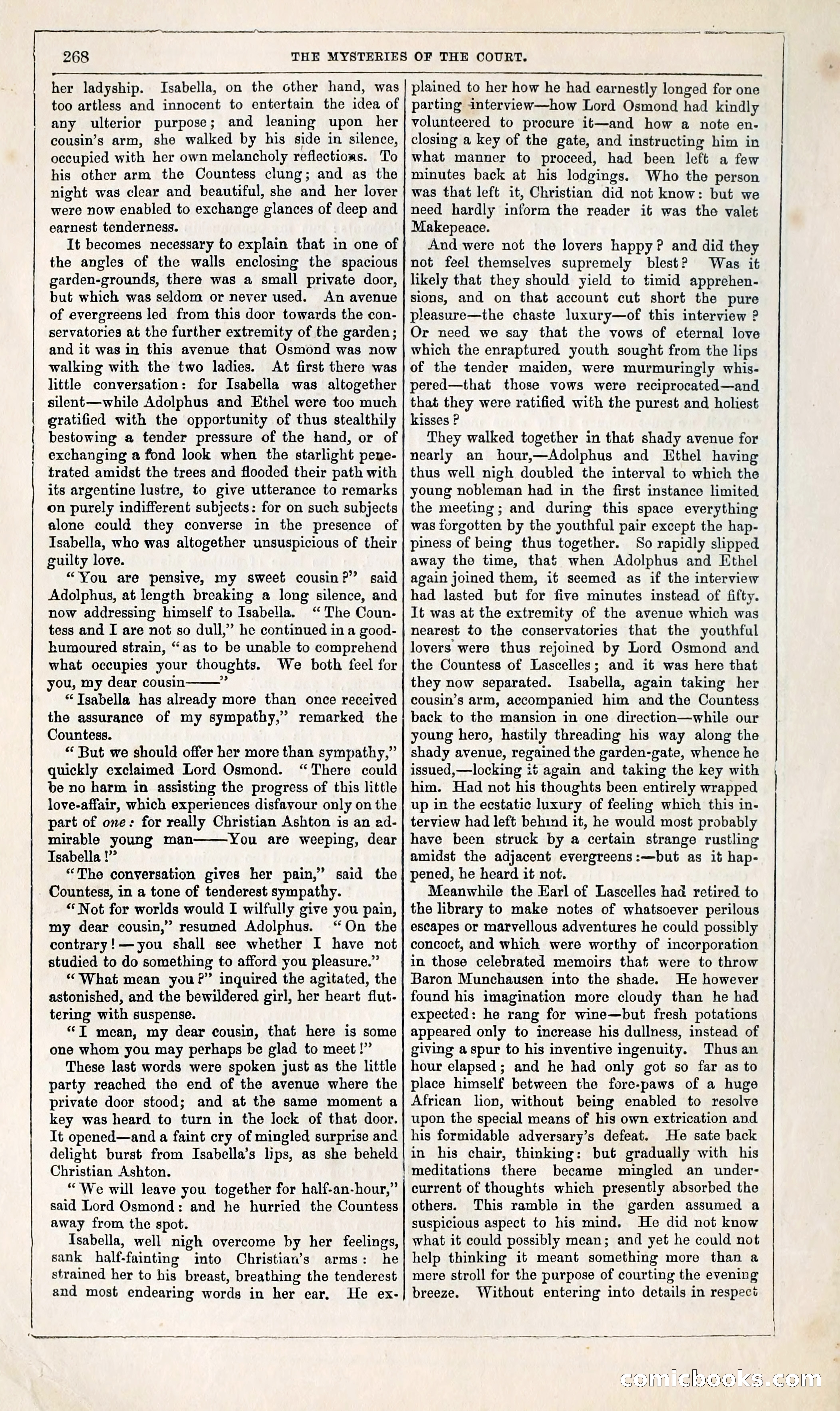
A restored page from Penny Dreadfuls, 1849. Page through the whole issue in the reader above.
📄 Transcribed text from this page (OCR, searchable)
Machine-transcribed from the original scan — historical spelling and the odd misread are preserved.
her ladyship. Isabella, on the other hand, was too artless and innocent to entertain the idea of any ulterior purpose; and leaning upon her cousin’s arm, she walked by his side in silence, occupied with her own melancholy reflectioas. ‘To his other arm the Countess clung; and as the night was clear and beautiful, she and her lover were now enabled to exchange glances of deep and earnest tenderness. It becomes necessary to explain that in one of the angles of the walls enclosing the spacious garden-grounds, there was a small private door, but which was seldom or never used. An avenue of evergreens led from this door towards the con- servatories at the further extremity of the garden; and it was in this avenue that Osmond was now walking with the two ladies. At first there was little conversation: for Isabella was altogether silent—while Adolphus and Ethel were too much gratified with the opportunity of thus stealthily bestowing a tender pressure of the hand, or of exchanging a fond look when the starlight pene- trated amidst the trees and flooded their path with its argentine lustre, to give utterance to remarks on purely indifferent subjects: for on such subjects alone could they converse in the presence of Isabella, who was altogether unsuspicious of their guilty love. “You are pensive, my sweet cousin?” said Adolphus, at length breaking a long silence, and now addressing himself to Isabella. ‘‘ The Coun- tess and I are not so dull,” he continued in a good- humoured strain, “as to be unable to comprehend what occupies your thoughts. We both feel for you, my dear cousin Hi “Isabella has already more than once received the assurance of my sympathy,’ remarked the Countess. “‘ But we should offer her more than sympathy,” quickly exclaimed Lord Osmond. “There could be no harm in assisting the progress of this little love-affair, which experiences disfavour only on the part of one: for really Christian Ashton is an ad- mirable young man You are weeping, dear Isabella |” “The conversation gives her pain,’ said the Countess, in a tone of tenderest sympathy. “Not for worlds would I wilfully give you pain, my dear cousin,” resumed Adolphus. ‘On the contrary!— you shall see whether I have not studied to do something to afford you pleasure.” “What mean you?” inquired the agitated, the astonished, and the bewildered girl, her heart flut- tering with suspense. “T mean, my dear cousin, that here is some one whom you may perhaps be glad to meet!” These last words were spoken just as the little party reached the end of the avenue where the private door stood; and at the same moment a key was heard to turn in the lock of that door. It opened—and a faint cry of mingled surprise and delight burst from Isabella’s lips, as she beheld Christian Ashton. “We will leave you together for half-an-hour,” said Lord Osmond: and he hurried the Countess away from the spot. Isabella, well nigh overcome by her feelings, sank half-fainting imto Christian’s arms: he strained her to his breast, breathing the tenderest and most endearing words in her ear, He ex- a ee ere Se Oe THE MYSTERIES OF THE COURT. plained to her how he had earnestly longed for one parting interview—how Lord Osmond had kindly volunteered to procure it—and how a note en- closing a key of the gate, and instructing him in what manner to proceed, had been left a few minutes back at his lodgings. Who the person was that left it, Christian did not know: but we need hardly inform the reader it was the valet Makepeace. And were not the lovers happy? and did they not feel themselves supremely blest? Was it likely that they should yield to timid apprehen- sions, and on that account cut short the pure pleasure—the chaste luxury—of this interview Or need we say that the vows of eternal love which the enraptured youth sought from the lips of the tender maiden, were murmuringly whis- pered—that those vows were reciprocated—and that they were ratified with the purest and holiest kisses P They walked together in that shady avenue for nearly an hour,—Adolphus and Ethel having thus well nigh doubled the interval to which the young nobleman had in the first instance limited the meeting; and during this space everything was forgotten by the youthful pair except the hap- piness of being thus together. So rapidly slipped away the time, that when Adolphus and Ethel again joined them, if seemed as if the interview had lasted but for five minutes instead of fifty. It was at the extremity of the avenue which was nearest to the conservatories that the youthful lovers were thus rejoined by Lord Osmond and the Countess of Lascelles; and it was here that they now separated. Isabella, again taking her cousin’s arm, accompanied him and the Countess back to the mansion in one direction—while our young hero, hastily threading his way along the shady avenue, regained the garden-gate, whence he issued,—locking it again and taking the key with him. Had not his thoughts been entirely wrapped up in the ecstatic luxury of feeling which this in- terview had left behind it, he would most probably have been struck by a certain strange rustling amidst the adjacent evergreens:—but as it hap- pened, he heard it not. Meanwhile the Earl of Lascelles had retired to the library to make notes of whatsoever perilous escapes or marvellous adventures he could possibly concoct, and which were worthy of incorporation in those celebrated memoirs that were to throw Baron Munchausen into the shade. He however found his imagination more cloudy than he had expected: he rang for wine—but fresh potations appeared only to increase his dullness, instead of giving aspur to his inventive ingenuity. Thus an hour elapsed; and he had only got so far as to place himself between the fore-paws of a huge African lion, without being enabled to resolve upon the special means of his own extrication and his formidable adversary’s defeat. He sate back in his chair, thinking: but gradually with his meditations there became mingled an under- | current of thoughts which presently absorbed the others. This ramble in the garden assumed a suspicious aspect to his mind. He did not know what it could possibly mean; and yet he could not help thinking it meant something more than a mere stroll for the purpose of courting the evening breeze. Without entering into details in respect JOO