
Penny Dreadfuls, 1849 · page 277 of 394
The Mysteries of the Court of London — page 277: what you’re looking at
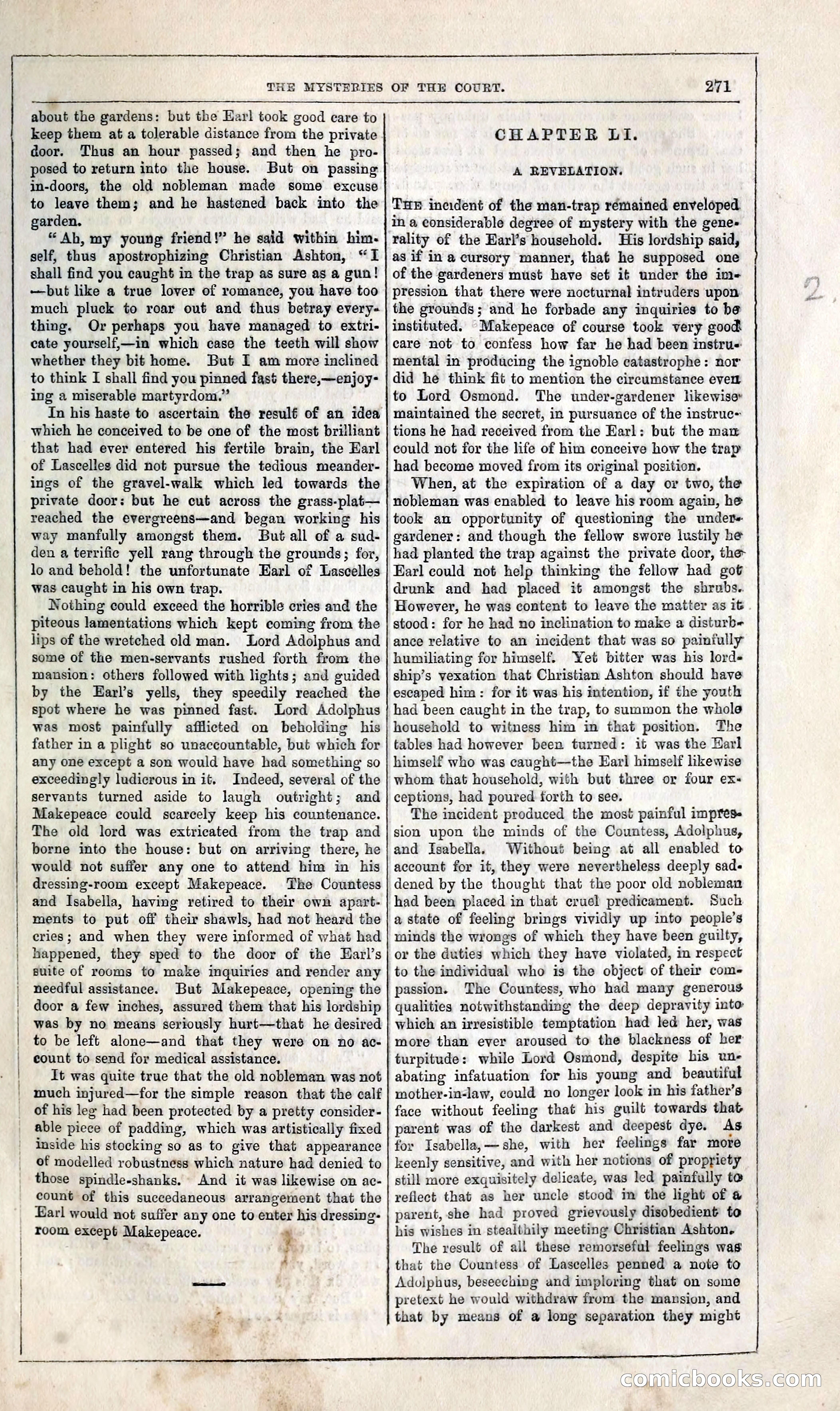
A restored page from Penny Dreadfuls, 1849. Page through the whole issue in the reader above.
📄 Transcribed text from this page (OCR, searchable)
Machine-transcribed from the original scan — historical spelling and the odd misread are preserved.
—_--—_—- ---- - + > - - C—O THE MYSTERIES OF THE about the gardens: but the Earl took good care to keep them at a tolerable distance from the private door. Thus an hour passed; and then he pro- posed to return into the house. in-doors, the old nobleman made some excuse to leave them; and he hastened back into the garden. “Ah, my young friend!” he said within him. self, thus apostrophizing Christian Ashton, “I shall find you caught in the trap as sure as a gun! —but like a true lover of romance, you have too much pluck to roar out and thus betray every- thing. Or perhaps you have managed to extri- cate yourself,—in which case the teeth will show whether they bit home. But I am more inclined to think I shall find you pinned fast there,—enjoy- ing a miserable martyrdom.” In his haste to ascertain the resulé of an idea which he conceived to be one of the most brilliant that had ever entered his fertile brain, the Earl of Lascelles did not pursue the tedious meander- ings of the gravel-walk which led towards the private door: but he cut across the grass-plat— reached the evergreens—and began working his way manfully amongst them. But all of a sud- den a terrific yell rang through the grounds; for, lo and behold! the unfortunate Earl of Lascelles was caught in his own trap. Nothing could exceed the horrible cries and the piteous lamentations which kept coming from the lips of the wretched old man. Lord Adolphus and some of the men-servants rushed forth from the mansion: others followed with lights; and guided by the Earl’s yells, they speedily reached the spot where he was pinned fast. Lord Adolphus was most painfully afflicted on beholding his father in a plight so unaccountable, but which for any one except a son would have had something so exceedingly ludicrous in it. Indeed, several of the servants turned aside to laugh outright; and Makepeace could scarcely keep his countenance. The old lord was extricated from the trap and borne into the house: but on arriving there, he would not suffer any one to attend him in his dressing-room except Makepeace. The Countess and Isabella, having retired to their own apart- ments to put off their shawls, had not heard the eries; and when they were informed of what had happened, they sped to the door of the Harl’s suite of rooms to make inquiries and render any needful assistance. But Makepeace, opening the door a few inches, assured them that his lordship was by no means seriously hurt—that he desired to be left alone—and that they were on no ac- count to send for medical assistance. It was quite true that the old nobleman was not much injured—for the simple reason that the calf of his leg had been protected by a pretty consider- able piece of padding, which was artistically fixed inside his stecking so as to give that appearance of modelled robustness which nature had denied to those spindle-shanks. And it was likewise on ac- count of this succedaneous arrangement that the Earl would not suffer any one to enter his dressing- room except Makepeace. % ‘4 s : 82 But on passing | COURT. 271 CHAPTER Li. A REVELATION. THE incident of the man-trap rémained enveloped in a considerable degree of mystery with the gene- rality of the Harl’s household. His lordship said, as if in a cursory manner, that he supposed one of the gardeners must have set it under the im- pression that there were nocturnal intruders upon the grounds; and he forbade any inquiries to be instituted. Makepeace of course took very good eare not to confess how far he had been instru« mental in producing the ignoble catastrophe: nor did he think fit to mention the cireumstance even to Lord Osmond. The under-gardener likewise maintained the secret, in pursuance of the instruc- tions he had received from the Karl: but the maz could not for the life of him conceive how the trap had become moved from its original position. When, at the expiration of a day ov two, the nobleman was enabled to leave his room again, he took an opportunity of questioning the under+ gardener: and though the fellow swore lustily he had planted the trap against the private door, the Earl could not help thinking the fellow had got drunk and had placed it amongst the shrubs. However, he was content to leave the matter as it stood: for he had no inclination to make a disturb ance relative to an incident that was so painiully humiliating for himself. Yet bitter was his lords ship’s vexation that Christian Ashton should have escaped him : for it was his intention, if the youth had been caught in the trap, to summon the whole household to witness him in that position. The tables had however been turned: it was the Harl himself who was caught—the Earl himself likewise whom that household, with but three or four ex- ceptions, had poured forth to see. The incident produced the most painful impres- sion upon the minds of the Countess, Adolphus, and Isabella. Without being at all enabled to account for it, they were nevertheless deeply sad- dened by the thought that the poor old nobleman had been placed in that cruel predicament. Such a state of feeling brings vividly up into people’s minds the wrongs of which they have been guilty, or the duties which they have violated, im respect to the individual who is the object of their come passion. The Countess, who had many generous qualities notwithstanding the deep depravity into which an irresistible temptation had led her, was more than ever aroused to the blackness of her turpitude: while Lord Osmond, despite his un- abating infatuation for his young and beautiful mother-in-law, could no longer look in his father’s face without feeling that his guilt towards that parent was of the darkest and deepest dye. As for Isabella,—she, with her feelings far more keenly sensitive, and with her notions of propriety still more exquisitely delicate, was led painfully to reflect that as her uncle stcod m the light of 4 parent, she had proved grievously disobedient to his wishes in stealthily meeting Christian Ashton. The result of all these remorseful feelings was that the Countess of Lascelles penned a note to Adolphus, beseeching and imploring that on some pretext he would withdraw from the mansion, and that by means of a long separation they might _ er rn PE CLE LA TCO (COLMIELACC) Cc S (66)