
Penny Dreadfuls, 1849 · page 278 of 394
The Mysteries of the Court of London — page 278: what you’re looking at
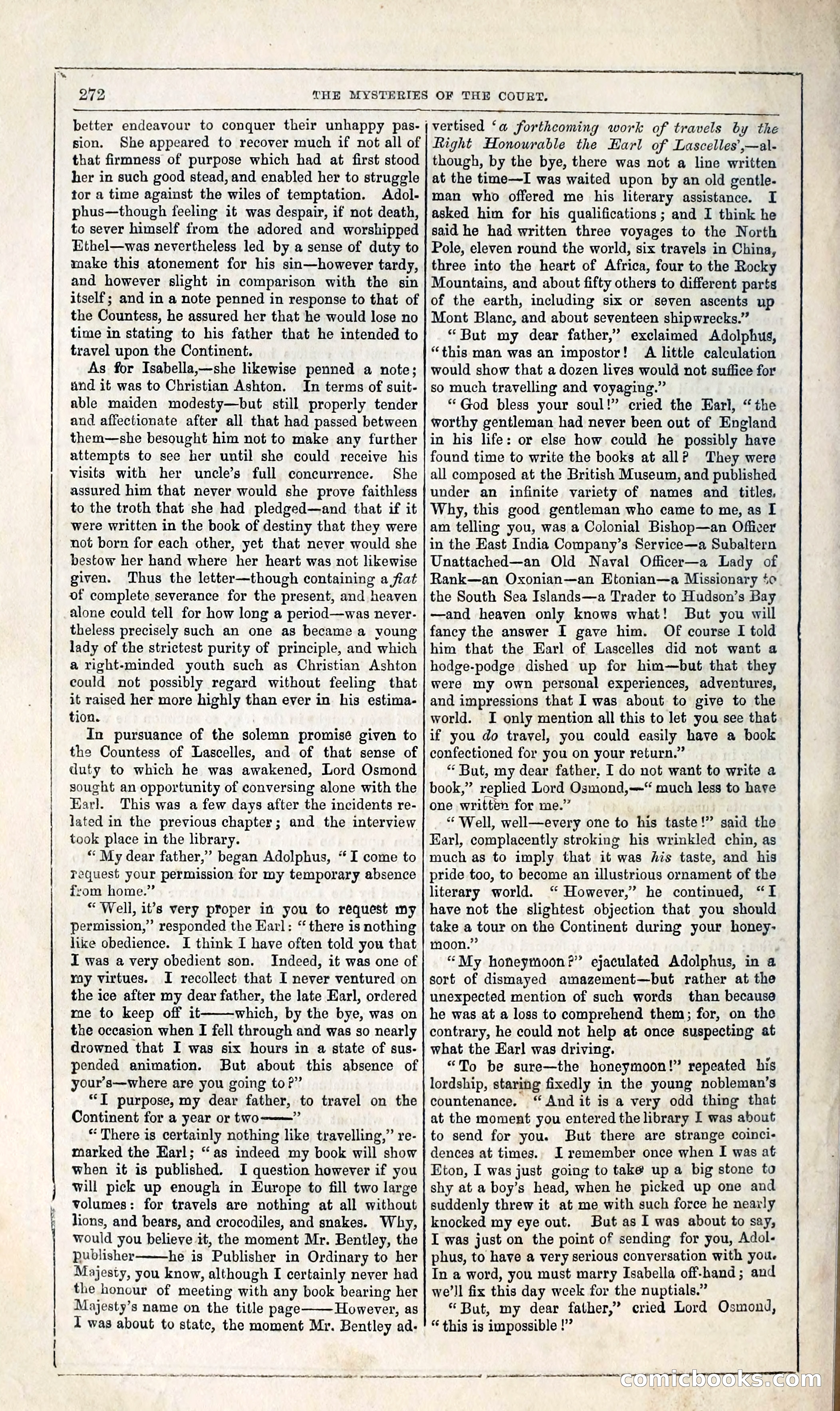
A restored page from Penny Dreadfuls, 1849. Page through the whole issue in the reader above.
📄 Transcribed text from this page (OCR, searchable)
Machine-transcribed from the original scan — historical spelling and the odd misread are preserved.
a Te ‘* -~_—_--- 272 better endeavour to conquer their unhappy pas- j sion. She appeared to recover much if not all of that firmness of purpose which had at first stood her in such good stead, and enabled her to struggle tor a time against the wiles of temptation. Adol- phus—though feeling it was despair, if not death, to sever himself from the adored and worshipped Ethel—was nevertheless led by a sense of duty to make this atonement for his sin—however tardy, and however slight in comparison with the sin itself; and in a note penned in response to that of the Countess, he assured her that he would lose no time in stating to his father that he intended to travel upon the Continent. As for Isabella,—she likewise penned a note; sind it was to Christian Ashton. In terms of suit- able maiden modesty—but still properly tender and affectionate after all that had passed between them—she besought him not to make any further attempts to see her until she could receive his visits with her uncle’s full concurrence. She assured him that never would she prove faithless to the troth that she had pledged—and that if it were written in the book of destiny that they were not born for each other, yet that never would she bestow her hand where her heart was not likewise given. Thus the letter—though containing a fiat of complete severance for the present, and heaven alone could tell for how long a period—was never- theless precisely such an one as became a young lady of the strictest purity of principle, and which a right-minded youth such as Christian Ashton could not possibly regard without feeling that it raised her more highly than ever in his estima- tion. ) In pursuance of the solemn promisé given to the Countess of Lascelles, and of that sense of duty to which he was awakened, Lord Osmond sought an opportunity of conversing alone with the Earl. This was a few days after the incidents re- jated in the previous chapter; and the interview took place in the library. “‘ My dear father,’ began Adolphus, “I come to request your permission for my temporary absence from home.” “Well, it’s very pfoper in you to request my permission,” responded the Earl: “ there is nothing like obedience. I think I have often told you that I was a very obedient son. Indeed, it was one of roy virtues. I recollect that I never ventured on the ice after my dear father, the late Earl, ordered me to keep off it which, by the bye, was on the occasion when I fell through and was so nearly drowned that I was six hours in a state of sus- pended animation. But about this absence of your’s—where are you going to?” *“T purpose, my dear father, to travel on the Continent for a year or two i, * There is certainly nothing like travelling,” re- marked the Harl; “as indeed my book will show when it is published. I question however if you will pick up enough in Europe to fill two large volumes: for travels are nothing at all without lions, and bears, and crocodiles, and snakes. Why, would you believe it, the moment Mr. Bentley, the publisher he is Publisher in Ordinary to her Majesty, you know, although I certainly never had the honour of meeting with any book bearing her Majesty’s name on the title page However, as I was about to state, the moment Mr. Bentley ad- oe et ee eee ot ee THE MYSTERIES OF THE COURT. PRS Gt ee COMIC. vertised ‘a forthcoming work of travels by the Right Honourable the Earl of Lascelles’,—al- though, by the bye, there was not a line written at the time—I was waited upon by an old gentle. man who offered me his literary assistance. I asked him for his qualifications ; and I think he said he had written three voyages to the North Pole, eleven round the world, six travels in China, three into the heart of Africa, four to the Rocky Mountains, and about fifty others to different parts of the earth, including six or seven ascents up Mont Blanc, and about seventeen shipwrecks.” “But my dear father,” exclaimed Adolphus, “this man was an impostor! A little calculation would show that a dozen lives would not suffice for so much travelling and voyaging.” “God bless your soul!” cried the Earl, “the worthy gentleman had never been out of England in his life: or else how could he possibly have found time to write the books at all? They were all composed at the British Museum, and published under an infinite variety of names and titles, Why, this good gentleman who came to me, as I am telling you, was a Colonial Bishop—an Officer in the East India Company’s Service—a Subaltern Unattached—an Old Naval Officer—a Lady of Rank—an Oxonian—an Etonian—a Missionary to the South Sea Islands—a Trader to Hudson’s Bay —and heaven only knows what! But you will fancy the answer I gave him. Of course I told him that the Earl of Lascelles did not want a hodge-podge dished up for him—but that they were my own personal experiences, adventures, and impressions that I was about to give to the world. I only mention all this to let you see that if you do travel, you could easily have a book confectioned for you on your return.” “ But, my dear father. I do not want to write a book,” replied Lord Osmond,“ much less to hare one written for me.” “ Well, well—every one to his taste!” said the Earl, complacently stroking his wrinkled chin, as much as to imply that it was fis taste, and his pride too, to become an illustrious ornament of the literary world. ‘“ However,” he continued, “I have not the slightest objection that you should take a tour on the Continent during your honey- moon.” “My honeymoon?” ejaculated Adolphus, in a sort of dismayed amazement—but rather at the unexpected mention of such words than because he was at a loss to comprehend them; for, on the contrary, he could not help at once suspecting at what the Karl was driving. “To be sure—the honeymoon!” repeated his lordship, staring fixedly in the young nobleman’s countenance. “ And it is a very odd thing that at the moment you entered the library I was about to send for you. But there are strange coinci- dences at times. I remember once when I was at Eton, I was just going to take up a big stone to shy at a boy’s head, when he picked up one and suddenly threw it at me with such force he nearly knocked my eye out. But as I was about to say, I was just on the point of sending for you, Adol- phus, to have a very serious conversation with you. In a word, you must marry Isabella off-hand; and we’ll fix this day week for the nuptials.” “But, my dear father,’ cried Lord Osmond, “this is impossible !’” VOW KS (co)