
Penny Dreadfuls, 1849 · page 347 of 394
The Mysteries of the Court of London — page 347: what you’re looking at
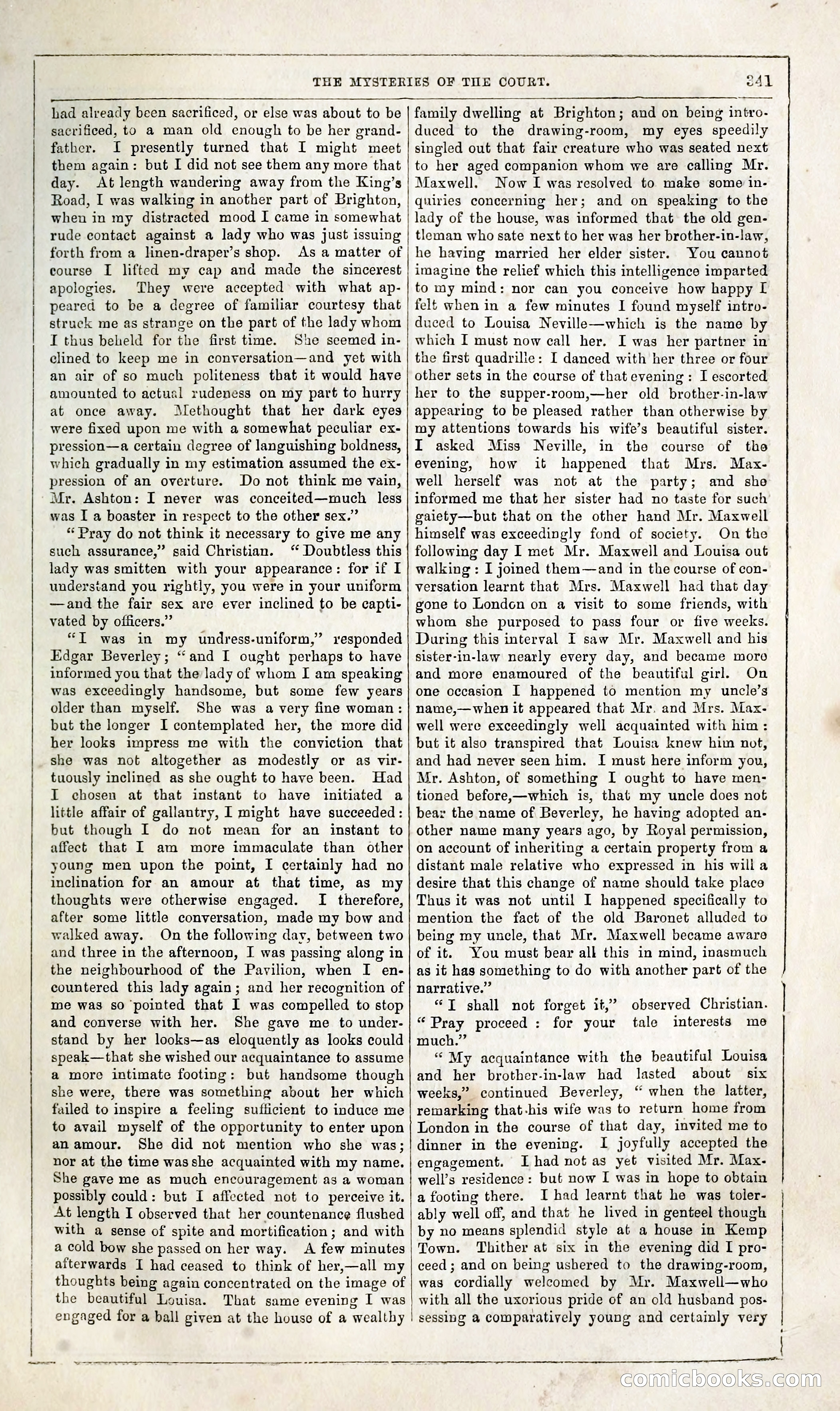
A restored page from Penny Dreadfuls, 1849. Page through the whole issue in the reader above.
📄 Transcribed text from this page (OCR, searchable)
Machine-transcribed from the original scan — historical spelling and the odd misread are preserved.
LL i i SS i ss i Pe a THE MYSTERIES OF THE COURT. ee had already been sacrificed, or else was about to be sacrificed, to a man old enough to be her grand- father. I presently turned that I might meet them again: but I did not see them any more that day. At length wandering away from the King’s Road, I was walking in another part of Brighton, when in my distracted mood I came in somewhat rude contact against a lady who was just issuing forth from a linen-draper’s shop. As a matter of course I lifted my cap and made the sincerest apologies. They were accepted with what ap- peared to be a degree of familiar courtesy that struck me as strange on the part of the lady whom T thus beheld for the first time. She seemed in- clined to keep me in conversation—and yet with an air of so much politeness tbat it would have amounted to actual rudeness on my part to hurry at once away. Methought that her dark eyes were fixed upon me with a somewhat peculiar ex- pression—a certain degree of languishing boldness, which gradually in my estimation assumed the ex- pression of an overture. Do not think me vain, Mr. Ashton: I never was conceited—much less was I a boaster in respect to the other sex.” “Pray do not think it necessary to give me any such assurance,” said Christian. ‘ Doubtless this lady was smitten with your appearance: for if I understand you rightly, you were in your uniform —and the fair sex are ever inclined to be capti- vated by officers.” “IT was in my undress-uniform,”’ responded Edgar Beverley; “and I ought perhaps to have informed you that the lady of whom I am speaking was exceedingly handsome, but some few years older than myself. She was a very fine woman: but the longer I contemplated her, the more did her looks impress me with the conviction that she was not altogether as modestly or as vir- tuously inclined as she ought to have been. Had I chosen at that instant to have initiated a little affair of gallantry, I might have succeeded : but though I do not mean for an instant to affect that I am more immaculate than other young men upon the point, I certainly had no inclination for an amour at that time, as my thoughts were otherwise engaged. I therefore, after some little conversation, made my bow and walked away. On the following dav, between two and three in the afternoon, I was passing along in the neighbourhood of the Pavilion, when I en- countered this lady again; and her recognition of me was so pointed that I was compelled to stop and converse with her. She gave me to under- stand by her looks—as eloquently as looks could speak—that she wished our acquaintance to assume a more intimate footing: but handsome though she were, there was something about her which failed to inspire a feeling suflicient to induce me to avail myself of the opportunity to enter upon an amour. She did not mention who she was; nor at the time wasshe acquainted with my name. She gave me as much encouragement as a woman possibly could: but I affected not to perceive it. At length I observed that her countenance flushed with a sense of spite and mortification; and with a cold bow she passed on her way. A few minutes afterwards I had ceased to think of her,—all my thoughts being again concentrated on the image of the beautiful Louisa. That same evening I was engaged for a ball given at the house of a wealthy family dwelling at Brighton; and on being intro- duced to the drawing-room, my eyes speedily singled out that fair creature who was seated next to her aged companion whom we are calling Mr. Maxwell. Now I was resolved to make some in- qiuiries concerning her; and on speaking to the lady of the house, was informed that the old gen- tleman who sate next to her was her brother-in-law, he having married her elder sister. You cannot imagine the relief which this intelligence imparted to my mind: nor can you conceive how happy I felt when in a few minutes I found myself intro- duced to Louisa Neville—which is the name by which I must now call her. I was her partner in the first quadrilie: I danced with her three or four other sets in the course of that evening : I escorted her to the supper-room,—her old brother-in-law appearing to be pleased rather than otherwise by my attentions towards his wife’s beautiful sister. I asked Miss Neville, in the course of tho evening, how it happened that Mrs. Max- well herself was not at the party; and she informed me that her sister had no taste for such gaiety—but that on the other hand Mr. Maxwell himself was exceedingly fond of society. On the following day I met Mr. Maxwell and Louisa out walking : I joined them—and in the course of con- versation learnt that Mrs. Maxwell had that day gone to London on a visit to some friends, with whom she purposed to pass four or five weeks. During this interval I saw Mr. Maxwell and his sister-in-law nearly every day, and became moro and more enamoured of the beautiful girl. On one occasion I happened to mention my uncle’s name,— when it appeared that Mr. and Mrs. Max- well were exceedingly well acquainted with him: but it also transpired that Louisa knew him not, and had never seen him. I must here inform you, Mr. Ashton, of something I ought to have men- tioned before,—which is, that my uncle does not bear the name of Beverley, he having adopted an- other name many years ago, by Royal permission, on account of inheriting a certain property from a distant male relative who expressed in his will a desire that this change of name should take place Thus it was not until I happened specifically to mention the fact of the old Baronet alluded to being my uncle, that Mr. Maxwell became aware of it. You must bear all this in mind, inasmuch as it has something to do with another part of the narrative.” “JT shall not forget it,’ observed Christian. “Pray proceed : for your tale interests me much.” “ My acquaintance with the beautiful Louisa and her brother-in-law had lasted about six weeks,” continued Beverley, “ when the latter, remarking that-his wife was to return home from London in the course of that day, invited me to dinner in the evening. I joyfully accepted the engagement. Ihad not as yet visited Mr. Max- well’s residence: but now I was in hope to obtain a footing there. I had learnt that he was toler- ably well off, and that he lived in genteel though by no means splendid style at a house in Kemp Town. Thither at six in the evening did I pro- ceed ; and on being ushered to the drawing-room, was cordially welcomed by Mr. Maxwell—who with all the uxorious pride of an old husband pos- sessing a comparatively young and certainly very a ee > So = 0)(0)(0) (C(O) im S | (0)