
Penny Dreadfuls, 1849 · page 348 of 394
The Mysteries of the Court of London — page 348: what you’re looking at
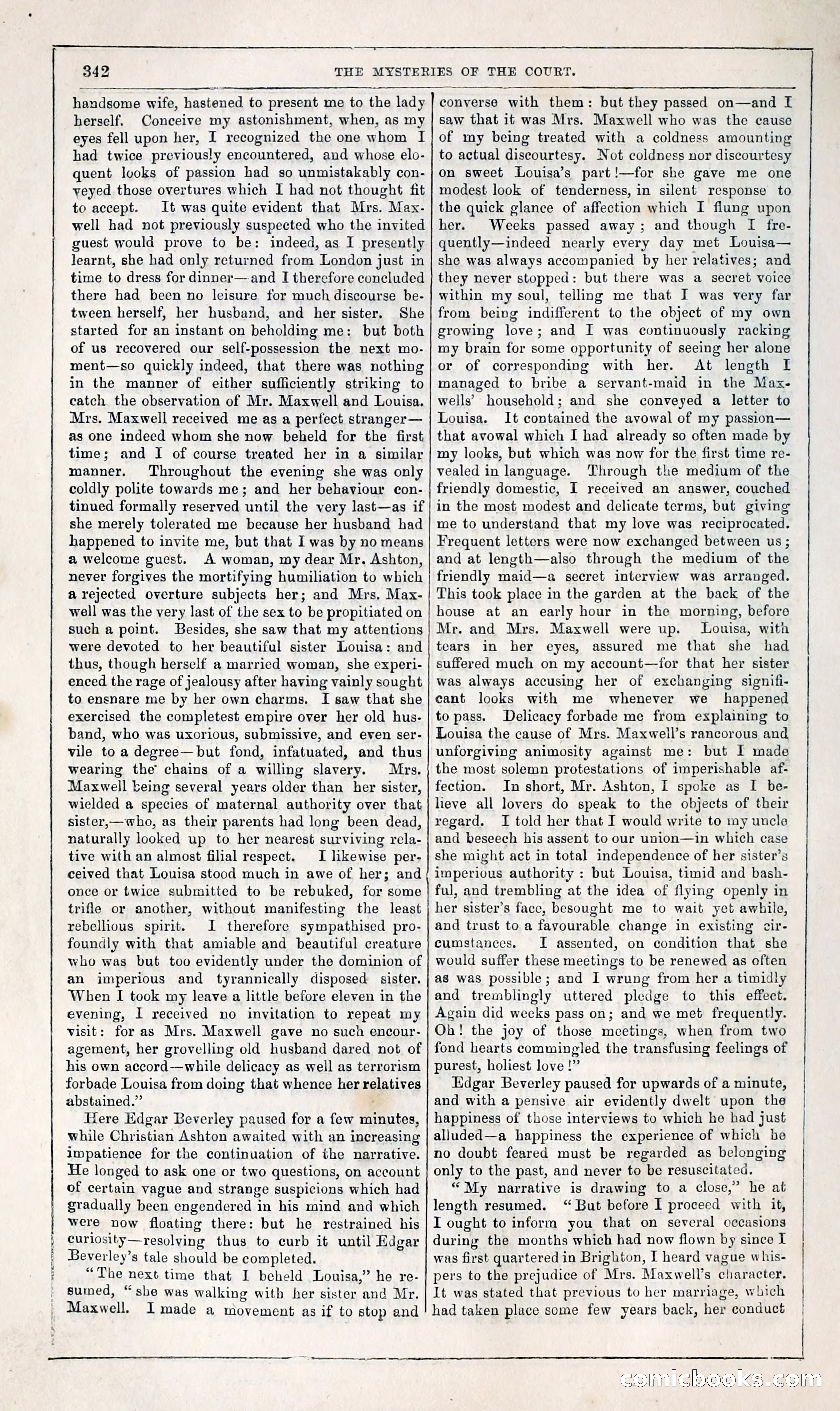
A restored page from Penny Dreadfuls, 1849. Page through the whole issue in the reader above.
📄 Transcribed text from this page (OCR, searchable)
Machine-transcribed from the original scan — historical spelling and the odd misread are preserved.
Se ie ae are 342 handsome wife, hastened to present me to the lady herself. Conceive my astonishment, when, as my eyes fell upon her, I recognized the one whom I had twice previously encountered, aud whose elo- quent looks of passion had so unmistakably con- veyed those overtures which I had not thought fit to accept. It was quite evident that Mrs. Max- well had not previously suspected who the invited guest would prove to be: indeed, as I presently learnt, she had only returned from London just in time to dress for dinner—and I therefore concluded there had been no leisure for much discourse be- tween herself, her husband, and her sister. She started for an instant on beholding me: but both of us recovered our self-possession the next mo- ment—so quickly indeed, that there was nothing in the manner of either sufficiently striking to catch the observation of Mr. Maxwell and Louisa. Mrs. Maxwell received me as a perfect stranger— as one indeed whom she now beheld for the first time; and I of course treated her in a similar manner. Throughout the evening she was only coldly polite towards me; and her behaviour con- tinued formally reserved until the very last—as if she merely tolerated me because her husband had happened to invite me, but that I was by no means a welcome guest. A woman, my dear Mr. Ashton, never forgives the mortifying humiliation to which a rejected overture subjects her; and Mrs, Max- well was the very last of the sex to be propitiated on such a point. Besides, she saw that my attentions were devoted to her beautiful sister Louisa: and thus, though herself a married woman, she experi- enced the rage of jealousy after having vainly sought to ensnare me by her own charms. I saw that she exercised the completest empire over her old hus- band, who was uxorious, submissive, and even ser: vile to a degree—but fond, infatuated, and thus wearing the’ chains of a willing slavery. Mrs. Maxwell being several years older than her sister, wielded a species of maternal authority over that sister,—who, as their parents had long been dead, naturally looked up to her nearest surviving rela- tive with an almost filial respect. I likewise per- ceived that Louisa stood much in awe of her; and once or twice submitted to be rebuked, for some trifle or another, without manifesting the least rebellious spirit. JI therefore sympathised pro- foundly with that amiable and beautiful creature who was but too evidently under the dominion of an imperious and tyrannically disposed sister. When I took my leave a little before eleven in the evening, I received no invitation to repeat my visit: for as Mrs. Maxwell gave no such encour- agement, her grovelling old husband dared not of his own accord—while delicacy as well as terrorism forbade Louisa from doing that whence her relatives abstained.” Here Edgar Beverley paused for a few minutes, while Christian Ashton awaited with an increasing impatience for the continuation of the narrative. He longed to ask one or two questions, on account of certain vague and strange suspicions which had gradually been engendered in his mind and which were now floating there: but he restrained his curlosity—resolying thus to curb it until Edgar Beverley’s tale should be completed. “The next time that I beheld Louisa,” he re- sumed, “she was walking witb her sister and Mr. Maxwell. I made a movement as if to stop and THE MYSTERIES OF THE COURT. converse with them: but they passed on—and I saw that it was Mrs. Maxwell who was the cause of my being treated with a coldness amounting to actual discourtesy. Not coldness nor discourtesy on sweet Louisa’s part!—for she gave me one modest look of tenderness, in silent response to the quick glance of affection which I flung upon her. Weeks passed away; and though [I fre- quently—indeed nearly every day met Louisa— she was always accompanied by her relatives; and they never stopped: but there was a secret voice within my soul, telling me that I was very far from being indifferent to the object of my own growing love; and I was continuously racking my brain for some opportunity of seeing her alone or of corresponding with her. At length LI managed to bribe a servant-maid in the Max- wells’ household; and she conveyed a letter to Louisa. It contained the avowal of my passion— that avowal which I had already so often made by my looks, but which was now for the first time re- vealed in language. Through the medium of the friendly domestic, I received an answer, couched in the most modest and delicate terms, but giving me to understand that my love was reciprocated. Frequent letters were now exchanged between us ; and at length—also through the medium of the friendly maid—a secret interview was arranged. This took place in the garden at the back of the house at an early hour in the morning, before Mr. and Mrs. Maxwell were up. Louisa, with tears in her eyes, assured me that she had suffered much on my account—for that her sister was always accusing her of exchanging signifi- cant looks with me whenever we _ happened to pass. Delicacy forbade me from explaining to Louisa the cause of Mrs. Maxwell’s rancorous and unforgiving animosity against me: but I made the most solemn protestations of imperishable af- fection. In short, Mr. Ashton, I spoke as I be- lieve all lovers do speak to the objects of their regard. I told her that I would write to my uncle and beseech his assent to our union—in which case she might act in total independence of her sister’s imperious authority : but Louisa, timid and bash- ful, and trembling at the idea of flying openly in her sister’s face, besought me to wait yet awhile, and trust to a favourable change in existing cir- cumstances. I assented, on condition that she would suffer these meetings to be renewed as often as was possible; and I wrung from her a timidly and tremblingly uttered pledge to this effect. Again did weeks pass on; and we met frequently. Oh! the joy of those meetings, when from two fond hearts commingled the transfusing feelings of purest, holiest love !” Edgar Beverley paused for upwards of a minute, and with a pensive air evidently dwelt upon the happiness of those interviews to which he had just alluded—a happiness the experience of which be no doubt feared must be regarded as belonging only to the past, and never to be resuscitated. “My narrative is drawing to a close,” he at length resumed. “ But before I proceed with it, I ought to inform you that on several occasions during the months which had now flown by since I was first quartered in Brighton, I heard vague whis- pers to the prejudice of Mrs. Maxwell’s character. It was stated that previous to her marriage, which had taken place some few years back, her conduct a NOOKS CO) (C(O)