
Penny Dreadfuls, 1849 · page 37 of 394
The Mysteries of the Court of London — page 37: what you’re looking at
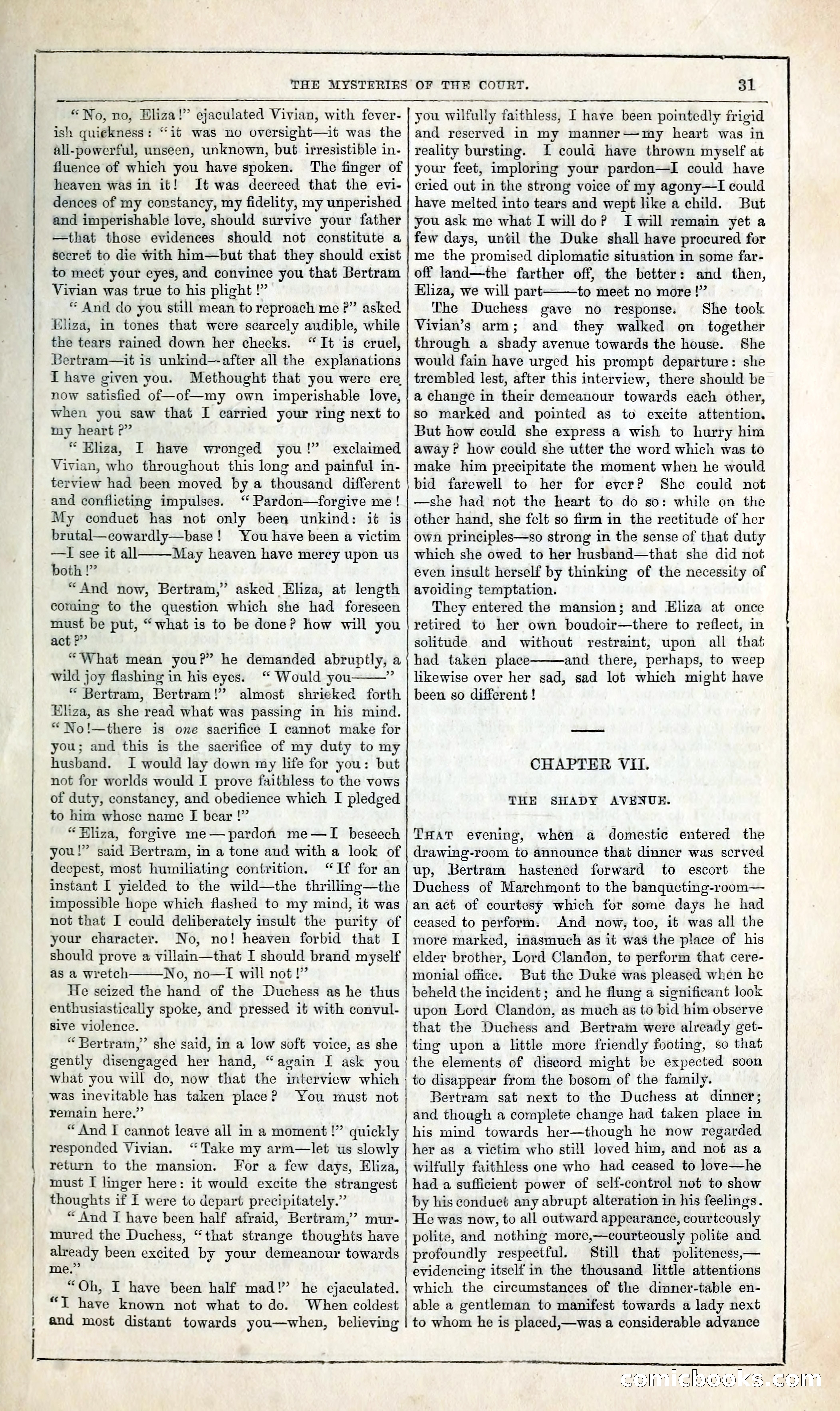
A restored page from Penny Dreadfuls, 1849. Page through the whole issue in the reader above.
📄 Transcribed text from this page (OCR, searchable)
Machine-transcribed from the original scan — historical spelling and the odd misread are preserved.
| THE MYSTERIES OF THE COURT. “No, no, Hliza!” ejaculated Vivian, with fever- ish quiekness: “‘it was no oversight—it was the all-powerful, unseen, unknown, but irresistible in- fluence of which you have spoken. The finger of heaven was in it! It was decreed that the evi- dences of my constancy, my fidelity, my unperished and imperishable love, should survive your father —that those evidences should not constitute a secret to die with him—but that they should exist to meet your eyes, and convince you that Bertram Vivian was true to his plight !” “ And do you still mean to reproach me ?” asked Eliza, in tones that were scarcely audible, while the tears rained down her cheeks. “It is cruel, Bertram—it is unkind—-after all the explanations IT have given you. Methought that you were ere now satisfied of—of—my own imperishable love, when you saw that I carried your ring next to my heart P” “Eliza, I have wronged you!” exclaimed Vivian, who throughout this long and painful in- terview had been moved by a thousand different and conflicting impulses. “ Pardon—forgive me! My conduct has not only been unkind: it is brutal—cowardly—base! You have been a victim —I see it all May heaven have mercy upon us both !” “And now, Bertram,” asked Eliza, at length coraing to the question which she had foreseen must be put, “what is to be done? how will you act P” “What mean you?” he demanded abruptly, a wild joy flashing in his eyes. “ Would you % “ Bertram, Bertram!” almost shrieked forth Eliza, as she read what was passing in his mind. “No!—there is one sacrifice I cannot make for you; and this is the sacrifice of my duty to my husband. I would lay down my life for you: but not for worlds would I prove faithless to the vows of duty, constancy, and obedience which I pledged to him whose name [J bear !” “liza, forgive me— pardon me—TI beseech you!” said Bertram, in a tone and with a look of deepest, most humiliating contrition. “If for an instant I yielded to the wild—the thrillmg—the impossible hope which flashed to my mind, it was not that I could deliberately insult the purity of your character. No, no! heaven forbid that I should prove a villain—that I should brand myself as a wretch No, no—I will not !” He seized the hand of the Duchess as he thus enthusiastically spoke, and pressed it with convul- Sive violence. “ Bertram,” she said, in a low soft voice, as she gently disengaged her hand, “again I ask you what you will do, now that the interview which was inevitable has taken place? You must not remain here.” “And I cannot leave all in a moment !” quickly responded Vivian. “Take my arm—let us slowly return to the mansion. For a few days, Eliza, must { linger here: it would excite the strangest thoughts if I were to depart precipitately.” “And I have been half afraid, Bertram,’? mur- mured the Duchess, “that strange thoughts have already been excited by your demeanour towards me.” “Oh, I have been half mad!” he ejaculated. “T have known not what todo. When coldest and most distant towards you—when, believing 1?? — 3L you wilfully faithless, I have been pointedly frigid and reserved in my manner—wmy heart was in reality bursting. I could have thrown myself at your feet, imploring your pardon—lI could have cried out in the strong voice of my agony—I could have melted into tears and wept like a child. But you ask me what I willdo?P Iwill remain yet a few days, until the Duke shall have procured for me the promised diplomatic situation in some far- off land—the farther off, the better: and then, Eliza, we will part to meet no more!” The Duchess gave no response. She took Vivian’s arm; and they walked on together through a shady avenue towards the house. She would fain have urged his prompt departure: she trembled lest, after this interview, there should be a change in their demeanour towards each other, so marked and pointed as to excite attention. But how could she express a wish to hurry him away? how could she utter the word which was to make him precipitate the moment when he would bid farewell to her for ever? She could not —she had not the heart to do so: while on the other hand, she felt so firm in the rectitude of her own principles—so strong in the sense of that duty which she owed to her husband—that she did not even insult herself by thinking of the necessity of avoiding temptation. They entered the mansion; and Eliza at once retired to her own boudoir—there to reflect, in solitude and without restraint, upon all that had taken place and there, perhaps, to weep likewise over her sad, sad lot which might have been so different ! CHAPTER VII. THE SHADY AVENUE. THatT evening, when a domestic entered the drawing-room to announce that dinner was served up, Bertram hastened forward to escort the Duchess of Marchmont to the banqueting-room— an act of courtesy which for some days he had ceased to perform: And now, too, it was all the more marked, inasmuch as it was the place of his elder brother, Lord Clandon, to perform that cere- monial office. But the Duke was pleased when he beheld the incident; and he flung a significant look upon Lord Clandon, as much as to bid him observe that the Duchess and Bertram were already get- ting upon a little more friendly footing, so that the elements of discord might be expected soon to disappear from the bosom of the family. Bertram sat next to the Duchess at dinner; and though a complete change had taken place in his mind towards her—though he now regarded her as a victim who still loved him, and not as a wilfully faithless one who had ceased to love—he had a sufficient power of self-control not to show by his conduct any abrupt alteration in his feelings. He was now, to all outward appearance, courteously polite, and nothing more,—courteously polite and profoundly respectful. Still that politeness,— evidencing itself in the thousand little attentions which the circumstances of the dinner-table en- able a gentleman to manifest towards a lady next to whom he is placed,—was a considerable advance (COLAMUCE NOOKS (C(O)