
Penny Dreadfuls, 1849 · page 38 of 394
The Mysteries of the Court of London — page 38: what you’re looking at
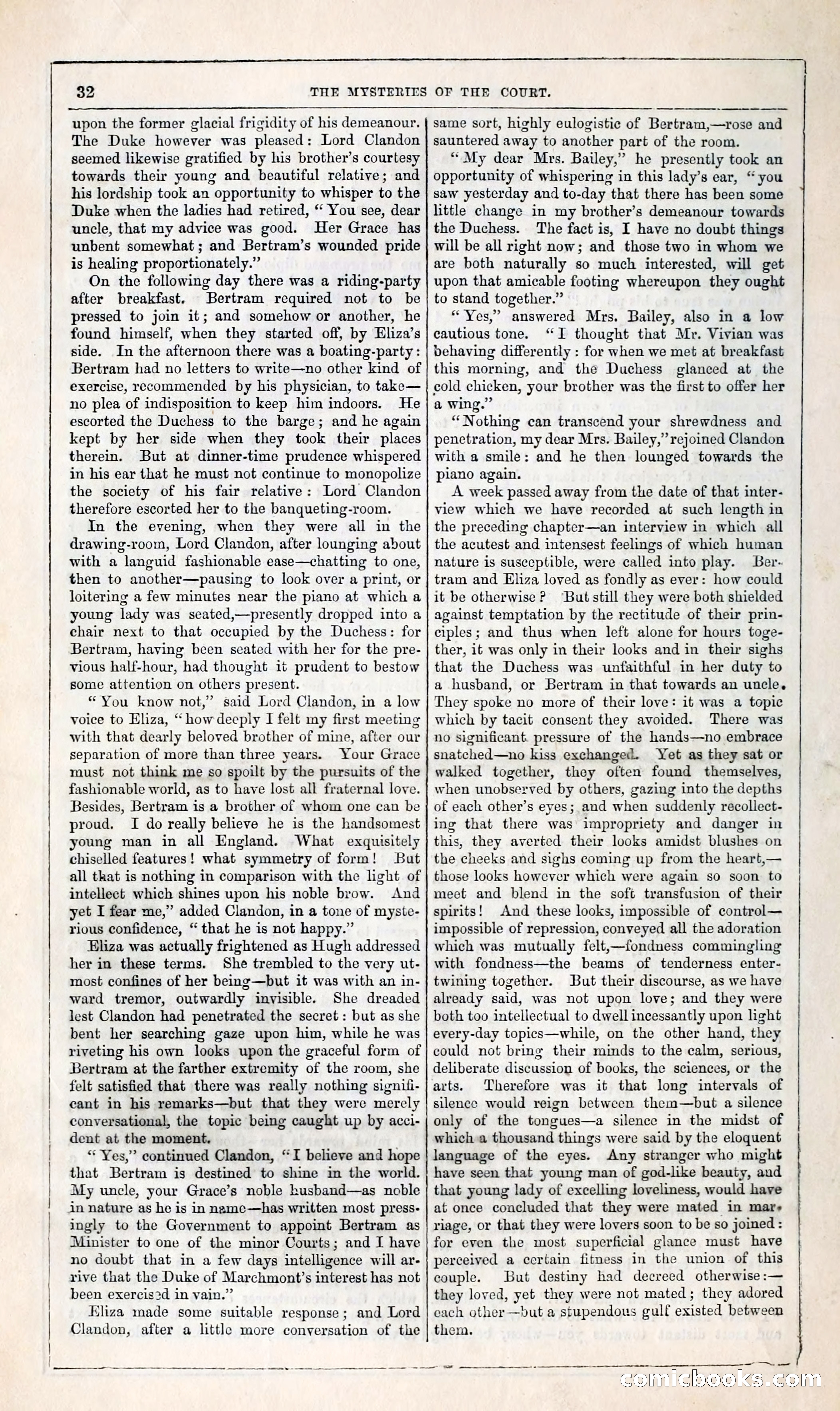
A restored page from Penny Dreadfuls, 1849. Page through the whole issue in the reader above.
📄 Transcribed text from this page (OCR, searchable)
Machine-transcribed from the original scan — historical spelling and the odd misread are preserved.
32 upon the former glacial frigidity of his demeanour. The Duke however was pleased: Lord Clandon seemed likewise gratified by his brother’s courtesy towards their young and beautiful relative; and his lordship took an opportunity to whisper to the Duke when the ladies had retired, “‘ You see, dear uncle, that my advice was good. Her Grace has unbent somewhat; and Bertram’s wounded pride is healing proportionately.” On the following day there was a riding-party after breakfast. Bertram required not to be pressed to join it; and somehow or another, he found himself, when they started off, by Eliza’s side. In the afternoon there was a boating-party : Bertram had no letters to write—no other kind of exercise, recommended by his physician, to take— no plea of indisposition to keep him indoors. He escorted the Duchess to the barge; and he again kept by her side when they took thei places therein. But at dinner-time prudence whispered in his ear that he must not continue to monopolize the society of his fair relative: Lord Clandon therefore escorted her to the banqueting-room. In the evening, when they were all in the drawing-room, Lord Clandon, after lounging about with a languid fashionable ease—chatting to one, then to another—pausing to look over a print, or loitering a few minutes near the piano at which a young lady was seated,—presently dropped into a chair next to that occupied by the Duchess: for Bertram, having been seated with her for the pre- vious half-hour, had thought 1¢ prudent to bestow some attention on others present. * You know not,” said Lord Clandon, in a low voice to Eliza, “ howdeeply I felt my first meeting with that dearly beloved brother of mine, after our separation of more than three years. Your Grace must not think me so spoilt by the pursuits of the fashionable world, as to have lost all fraternal love. Besides, Bertram is a brother of whom one can be proud. I do really believe he is the handsomest young man in all England. What exquisitely chiselled features! what symmetry of form! But all that is nothing in comparison with the light of intellect which shines upon his noble brow. And yet I fear me,” added Clandon, in a tone of myste- rious confidence, “ that he is not happy.” Eliza was actually frightened as Hugh addressed her in these terms. She trembled to the very ut- most confines of her being—but it was with an in- ward tremor, outwardly invisible. She dreaded lest Clandon had penetrated the secret: but as she bent her searching gaze upon him, while he was riveting his own looks upon the graceful form of Bertram at the farther extremity of the room, she felt satisfied that there was really nothing signifi- cant in his remarks—but that they were mercly conversational, the topic being caught up by acci- dent at the moment. “ Yes,” continued Clandon, “I believe and hope that Bertram is destined to shine in the world. My uncle, your Grace’s noble husband—as noble in nature as he is in name—has written most press- ingly to the Government to appoint Bertram as Minister to one of the minor Courts; and I have no doubt that in a few days intelligence will ar- rive that the Duke of Marchmont’s interest has not been exercis2d in vain.” Kliza made some suitable response; and Lord Clandon, after a little more conversation of the THE MYSTERIES OF THE COURT. same sort, highly eulogistic of Bertram,—rose and sauntered away to another part of the room. “My dear Mrs. Bailey,” he presently took an opportunity of whispering in this lady’s ear, “ you saw yesterday and to-day that there has been some little change in my brother’s demeanour towards the Duchess. The fact is, I have no doubt things will be all right now; and those two in whom we are both naturally so much interested, will get upon that amicable footing whereupon they ought to stand together.” “Yes,” answered Mrs. Bailey, also in a low cautious tone. “I thought that Mr. Vivian was behaving differently : for when we met at breakfast this morning, and the Duchess glanced at the cold chicken, your brother was the first to offer her a wing.” “Nothing can transcend your shrewdness and penetration, my dear Mrs. Bailey,” rejoined Clandon with a smile: and he then lounged towards the plano again. A week passed away from the date of that inter- view which we have recorded at such length in the preceding chapter—an interview in which all the acutest and intensest feelings of which human nature is susceptible, were called into play. Ber. tram and Eliza loved as fondly as ever: how could it be otherwise? ‘But still they were both shielded against temptation by the rectitude of their prin- ciples; and thus when left alone for hours toge- ther, it was only in their looks and in their sighs that the Duchess was unfaithful in her duty to a husband, or Bertram in that towards an uncle. They spoke no more of their love: it was a topic which by tacit consent they avoided. There was no significant. pressure of the hands—no embrace snatched—no kiss exchanged. Yet as they sat or walked together, they often found themselves, when unobserved by others, gazing into the depths of each other’s eyes; and when suddenly recollect- ing that there was impropriety and danger in this, they averted their looks amidst blushes on the cheeks and sighs coming up from the heart,— those looks however which were again so soon to meet and blend in the soft transfusion of their spirits! And these looks, impossible of control— impossible of repression, conveyed all the adoration which was mutually felt,—fondness commingling with fondness—the beams of tenderness enter- twining together. But their discourse, as we have already said, was not upon love; and they were both too intellectual to dwell incessantly upon light every-day topics—while, on the other hand, they could not bring their minds to the calm, serious, deliberate discussion of books, the sciences, or the arts. Therefore was it that long intervals of silence would reign between them—but a silence only of the tongues—a silence in the midst of which a thousand things were said by the eloquent language of the eyes. Any stranger who might have seen that young man of god-like beauty, and that young lady of excelling loveliness, would have at once concluded that they were mated in mars riage, or that they were lovers soon to be so joined: for even the most superficial glance must have perceived a certain fitness in the union of this couple. But destiny had decreed otherwise :— they loved, yet they were not mated; they adored each other —but a stupendous gulf existed between them. ET ~~ MICLOOOKS