
Penny Dreadfuls, 1849 · page 48 of 394
The Mysteries of the Court of London — page 48: what you’re looking at
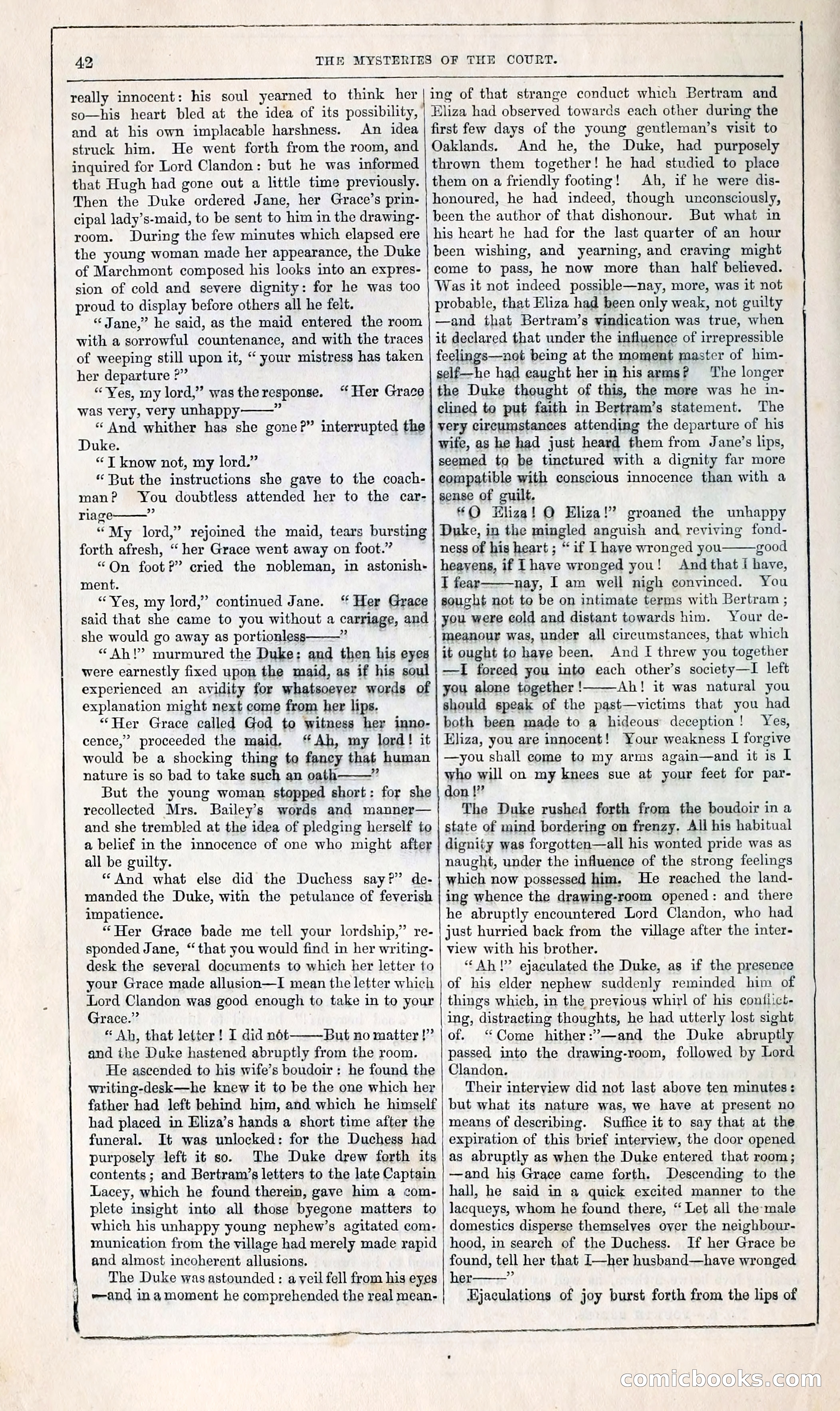
A restored page from Penny Dreadfuls, 1849. Page through the whole issue in the reader above.
📄 Transcribed text from this page (OCR, searchable)
Machine-transcribed from the original scan — historical spelling and the odd misread are preserved.
a a tt A tO LLL GL LLL LLL LOL ELL ALA ALLELE 42 really innocent: his soul yearned to think her so—his heart bled at the idea of its possibility, and at his own implacable harshness. An idea struck him. He went forth from the room, and inquired for Lord Clandon: but he was informed that Hugh had gone out a little time previously. Then the Duke ordered Jane, her Grace’s prin- cipal lady’s-maid, to be sent to him in the drawing- room. During the few minutes which elapsed ere the young woman made her appearance, the Duke of Marchmont composed his looks into an expres- sion of cold and severe dignity: for he was too proud to display before others all he felt. “ Jane,” he said, as the maid entered the room with a sorrowful countenance, and with the traces of weeping still upon it, “ your mistress has taken her departure ?” “Yes, my lord,” was the response. was very, very unhappy 5g “ And whither has she gone?” interrupted the Duke. “T know not, my lord.” “ But the instructions she gave to the coach- manP You doubtless attended her to the car- riage 7 “My lord,” rejoined the maid, tears bursting forth afresh, “ her Grace went away on foot.” “On foot?” cried the nobleman, in astonish- ment. “Yes, my lord,” continued Jane. “ Her Grace said that she came to you without a carriage, and she would go away as portionless a : «“ Ah!” murmured the Duke: and then his eyes were earnestly fixed upon the maid, as if his soul experienced an avidity for whatsoever words of explanation might next come from her lips. “Her Grace called God to witness her inno- cence,’ proceeded the maid, ‘Ah, my lord! it would be a shocking thing to fancy that human nature is so bad to take such an oath a" But the young woman stopped short: for she recollected Mrs. Bailey’s words and manner— and she trembled at the idea of pledging herself to a belief in the innocence of one who might after all be guilty. “And what else did the Duchess say?” de- manded the Duke, witn the petulance of feverish impatience. “Her Grace bade me tell your lordship,” re- sponded Jane, “that you would find in her writing- desk the several documents to which her letter to your Grace made allusion—I mean the letter which Lord Clandon was good enough to take in to your Grace.” « Ah, that letter ! I did nét But no matter !” and the Duke hastened abruptly from the room. He ascended to his wife’s boudoir: he found the writing-desk—he knew it to be the one which her father had left behind him, and which he himself had placed in Eliza’s hands a short time after the funeral. It was unlocked: for the Duchess had purposely left it so. The Duke drew forth its contents ; and Bertram’s letters to the late Captain Lacey, which he found therein, gave him a com- plete insight into all those byegone matters to which his unhappy young nephew’s agitated com- munication from the village had merely made rapid and almost incoherent allusions. The Duke was astounded : a veil fell from his eyes e-and ina moment he comprehended the real mean- “Her Grace a eg A CLE IE DELTA LT, AEA LO DO nena THE MYSTERIES OF THE on POT TT EE Een eet Renna ee ae ee COURT. ing of that strange conduct which Bertram and Eliza had observed towards each other during the first few days of the young gentleman’s visit to Oaklands. And he, the Duke, had purposely thrown them together! he had studied to place them on a friendly footing! Ah, if he were dis- honoured, he had indeed, though unconsciously, been the author of that dishonour. But what in his heart he had for the last quarter of an hour been wishing, and yearning, and craving might come to pass, he now more than half believed. Was it not indeed possible—nay, more, was it not probable, that Eliza had been only weak, not guilty —and that Bertram’s yindication was true, when it declared that under the influence of irrepressible feelings—not being at the moment master of him- self—he had caught her in his arms? The longer the Duke thought of this, the more was he in- clined to put faith in Bertram’s statement. The very circumstances attending the departure of his wife, as he had just heard them from Jane’s lips, seemed to be tinctured with a dignity far more compatible with conscious innocence than with a sense of guilt. *O Eliza! Q Eliza!” groaned the unhappy Duke, in the mingled anguish and reviving fond- ness of his heart ; “if I haye wronged you good heavens, if [have wronged you! And that I have, T fear nay, IT am well nigh convinced. You sought not to be on intimate terms with Bertram ; you were cold and distant towards him. Your de- meanour was, under all circumstances, that which it ought to haye been. And I threw you together —I foreed you into each other’s society—I left you alone together ! Ah! it was natural you should speak of the past—victims that you had both been made to a hideous deception! Yes, Eliza, you are innocent! Your weakness I forgive —you shall come to my arms again—and it is I who will on my knees sue at your feet for par- don \?? The Duke rushed forth from the boudoir in a state of mind bordering on frenzy. All his habitual dignity was forgotten—all his wonted pride was as naught, under the influence of the strong feelings which now possessed him. He reached the land- ing whence the drawing-room opened: and there he abruptly encountered Lord Clandon, who had just hurried back from the village after the inter- view with his brother. “Ah!” ejaculated the Duke, as if the presence of his elder nephew suddenly reminded him of things which, in the previous whirl of his confiict- ing, distracting thoughts, he had utterly lost sight of. ‘Come hither:’—and the Duke abruptly passed into the drawing-room, followed by Lord Clandon. Their interview did not last above ten minutes: but what its nature was, we have at present no means of describing. Suffice it to say that at the expiration of this brief interview, the door opened as abruptly as when the Duke entered that room; —and his Grace came forth. Descending to the hall, he said in a quick excited manner to the lacqueys, whom he found there, “ Let all the male domestics disperse themselves over the neighbour- hood, in search of the Duchess. If her Grace be found, tell her that I—her husband—have wronged her ¥/ Ejaculations of joy burst forth from the lips of ———— al (C(O) mM ClOOOKS.€O)