
Penny Dreadfuls, 1849 · page 49 of 394
The Mysteries of the Court of London — page 49: what you’re looking at
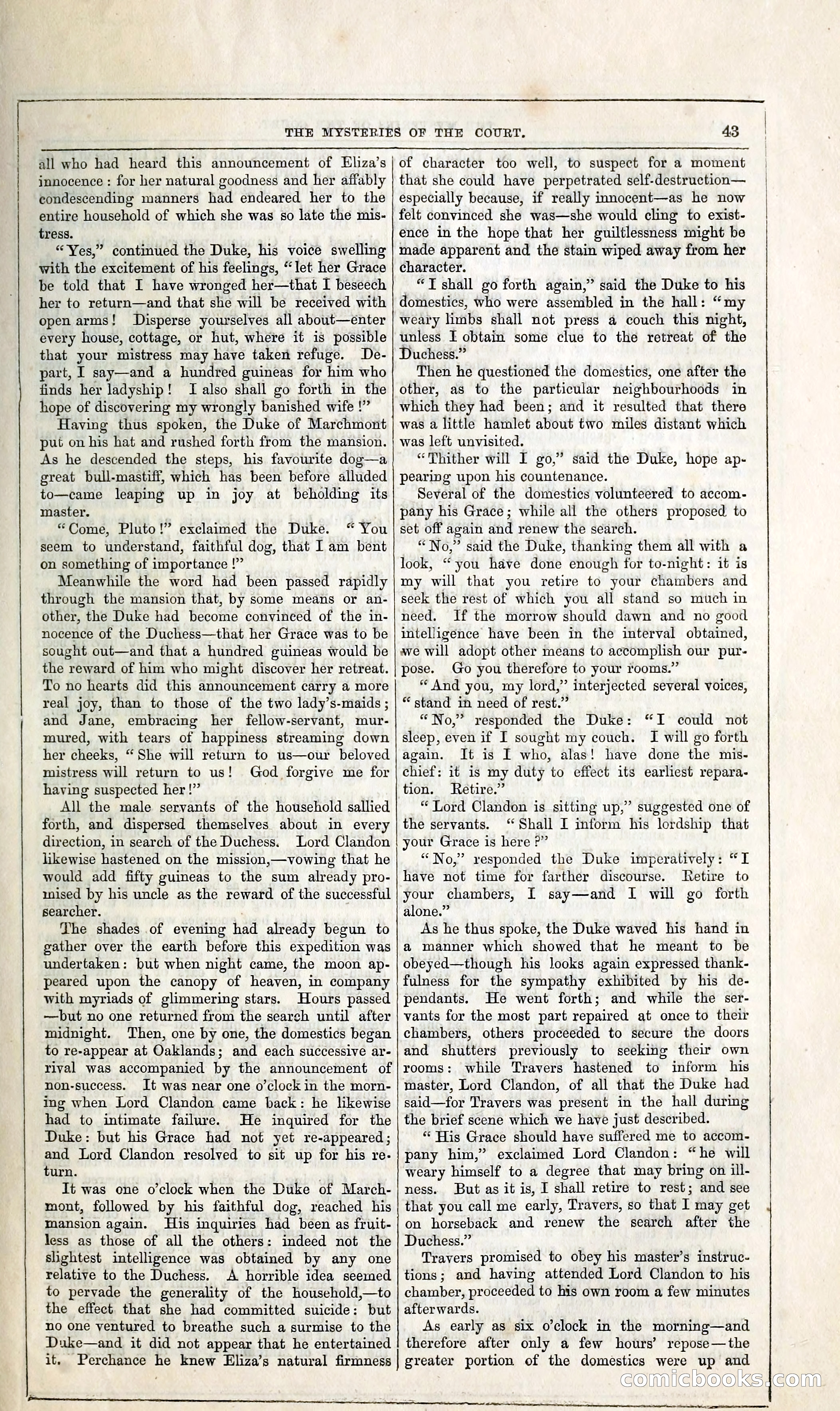
A restored page from Penny Dreadfuls, 1849. Page through the whole issue in the reader above.
📄 Transcribed text from this page (OCR, searchable)
Machine-transcribed from the original scan — historical spelling and the odd misread are preserved.
— THE MYSTERIES OF THE COURT. 43 a ee + all who had heard this announcement of Eliza’s | innocence : for her natural goodness and her affably condescending manners had endeared her to the entire household of which she was so late the mis- tress. “Yes,” contimued the Duke, his voice swelling with the excitement of his feelings, “let her Grace be told that I have wronged her—that I beseech her to return—and that she will be received with open arms! Disperse yourselves all about—enter every house, cottage, or hut, where it is possible that your mistress may have taken refuge. De- part, I say—and a hundred guineas for him who finds her ladyship! I also shall go forth in the hope of discovering my wrongly banished wife !” Having thus spoken, the Duke of Marchmont put on his hat and rushed forth from the mansion. As he descended the steps, his favourite dog—a great bull-mastiff, which has been before alluded to—came leaping up in joy at beholding its master. “Come, Pluto!” exclaimed the Duke. “ You seem to understand, faithful dog, that I am bent on something of importance !” Meanwhile the word had been passed rapidly through the mansion that, by some means or an- other, the Duke had become convineed of the in- nocence of the Duchess—that her Grace was to be sought out—and that a hundred guineas would be the reward of him who might discover her retreat. To no hearts did this announcement carry a more real joy, than to those of the two lady’s-maids ; and Jane, embracing her fellow-servant, mur- mured, with tears of happiness streaming down her cheeks, ‘ She will return to us—our beloved mistress will return to us! God forgive me for having suspected her !” All the male servants of the household sallied forth, and dispersed themselves about in every direction, in search of the Duchess. Lord Clandon likewise hastened on the mission,—vowing that he would add fifty guineas to the sum already pro- mised by his uncle as the reward of the successful searcher. . Whe shades of evening had already begun to gather over the earth before this expedition was undertaken: but when night came, the moon ap- peared upon the canopy of heaven, in company with myriads of glimmering stars. Hours passed —but no one returned from the search until after midnight. ‘Then, one by one, the domestics began to re-appear at Oaklands; and each successive ar- rival was accompanied by the announcement of non-success. It was near one o’clock in the morn- ing when Lord Clandon came back: he likewise had to intimate failure. He inquired for the Duke: but his Grace had not yet re-appeared; and Lord Clandon resolved to sit up for his re- turn. It was one o'clock when the Duke of March- mont, followed by his faithful dog, reached his mansion again. His inquiries had been as fruit- less as those of all the others: indeed not the shghtest intelligence was obtained by any one relative to the Duchess. <A horrible idea seemed to pervade the generality of the household,—to the effect. that she had committed suicide: but no one yentured to breathe such a surmise to the Duke—and it did not appear that he entertained it. Perchance he knew Eliza’s natural firmness | greater portion of the domestics were up and SqCO) of character too well, to suspect for a moment that she could have perpetrated self-destruction— especially because, if really innocent—as he now felt convinced she was—she would cling to exist- ence in the hope that her guiltlessness might be made apparent and the stain wiped away from her character. “T shall go forth again,” said the Duke to his domestics, who were assembled in the hall: “my weary limbs shall not press a couch this night, unless I obtain some clue to the retreat of the Duchess.” Then he questioned the domestics, one after the other, as to the particular neighbourhoods in which they had been; and it resulted that there was a little hamlet about two miles distant which was left unvisited. “hither will I go,” said the Duke, hope ap- pearing upon his countenance. Several of the domestics volunteered to accom- pany his Grace; while all the others proposed to set off again and renew the search. “No,” said the Duke, thanking them all with a look, “you have done enough for to-mght: it is my will that you retire to your chambers and seek the rest of which you all stand so much in need. If the morrow should dawn and no good intelligence have been in the interval obtained, ave will adopt other means to accomplish our pur- pose. Go you therefore to your rooms.” And you, my lord,” interjected several voices, “stand in need of rest.” “No,” responded the Duke: “I could not sleep, even if I sought my couch. I will go forth again. It is I who, alas! have done the mis- chief: it is my duty to effect its earliest repara- tion. Retire.” “ Lord Clandon is sitting up,” suggested one of the servants. “Shall I inform his lordship that your Grace is here ?” “No,” responded the Duke imperatively: “I have not time for farther discourse. Jetire to your chambers, I say—and I will go forth alone.” As he thus spoke, the Duke waved his hand in a manner which showed that he meant to be obeyed—though his looks again expressed thank- fulness for the sympathy exhibited by his de- pendants. He went forth; and while the ser- vants for the most part repaired at once to their chambers, others proceeded to secure the doors and shutters previously to seeking their own rooms: while Travers hastened to inform his master, Lord Clandon, of all that the Duke had said—for Travers was present in the hall during the brief scene which we have just described. ** His Grace should have suffered me to accom- pany him,” exclaimed Lord Clandon: “he will weary himself to a degree that may bring on ill- ness. But as it is, I shall retire to rest; and see that you call me early, Travers, so that I may get on horseback and renew the search after the Duchess.” Travers promised to obey his master’s instruc- tions; and having attended Lord Clandon to his chamber, proceeded to his own room a few minutes afterwards. As early as six o’clock in the morning—and therefore after only a few hours’ repose—the (C 0)(0)(0) (COMM