
Penny Dreadfuls, 1849 · page 59 of 394
The Mysteries of the Court of London — page 59: what you’re looking at
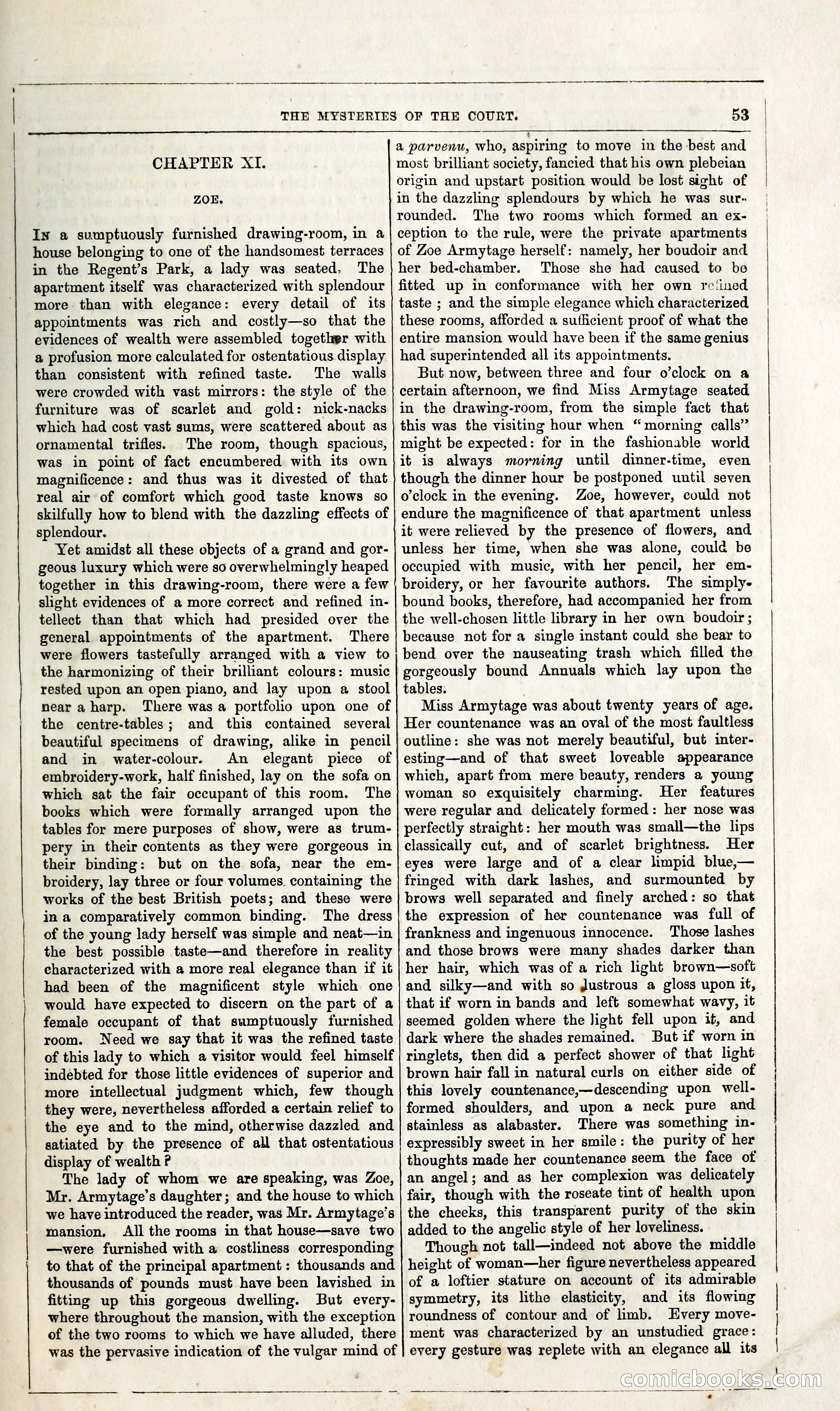
A restored page from Penny Dreadfuls, 1849. Page through the whole issue in the reader above.
📄 Transcribed text from this page (OCR, searchable)
Machine-transcribed from the original scan — historical spelling and the odd misread are preserved.
—_ —————<— THE MYSTERIES OF THE COURT. CHAPTER XI. ZOE. In a sumptuously furnished drawing-room, in a house belonging to one of the handsomest terraces in the Regent’s Park, a lady was seated. The apartment itself was characterized with splendour more than with elegance: every detail of its appointments was rich and costly—so that the evidences of wealth were assembled together with a profusion more calculated for ostentatious display than consistent with refined taste. The walls were crowded with vast mirrors: the style of the furniture was of scarlet and gold: nick-nacks which had cost vast sums, were scattered about as ornamental trifles. The room, though spacious, was in point of fact encumbered with its own magnificence: and thus was it divested of that real air of comfort which good taste knows so skilfully how to blend with the dazzling effects of splendour. Yet amidst all these objects of a grand and gor- geous luxury which were so overwhelmingly heaped together in this drawing-room, there were a few slight evidences of a more correct and refined in- tellect than that which had presided over the general appointments of the apartment. There were flowers tastefully arranged with a view to the harmonizing of their brilliant colours: music rested upon an open piano, and lay upon a stool near a harp. There was a portfolio upon one of the centre-tables; and this contained several beautiful specimens of drawing, alike in pencil and in water-colour. An elegant piece of embroidery-work, half finished, lay on the sofa on which sat the fair occupant of this room. The books which were formally arranged upon the tables for mere purposes of show, were as trum- pery in their contents as they were gorgeous in their binding: but on the sofa, near the em- broidery, lay three or four volumes. containing the works of the best British poets; and these were in a comparatively common binding. The dress of the young lady herself was simple and neat—in the best possible taste—and therefore in reality characterized with a more real elegance than if it had been of the magnificent style which one would have expected to discern on the part of a female occupant of that sumptuously furnished room. Need we say that it was the refined taste of this lady to which a visitor would feel himself indebted for those little evidences of superior and more intellectual judgment which, few though they were, nevertheless afforded a certain relief to the eye and to the mind, otherwise dazzled and satiated by the presence of all that ostentatious display of wealth P The lady of whom we are speaking, was Zoe, Mr. Armytage’s daughter; and the house to which we have introduced the reader, was Mr. Armytage’s mansion, All the rooms in that house—save two —were furnished with a costliness corresponding to that of the principal apartment : thousands and thousands of pounds must have been lavished in fitting up this gorgeous dwelling. But every- where throughout the mansion, with the exception of the two rooms to which we have alluded, there was the pervasive indication of the vulgar mind of ——— i 53 pA a ee ee a parvenu, who, aspiring to move in the best and most brilliant society, fancied that his own plebeian origin and upstart position would be lost sight of in the dazzling splendours by which he was sur. rounded. The two rooms which formed an ex- ception to the rule, were the private apartments of Zoe Armytage herself: namely, her boudoir and her bed-chamber. Those she had caused to be fitted up in conformance with her own re:ined taste ; and the simple elegance which characterized these rooms, afforded a sufficient proof of what the entire mansion would have been if the same genius had superintended all its appointments. But now, between three and four o’clock on a certain afternoon, we find Miss Armytage seated in the drawing-room, from the simple fact that this was the visiting hour when “morning calls” might be expected: for in the fashionable world it is always morning until dinner-time, even though the dinner hour be postponed until seven o’clock in the evening. Zoe, however, could not endure the magnificence of that apartment unless it were relieved by the presence of flowers, and unless her time, when she was alone, could be occupied with music, with her pencil, her em- broidery, or her favourite authors. The simply- bound books, therefore, had accompanied her from the well-chosen little library in her own boudoir ; because not for a single instant could she bear to bend over the nauseating trash which filled the gorgeously bound Annuals which lay upon the tables: | Miss Armytage was about twenty years of age. Her countenance was an oval of the most faultless outline: she was not merely beautiful, but inter- esting—and of that sweet loveable appearance which, apart from mere beauty, renders a young woman so exquisitely charming. Her features were regular and delicately formed: her nose was perfectly straight: her mouth was small—the lips classically cut, and of scarlet brightness. Her eyes were large and of a clear limpid blue,— fringed with dark lashes, and surmounted by brows well separated and finely arched: so that the expression of her countenance was full of frankness and ingenuous innocence. Those lashes and those brows were many shades darker than her hair, which was of a rich light brown—sott and silky—and with so Justrous a gloss upon it, that if worn in bands and left somewhat wavy, it seemed golden where the light fell upon if, and dark where the shades remained. But if worn in ringlets, then did a perfect shower of that light brown hair fall in natural curls on either side of this lovely countenance,—descending upon well- formed shoulders, and upon a neck pure and stainless as alabaster. There was something in- expressibly sweet in her smile: the purity of her thoughts made her countenance seem the face of an angel; and as her complexion was delicately fair, though with the roseate tint of health upon the cheeks, this transparent purity of the skin added to the angelic style of her loveliness. Though not tall—indeed not above the middle height of woman—her figure nevertheless appeared of a loftier stature on account of its admirable symmetry, its lithe elasticity, and its flowing roundness of contour and of limb. Every move- ment was characterized by an unstudied grace: every gesture was replete with an elegance all its IKSHEE —— ee SS =