
Penny Dreadfuls, 1849 · page 60 of 394
The Mysteries of the Court of London — page 60: what you’re looking at
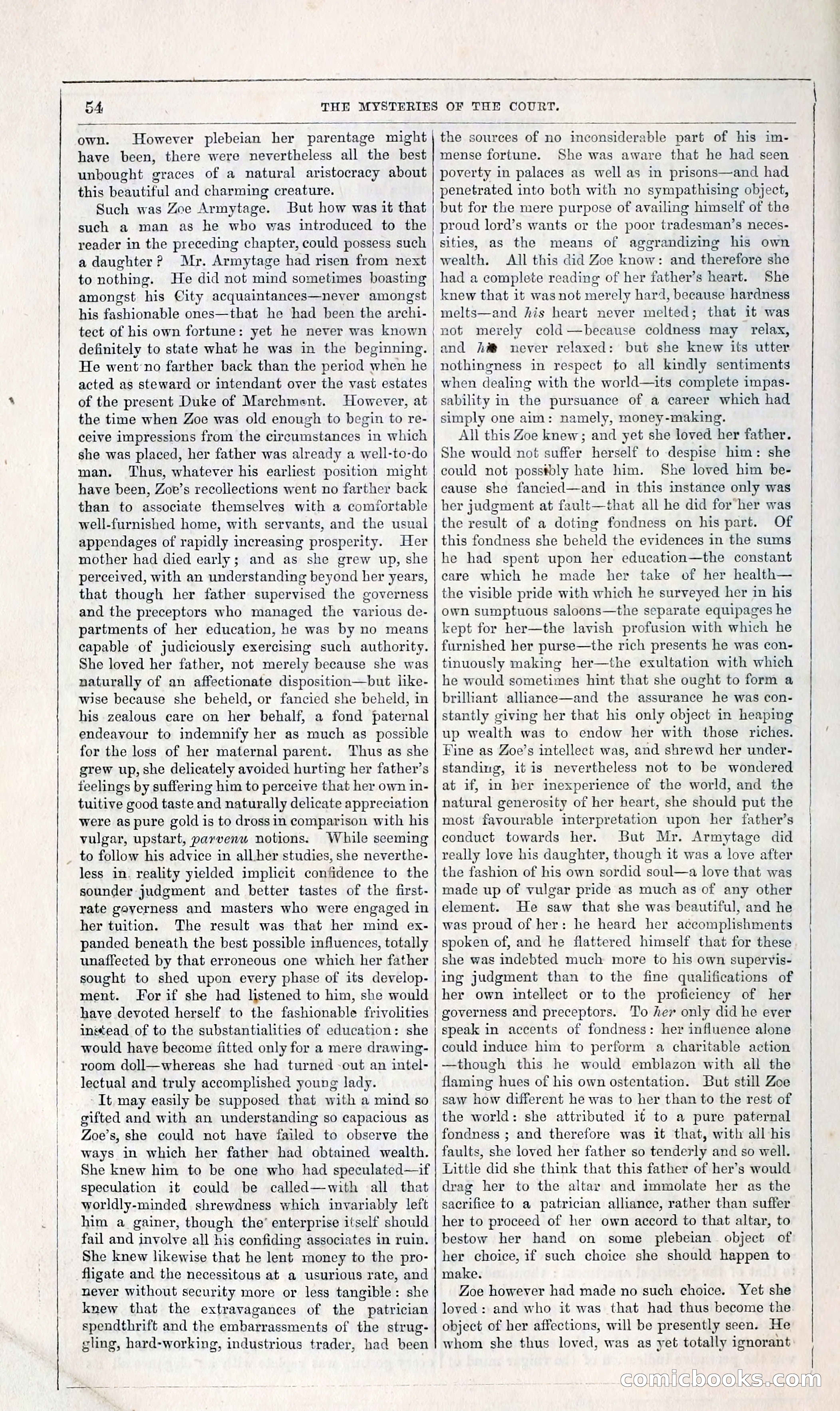
A restored page from Penny Dreadfuls, 1849. Page through the whole issue in the reader above.
📄 Transcribed text from this page (OCR, searchable)
Machine-transcribed from the original scan — historical spelling and the odd misread are preserved.
54 own. However plebeian her parentage might have been, there were nevertheless all the best unbhought graces of a natural aristocracy about this beautiful and charming creature. Such was Zoe Armytage. But how was it that such a man as he who was introduced to the reader in the preceding chapter, could possess such a daughter? Mr. Armytage had risen from next to nothing. He did not mind sometimes boasting amongst his City acquaintances—never amongst his fashionable ones—that he had been the archi- tect of his own fortune: yet he never was known definitely to state what he was in the beginning. He went no farther back than the period when he acted as steward or intendant over the vast estates of the present Duke of Marchment. However, at the time when Zoe was old enough to begin to re- ceive impressions from the circumstances in which she was placed, her father was already a well-to-do man. Thus, whatever his earliest position might have been, Zoe’s recollections went no farther back than to associate themselves with a comiortable well-furnished home, with servants, and the usual appendages of rapidly increasing prosperity. Her mother had died early; and as she grew up, she perceived, with an understanding beyond her years, that though her father supervised the governess and the preceptors who managed the various de- partments of her education, he was by no means capable of judiciously exercising such authority. She loved her father, not merely because she was naturally of an affectionate disposition—but lke- wise because she beheld, or fancied she beheld, in his zealous eare on her behalf, a fond paternal endeavour to indemnify her as much as possible for the loss of her maternal parent. Thus as she grew up, she delicately avoided hurting her father’s feelings by suffering him to perceive that her own in- tuitive good taste and naturally delicate appreciation were as pure gold is to drossin comparison with his vulgar, upstart, parvenu notions. While seeming _ to follow his advice in all.her studies, she neverthe- less in. reality yielded implicit confidence to the sounder judgment and better tastes of the first- rate governess and masters who were engaged in her tuition. The result was that her mind ex- panded beneath the best possible influences, totally unaffected by that erroneous one which her father sought to shed upon every phase of its develop- ment. Forif she had listened to him, she would have devoted herself to the fashionable frivolities instead of to the substantialities of education: she would have become fitted only for a mere drawing- room doll—whereas she had turned -out an intel- lectual and truly accomplished young lady. -It may easily be supposed that with a mind so sifted and with an understanding so capacious as Zoe’s, she could not have failed to observe the ways in which her father had obtained wealth. She knew him to be one who had speculated—if speculation it could be called—with all that worldly-minded shrewdness which invariably left him a gainer, though the’ enterprise itself should fail and involve all his confiding associates in ruin. She knew likewise that he lent money to the pro- fligate and the necessitous at a usurious rate, and never without security more or less tangible: she knew that the extravagances of the patrician spendthrift and the embarrassments of the strug- gling, hard-working, industrious trader, had been THE MYSTERIES OF THE COURT. the sources of no inconsiderable part of his im- mense fortune. She was aware that he had seen poverty in palaces as well as in prisons—and had penetrated into both with no sympathising object, but for the mere purpose of availing himself of the proud lord’s wants or the poor tradesman’s neces- sities, as the means of aggrandizing his own wealth. All this did Zoe know: and therefore she had a complete reading of her father’s heart. She knew that it was not merely hard, because hardness melts—and his heart never melted; that it was not merely cold—because coldness may relax, and f#@ never relaxed: but she knew its utter nothingness in respect to all kindly sentiments when dealing with the world—its complete impas- sability in the pursuance of a career which had simply one aim: namely, money-making. All this Zoe knew; and yet she loved her father. She would not suffer herself to despise him: she could not posstbly hate him. She loved him be- cause she fancied—and in this instance only was her judgment at fault—that all he did for’her was the result of a doting fondness on his part. Of this fondness she beheld the evidences in the sums he had spent upon her education—the constant care which he made her take of her health— the visible pride with which he surveyed her in his own sumptuous saloons—the separate equipages he kept for her—the lavish profusion with which he furnished her purse—the rich presents he was con- tinuously making her—the exultation with which he would sometimes hint that she ought to form a brilliant alliance—and the assurance he was con- stantly giving her that his only object in heaping up wealth was to endow her with those riches. Fine as Zoe’s intellect was, and shrewd her under- standing, itis nevertheless not to be wondered at if, in her inexperience of the world, and the natural generosity of her heart, she should put the most favourable interpretation upon her father’s conduct towards her. But Mr. Armytage did really love his daughter, though it was a love after the fashion of his own sordid soul—a love that was made up of vulgar pride as much as of any other element. He saw that she was beautiful, and he was proud of her: he heard her accomplishments spoken of, and he flattered himself that for these she was indebted much more to his own supervis- ing judgment than to the fine qualifications of her own intellect or to the proficiency of her governess and preceptors. To her only did he ever speak in accents of fondness: her influence alone could induce him to perform a charitable action —though this he would emblazon with all the flaming hues of his own ostentation. But still Zoe saw how different he was to her than to the rest of the world: she attributed it to a pure paternal fondness ; and therefore was it that, with all his faults, she loved her father so tenderly and so well. Little did she think that this father of her’s would drag her to the altar and immolate her as the sacrifice to a patrician alliance, rather than suffer her to proceed of her own accord to that altar, to bestow her hand on some plebeian object of her choice, if such choice she should happen to make. Zoe however had made no such choice. Yet she loved: and who it was that had thus become the object of her affections, will be presently seen. He whom she thus loved, was as yet totally ignorant CORNICE OO SCO)!