
Penny Dreadfuls, 1849 · page 61 of 394
The Mysteries of the Court of London — page 61: what you’re looking at
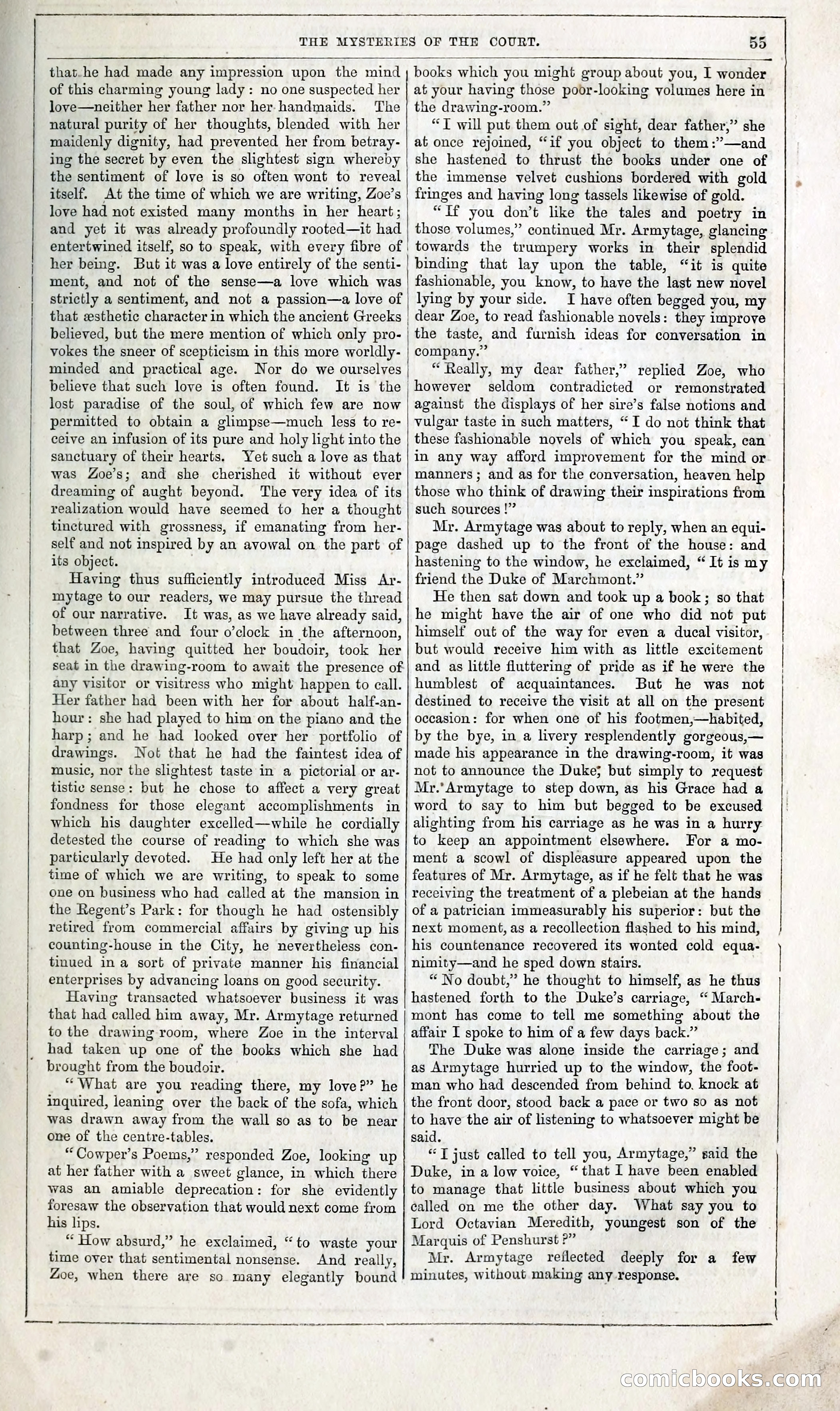
A restored page from Penny Dreadfuls, 1849. Page through the whole issue in the reader above.
📄 Transcribed text from this page (OCR, searchable)
Machine-transcribed from the original scan — historical spelling and the odd misread are preserved.
— mw rn ee THE MYSTERIES OF THE COURT. that. he had made any impression upon the mind of this charming young lady: no one suspected her love—neither her father nor her-handmaids. The natural purity of her thoughts, blended with her maidenly dignity, had prevented her from betray- ing the secret by even the slightest sign whereby the sentiment of love is so often wont to reveal itself. At the time of which we are writing, Zoe’s love had not existed many months in her heart; and yet it was already profoundly rooted—it had entertwined itself, so to speak, with every fibre of | | 3) books which you might group about you, I wonder at your having those poodr-looking volumes here in the drawing-room.” “T will put them out of sight, dear father,” she at once rejoined, “if you object to them :’—and she hastened to thrust the books under one of the immense velvet cushions bordered with gold fringes and having long tassels likewise of gold. “Tf you don’t like the tales and poetry in those volumes,” continued Mr. Armytage, glancing towards the trumpery works in their splendid her being. But it was a love entirely of the senti-| binding that lay upon the table, “it is quite ment, and not of the sense—a love which was | fashionable, you know, to have the last new novel strictly a sentiment, and not a passion—a love of | lying by your side. I have often begged you, my that esthetic character in which the ancient Greeks | dear Zoe, to read fashionable novels: they improve believed, but the mere mention of which only pro- vokes the sneer of scepticism in this more worldly- minded and practical age. Nor do we ourselves believe that such love is often found. It is the lost paradise of the soul, of which few are now permitted to obtain a glimpse—much less to re- ceive an infusion of its pure and holy light into the sanctuary of their hearts. Yet such a love as that was Zoe’s; and she cherished it without ever dreaming of aught beyond. The very idea of its realization would have seemed to her a thought tinctured with grossness, if emanating from her- self and not inspired by an avowal on the part of its object. | Having thus sufficiently introduced Miss Ar- mytage to our readers, we may pursue the thread of our narrative. It was, as we have already said, between three and four o’clock in the afternoon, that Zoe, having quitted her boudoir, took her seat in the drawing-room to await the presence of any visitor or visitress who might happen to eall. Her father had been with her for about half-an- hour: she had played to him on the piano and the harp; and he had looked over her portfolio of drawings. Not that he had the faintest idea of music, nor the slightest taste in a pictorial or ar- tistic sense: but he chose to affect a very great fondness for those elegant accomplishments in which his daughter excelled—while he cordially detested the course of reading to which she was particularly devoted. He had only left her at the time of which we are writing, to speak to some one on business who had called at the mansion in the Regent’s Park: for though he had ostensibly retired from commercial affairs by giving up his counting-house in the City, he nevertheless con- tinued ina sort of private manner his financial enterprises by advancing loans on good security. Having transacted whatsoever business it was that had called him away, Mr. Armytage returned to the drawing room, where Zoe in the interval had taken up one of the books which she had brought from the boudoir. “What are you reading there, my love?” he inquired, leaning over the back of the sofa, which was drawn away from the wall so as to be near one of the centre-tables. “Cowper’s Poems,” responded Zoe, looking up at her father with a sweet glance, in which there was an amiable deprecation: for she evidently foresaw the observation that would next come from his lips. “ How absurd,” he exclaimed, “to waste your time over that sentimental nonsense. And really, Zoe, when there are so many elegantly bound ee eee | however the taste, and furnish ideas for conversation in company.” “Really, my dear father,’ replied Zoe, who seldom contradicted or remonstrated against the displays of her sire’s false notions and vulgar taste in such matters, “I do not think that these fashionable novels of which you speak, can in any way afford improvement for the mind or manners ; and as for the conversation, heaven help those who think of drawing their inspirations from such sources !” Mr. Armytage was about to reply, when an equi- page dashed up to the front of the house: and hastening to the window, he exclaimed, “It is my friend the Duke of Marchmont.” He then sat down and took up a book; so that he might have the air of one who did not put himself out of the way for even a ducal visitor, but would receive him with as little excitement and as little fluttering of pride as if he were the humblest of acquaintances. But he was not destined to receive the visit at all on the present occasion: for when one of his footmen,—habited, by the bye, in a livery resplendently gorgeous,— made his appearance in the drawing-room, it was not to announce the Duke; but simply to request Mr.’Armytage to step down, as his Grace had a word to say to him but begged to be excused alighting from his carriage as he was in a hurry to keep an appointment elsewhere. For a mo- ment a scowl of displeasure appeared upon the features of Mr. Armytage, as if he felt that he was receiving the treatment of a plebeian at the hands of a patrician immeasurably his superior: but the next moment, as a recollection flashed to his mind, his countenance recovered its wonted cold equa- nimity—and he sped down stairs. “ No doubt,’ he thought to himself, as he thus hastened forth to the Duke’s carriage, “ March- mont has come to tell me something about the affair I spoke to him of a few days back.” The Duke was alone inside the carriage; and as Armytage hurried up to the window, the foot- man who had descended from behind to. knock at the front door, stood back a pace or two so as not to have the air of listening to whatsoever might be said. “T just called to tell you, Armytage,” said the Duke, in a low voice, “that I have been enabled to manage that little business about which you called on me the other day. What say you to Lord Octavian Meredith, youngest son of the Marquis of Penshurst P” Mr. Armytage reflected deeply for a few minutes, without making any response. Eomichook