
Penny Dreadfuls, 1849 · page 77 of 394
The Mysteries of the Court of London — page 77: what you’re looking at
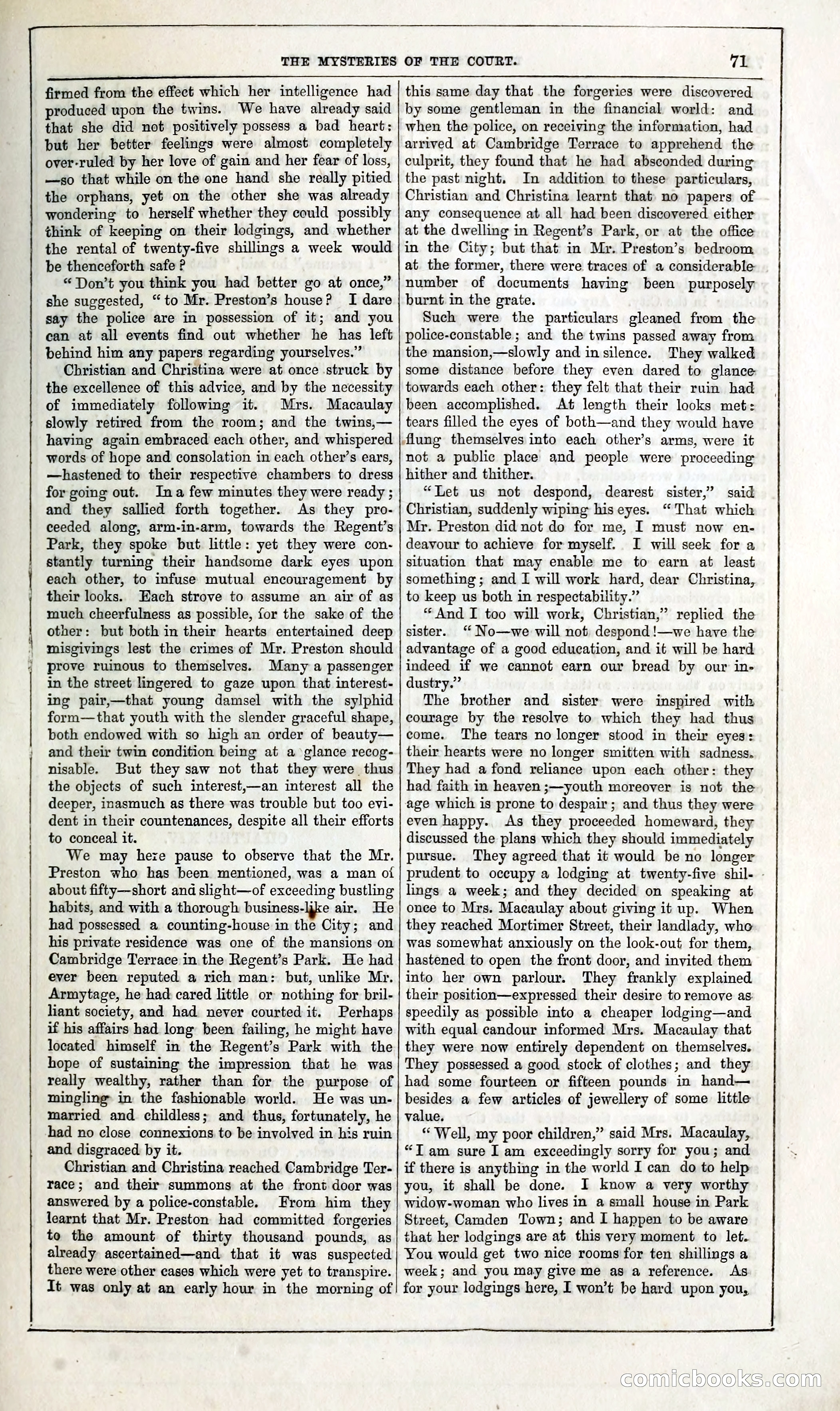
A restored page from Penny Dreadfuls, 1849. Page through the whole issue in the reader above.
📄 Transcribed text from this page (OCR, searchable)
Machine-transcribed from the original scan — historical spelling and the odd misread are preserved.
THE MYSTERIES firmed from the effect which her intelligence had produced upon the twins. We have already said that she did not positively possess a bad heart: but her better feelings were almost completely over-ruled by her love of gain and her fear of loss, —so that while on the one hand she really pitied the orphans, yet on the other she was already wondering to herself whether they could possibly think of keeping on their lodgings, and whether the rental of twenty-five shillings a week would be thenceforth safe P “ Don’t you think you had better go at once,” she suggested, “to Mr. Preston’s house? I dare say the police are in possession of it; and you can at all events find out whether he has left behind him any papers regarding yourselves.” Christian and Christina were at once struck by the excellence of this advice, and by the necessity of immediately following it. Mrs. Macaulay slowly retired from the room; and the twins,— having again embraced each other, and whispered words of hope and consolation in each other’s ears, —hastened to their respective chambers to dress for going out. Ina few minutes they were ready ; and they sallied forth together. As they pro- ceeded along, arm-in-arm, towards the Regent’s Park, they spoke but little: yet they were con- stantly turning their handsome dark eyes upon each other, to infuse mutual encouragement by their looks. Each strove to assume an air of as much cheerfulness as possible, for the sake of the other: but both in their hearts entertained deep misgivings lest the crimes of Mr. Preston should prove ruinous to themselves. Many a passenger in the street lingered to gaze upon that interest- ing pair,—that young damsel with the sylphid form—that youth with the slender graceful shape, both endowed with so high an order of beauty— and their twin condition being at a glance recog- nisable. But they saw not that they were thus the objects of such interest,—an interest all the deeper, inasmuch as there was trouble but too evi- dent in their countenances, despite all their efforts to conceal it. We may heze pause to observe that the Mr. Preston who has been mentioned, was a man ot about fifty—short and slight—of exceeding bustling habits, and with a thorough business-ljke air. He had possessed a counting-house in the City; and his private residence was one of the mansions on Cambridge Terrace in the Regent’s Park. He had ever been reputed a rich man: but, unlike Mr. Armytage, he had cared little or nothing for bril- liant society, and had never courted it. Perhaps if his affairs had long been failing, he might have located himself in the Regent’s Park with the hope of sustaining the impression that he was really wealthy, rather than for the purpose of mingling in the fashionable world. He was un- married and childless; and thus, fortunately, he had no close connexions to be involved in his ruin and disgraced by it. Christian and Christina reached Cambridge Ter- race; and their summons at the front door was answered by a police-constable. From him they learnt that Mr. Preston had committed forgeries to the amount of thirty thousand pounds, as already ascertained—and that it was suspected there were other cases which were yet to transpire. It was only at an early hour in the morning of 71 this same day that the forgeries were discovered by some gentleman in the financial world: and when the police, on receiving the information, had arrived at Cambridge Terrace to apprehend the culprit, they found that he had absconded during the past night. In addition to these particulars, Christian and Christina learnt that no papers of any consequence at all had been discovered either at the dwelling in Regent’s Park, or at the office in the City; but that in Mr. Preston’s bedroom at the former, there were traces of a considerable number of documents having been purposely burnt in the grate. Such were the particulars gleaned from the police-constable ; and the twins passed away from the mansion,—slowly and in silence. They walked some distance before they even dared to glance towards each other: they felt that their ruin had been accomplished. At length their looks met: tears filled the eyes of both—and they would have flung themselves into each other’s arms, were it not a public place and people were proceeding hither and thither. “Let us not despond, dearest sister,” said Christian, suddenly wiping hiseyes. “That which Mr. Preston did not do for me, I must now en- deavour to achieve for myself. I will seek for a situation that may enable me to earn at least something; and I will work hard, dear Christina, to keep us both in respectability.” “And I too will work, Christian,” replied the sister. “ No—we will not despond !—we have the advantage of a good education, and it will be hard indeed if we cannot earn our bread by our in- dustry.” The brother and sister were inspired with courage by the resolve to which they had thus come. The tears no longer stood in their eyes: their hearts were no longer smitten with sadness. They had a fond reliance upon each other: they had faith in heaven ;—youth moreover is not the age which is prone to despair; and thus they were even happy. As they proceeded homeward, they discussed the plans which they should immediately pursue. They agreed that it would be no longer OF THE COURT. prudent to occupy a lodging at twenty-five shil- - lings a week; and they decided on speaking at once to Mrs. Macaulay about giving it up. When they reached Mortimer Street, their landlady, who was somewhat anxiously on the look-out for them, hastened to open the front door, and inyited them into her own parlour. They frankly explained their position—expressed their desire to remove as speedily as possible into a cheaper lodging—and with equal candour informed Mrs. Macaulay that they were now entirely dependent on themselves. They possessed a good stock of clothes; and they had some fourteen or fifteen pounds in hand— besides a few articles of jewellery of some little value. “Well, my poor children,” said Mrs. Macaulay, “T am sure I am exceedingly sorry for you; and if there is anything in the world I can do to help you, it shall be done. I know a very worthy widow-woman who lives in a small house in Park Street, Camden Town; and I happen to be aware that her lodgings are at this very moment to let. You would get two nice rooms for ten shillings a week; and you may give me as a reference. As for your lodgings here, I won’t be hard upon you, (C(O) 6)(0)(0) S (CO)