
Penny Dreadfuls, 1849 · page 78 of 394
The Mysteries of the Court of London — page 78: what you’re looking at
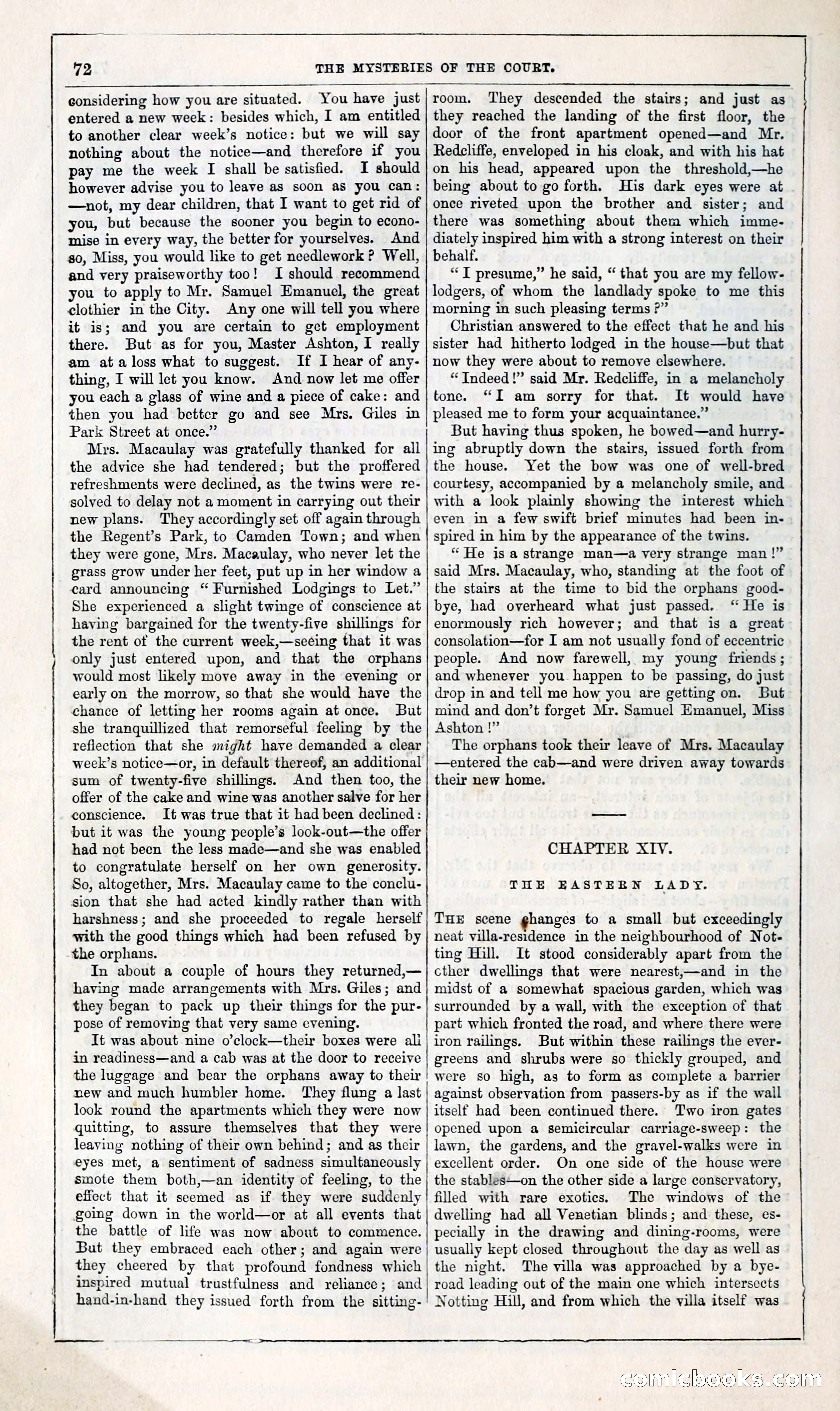
A restored page from Penny Dreadfuls, 1849. Page through the whole issue in the reader above.
📄 Transcribed text from this page (OCR, searchable)
Machine-transcribed from the original scan — historical spelling and the odd misread are preserved.
eS ——---— 72 considering how you are situated. You have just entered a new week: besides which, I am entitled to another clear week’s notice: but we will say nothing about the notice—and therefore if you pay me the week I shall be satisfied. I should however advise you to leave as soon as you can: —not, my dear children, that I want to get rid of you, but because the sooner you begin to econo- mise in every way, the better for yourselves. And so, Miss, you would like to get needlework ? Well, and very praiseworthy too! I should recommend you to apply to Mr. Samuel Emanuel, the great clothier in the City. Any one will tell you where it is; and you are certain to get employment there. But as for you, Master Ashton, I really am ata loss what to suggest. If I hear of any- thing, I will let you know. And now let me offer you each a glass of wine and a piece of cake: and then you had better go and see Mrs. Giles in Park Street at once.” Mrs. Macaulay was gratefully thanked for all the advice she had tendered; but the proffered refreshments were declined, as the twins were re- solved to delay not a moment in carrying out their new plans. They accordingly set off again through the Regent’s Park, to Camden Town; and when they were gone, Mrs. Macaulay, who never let the grass grow under her feet, put up in her window a card announcing “ Furnished Lodgings to Let.” She experienced a slight twinge of conscience at having bargained for the twenty-five shillings for the rent of the current week,—seeing that it was only just entered upon, and that the orphans would most likely move away in the evening or early on the morrow, so that she would have the chance of letting her rooms again at once. But she tranquillized that remorseful feeling by the reflection that she might have demanded a clear week’s notice—or, in default thereof, an additional sum of twenty-five shillings. And then too, the offer of the cake and wine was another salve for her conscience. It was true that it had been declined: but it was the young people’s look-out—the offer had not been the less made—and she was enabled to congratulate herself on her own generosity. So, altogether, Mrs. Macaulay came to the conclu- sion that she had acted kindly rather than with harshness; and she proceeded to regale herself with the good things which had been refused by the orphans. In about a couple of hours they returned,— having made arrangements with Mrs. Giles; and they began to pack up their things for the pur- pose of removing that very same evening. It was about nine o’clock—their boxes were ali in readiness—and a cab was at the door to receive the luggage and bear the orphans away to their new and much humbler home. They flung a last look round the apartments which they were now quitting, to assure themselves that they were leaving nothing of their own behind; and as their eyes met, a sentiment of sadness simultaneously smote them both,—an identity of feeling, to the effect that it seemed as if they were suddenly going down in the world—or at all events that the battle of life was now about to commence. But they embraced each other; and again were they cheered by that profound fondness which inspired mutual trustfulness and reliance; and hand-in-hand they issued forth from the sitting- THE MYSTERIES OF THE COURT. room. They descended the stairs; and just as they reached the landing of the first floor, the door of the front apartment opened—and Mr. Redcliffe, enveloped in his cloak, and with his hat on his head, appeared upon the threshold,—he being about to go forth. His dark eyes were at once riveted upon the brother and sister; and there was something about them which imme- diately inspired him with a strong interest on their behalf. “I presume,” he said, “ that you are my fellow- lodgers, of whom the landlady spoke to me this morning in such pleasing terms ?” Christian answered to the effect that he and his sister had hitherto lodged in the house—but that now they were about to remove elsewhere. “Indeed!” said Mr. Redcliffe, in a melancholy tone. “I am sorry for that. It would have pleased me to form your acquaintance.” But having thus spoken, he bowed—and hurry- ing abruptly down the stairs, issued forth from the house. Yet the bow was one of well-bred courtesy, accompanied by a melancholy smile, and with a look plainly showing the interest which even in a few swift brief minutes had been in- spired in him by the appearance of the twins. “He isa strange man—a very strange man!” said Mrs. Macaulay, who, standing at the foot of the stairs at the time to bid the orphans good- bye, had overheard what just passed. ‘He is enormously rich however; and that is a great consolation—for I am not usually fond of eccentric people. And now farewell, my young friends ; and whenever you happen to be passing, do just drop in and tell me how you are getting on. But mind and don’t forget Mr. Samuel Emanuel, Miss Ashton !” The orphans took their leave of Mrs. Macaulay —entered the cab—and were driven away towards their new home. CHAPTER XIV. THE EASTERN LADY. THE scene ghanges to a small but exceedingly neat villa-residence in the neighbourhood of Not- ting Hill. It stood considerably apart from the cther dwellings that were nearest,—and in the midst of a somewhat spacious garden, which was surrounded by a wall, with the exception of that part which fronted the road, and where there were iron railings. But within these railings the ever- greens and shrubs were so thickly grouped, and were so high, as to form as complete a barrier against observation from passers-by as if the wall itself had been continued there. Two iron gates opened upon a semicircular carriage-sweep: the lawn, the gardens, and the gravel-walks were in excellent order. On one side of the house were the stables—on the other side a large conservatory, filled with rare exotics. The windows of the dwelling had all Venetian blinds; and these, es- pecially in the drawing and dining-rooms, were usually kept closed throughout the day as well as the night. The villa was approached by a bye- road leading out of the main one which intersects Notting Hill, and from which the villa itself was 0)(0) > a (C(O) S (©)