
Penny Dreadfuls, 1849 · page 98 of 394
The Mysteries of the Court of London — page 98: what you’re looking at
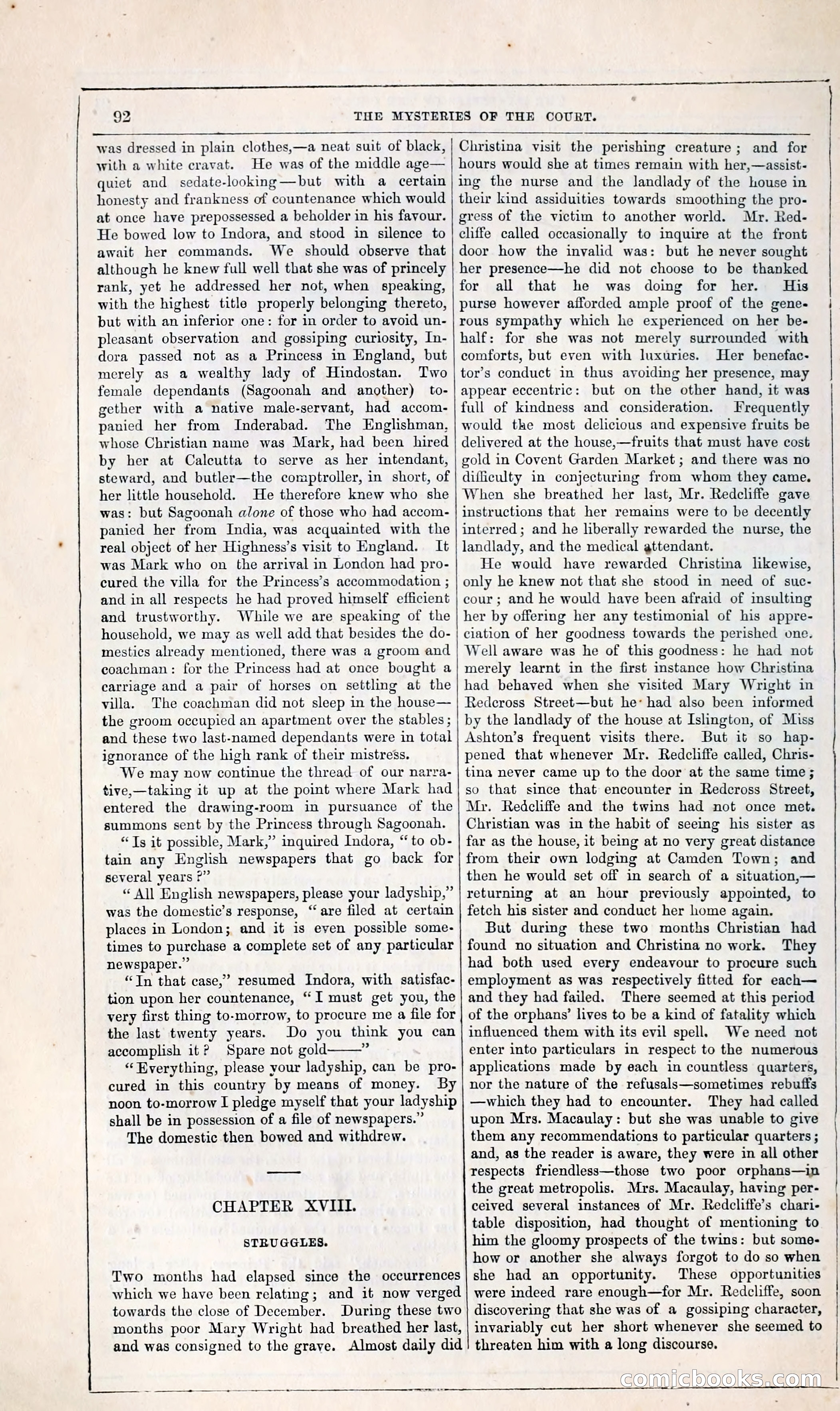
A restored page from Penny Dreadfuls, 1849. Page through the whole issue in the reader above.
📄 Transcribed text from this page (OCR, searchable)
Machine-transcribed from the original scan — historical spelling and the odd misread are preserved.
92 THE MYSTERIES OF THE COURT. was dressed in plain clothes,—a neat suit of black, with a white cravat. He was of the middle age— quiet and sedate-looking—but with a certain honesty and frankness of countenance which would at once have prepossessed a beholder in his favour. He bowed low to Indora, and stood in silence to await her commands. We should observe that although he knew full well that she was of princely rank, yet he addressed her not, when speaking, with the highest title properly belonging thereto, but with an inferior one: for in order to avoid un- pleasant observation and gossiping curiosity, In- dora passed not as a Princess in England, but merely as a wealthy lady of Hindostan. Two female dependants (Sagoonah and another) to- gether with a native male-servant, had accom- panied her from Inderabad. The Englishman, whose Christian name was Mark, had been hired by her at Calcutta to serve as her intendant, steward, and butler—the comptroller, in short, of her little household. He therefore knew who she was: but Sagoonah alone of those who had accom- panied her from India, was acquainted with the real object of her Highness’s visit to England. It was Mark who on the arrival in London had pro- cured the villa for the Princess’s accommodation ; and in all respects he had proved himself efficient and trustworthy. While we are speaking of the household, we may as well add that besides the do- mestics already mentioned, there was a groom and coachman: for the Princess had at once bought a carriage and a pair of horses on settling at the villa. The coachman did not sleep in the house— the groom occupied an apartment over the stables ; and these two last-named dependants were in total ignorance of the high rank of their mistress. We may now continue the thread of our narra- tive,—taking it up at the point where Mark had entered the drawing-room in pursuance of the summons sent by the Princess through Sagoonah. “Ts it possible, Mark,” inquired Indora, “ to ob- tain any English newspapers that go back for several years ?” “ All English newspapers, please your ladyship,” was the domestic’s response, “are filed at certain places in London; and it is even possible some- times to purchase a complete set of any particular newspaper.” “Tn that case,’ resumed Indora, with satisfac- tion upon her countenance, “I must get you, the very first thing to-morrow, to procure me a file for the last twenty years. Do you think you can accomplish it? Spare not gold m1 “Everything, please your ladyship, can be pro- cured in this country by means of money. By noon to-morrow I pledge myself that your ladyship shall be in possession of a file of newspapers.” The domestic then bowed and withdrew. — ———< CHAPTER XVIII. STRUGGLES. Two months had elapsed since the occurrences which we have been relating; and it now verged towards the close of December. During these two months poor Mary Wright had breathed her last, and was consigned to the grave. Almost daily did _~—— a Christina visit the perishing creature ; and for hours would she at times remain with her,—assist- ing the nurse and the Jandlady of the house in their kind assiduities towards smoothing the pro- gress of the victim to another world. Mr. Red- cliffe called occasionally to inquire at the front door how the invalid was: but he never sought her presence—he did not choose to be thanked for all that he was doing for her. His purse however afforded ample proof of the gene- rous sympathy which he experienced on her be- half: for she was not merely surrounded with comforts, but even with luxuries. Her benefac- tor’s conduct in thus avoiding her presence, may appear eccentric: but on the other hand, it was full of kindness and consideration. Frequently would the most delicious and expensive fruits be delivered at the house,—fruits that must have cost gold in Covent Garden Market ; and there was no difficulty in conjecturing from whom they came. When she breathed her last, Mr. Redcliffe gave instructions that her remains were to be decently interred ; and he liberally rewarded the nurse, the landlady, and the medical attendant. He would have rewarded Christina likewise, only he knew not that she stood in need of suc- cour; and he would have been afraid of insulting her by offering her any testimonial of his appre- ciation of her goodness towards the perished one. Well aware was he of this goodness: he had not merely learnt in the first instance how Christina had behaved when she visited Mary Wright in Redcross Street—but he: had also been informed by the landlady of the house at Islington, of Miss Ashton’s frequent visits there. But it so hap- pened that whenever Mr. Redcliffe called, Chris- tina never came up to the door at the same time ; so that since that encounter in Redcross Street, My. Redcliffe and the twins had not once met. Christian was in the habit of seeing his sister as far as the house, it being at no very great distance from their own lodging at Camden Town; and then he would set off in search of a situation,— returning at an hour previously appointed, to fetch his sister and conduct her home again, But during these two months Christian had found no situation and Christina no work. They had both used every endeavour to procure such employment as was respectively fitted for each— and they had failed. There seemed at this period of the orphans’ lives to be a kind of fatality which influenced them with its evil spell. We need not enter into particulars in respect to the numerous applications made by each in countless quarters, nor the nature of the refusals—sometimes rebuffs —which they had to encounter. They had called upon Mrs. Macaulay: but she was unable to give them any recommendations to particular quarters ; and, as the reader is aware, they were in all other respects friendless—those two poor orphans—in the great metropolis. Mrs. Macaulay, having per- ceived several instances of Mr. Redcliffe’s chari- table disposition, had thought of mentioning to him the gloomy prospects of the twins: but some- how or another she always forgot to do so when she had an opportunity. These opportunities were indeed rare enough—for Mr. Redcliffe, soon discovering that she was of a gossiping character, invariably cut her short whenever she seemed to threaten him with a long discourse. (C(O) DOOK 0 AMINE