
Penny Dreadfuls, 1849 · page 99 of 394
The Mysteries of the Court of London — page 99: what you’re looking at
A restored page from Penny Dreadfuls, 1849. Page through the whole issue in the reader above.
📄 Transcribed text from this page (OCR, searchable)
Machine-transcribed from the original scan — historical spelling and the odd misread are preserved.
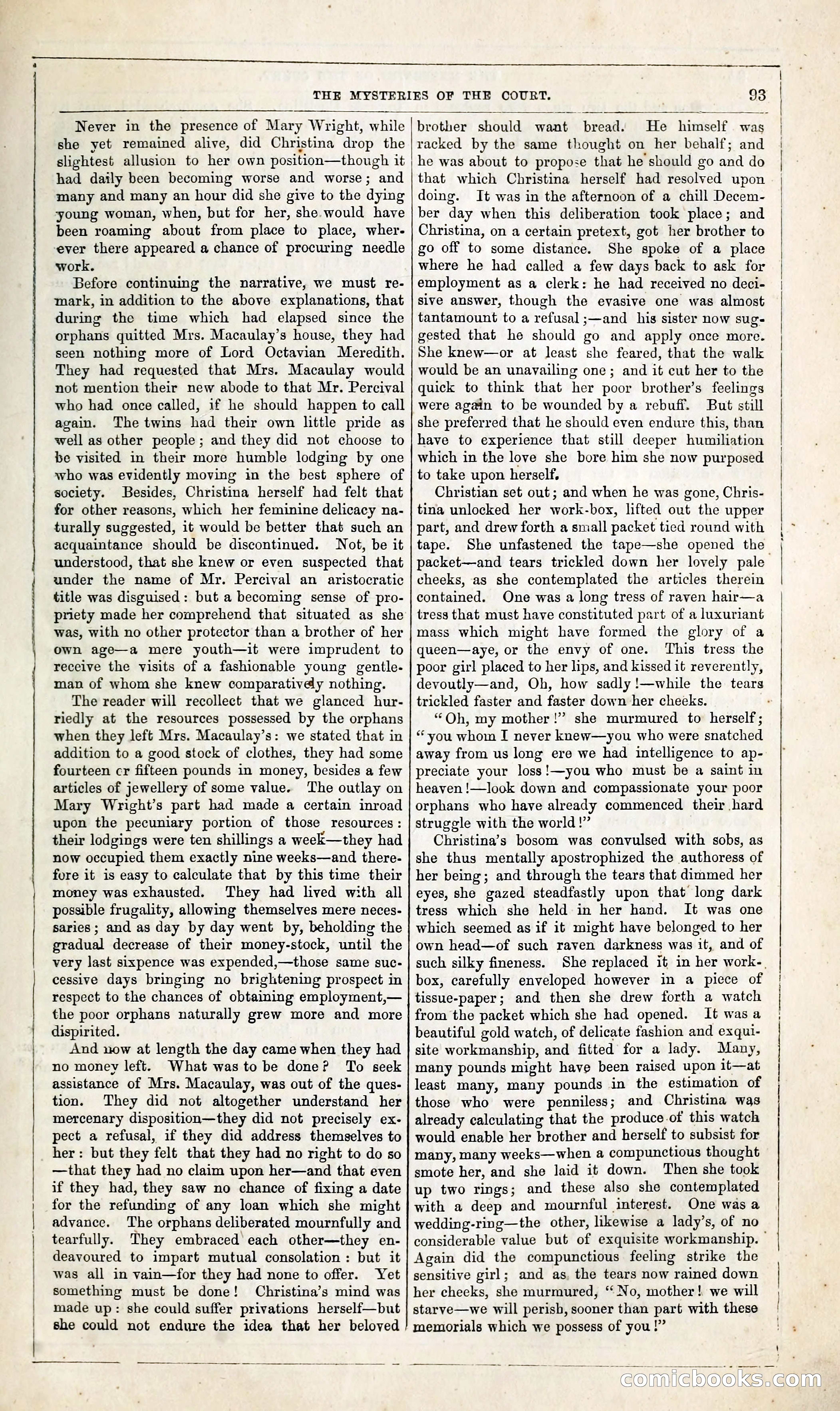
THE MYSTERIES OF THE COURT. Never in the presence of Mary Wright, while | brother should want bread. 93 she yet remained alive, did Christina drop the |racked by the same thought on her behalf; and slichtest allusion to her own position—though it | he was about to propose that he should go and do had daily been becoming worse and worse; and many and many an hour did she give to the dying young woman, when, but for her, she.would have been roaming about from place to place, wher- ‘ever there appeared a chance of procuring needle work. Before continuing the narrative, we must re- mark, in addition to the above explanations, that during the time which had elapsed since the orphans quitted Mrs. Macaulay’s house, they had seen nothing more of Lord Octavian Meredith. They had requested that Mrs. Macaulay would not mention their new abode to that Mr. Percival who had once called, 1f he should happen to call again. The twins had their own little pride as well as other people; and they did not choose to be visited in their more humble lodging by one who was evidently moving in the best sphere of society. Besides, Christina herself had felt that for other reasons, which her feminine delicacy na- turally suggested, it would be better that such an acquaintance should be discontinued. Not, be it understood, that she knew or even suspected that under the name of Mr. Percival an aristocratic title was disguised: but a becoming sense of pro- priety made her comprehend that situated as she was, with no other protector than a brother of her own age—a mere youth—it were imprudent to receive the visits of a fashionable young gentle- man of whom she knew comparatively nothing. The reader will recollect that we glanced hur- riedly at the resources possessed by the orphans when they left Mrs. Macaulay’s: we stated that in addition to a good stock of clothes, they had some fourteen cr fifteen pounds in money, besides a few articles of jewellery of some value. The outlay on Mary Wright’s part had made a certain inroad upon the pecuniary portion of those resources: their lodgings were ten shillings a week—they had now occupied them exactly nine weeks—and there- fore it is easy to calculate that by this time their money was exhausted. They had lived with all possible frugality, allowing themselves mere neces- saries; and as day by day went by, beholding the gradual decrease of their money-stock, until the very last sixpence was expended,—those same suc- cessive days bringing no brightening prospect in respect to the chances of obtaining employment,— the poor orphans naturally grew more and more dispirited. And now at length the day came when they had no money left. What was to be done? To seek assistance of Mrs. Macaulay, was out of the ques- tion. They did not altogether understand her mercenary disposition—they did not precisely ex- pect a refusal, if they did address themselves to her: but they felt that they had no right to do so —that they had no claim upon her—and that even if they had, they saw no chance of fixing a date for the refunding of any loan which she might advance. The orphans deliberated mournfully and tearfully. They embraced each other—they en- deavoured to impart mutual consolation : but it was all in vain—for they had none to offer. Yet something must be done! Christina’s mind was made up: she could suffer privations herself—but she could not endure the idea that her beloved ee —_———$—$——$—$————— ee -e that which Christina herself had resolved upon doing. It was in the afternoon of a chill Decem- ber day when this deliberation took place; and Christina, on a certain pretext, got her brother to go off to some distance. She spoke of a place where he had called a few days back to ask for employment as a clerk: he had received no deci- sive answer, though the evasive one was almost tantamount to a refusal ;—and _ his sister now sug- gested that he should go and apply once more. She knew—or at least she feared, that the walk would be an unavailing one; and it cut her to the quick to think that her poor brother’s feelings were again to be wounded by a rebuff. But still she preferred that he should even endure this, than have to experience that still deeper humiliation which in the love she bore him she now purposed to take upon herself, Christian set out; and when he was gone, Chris- tina unlocked her work: box, lifted out the upper part, and drew forth a small packet tied round with tape. She unfastened the tape—she opened the packet—and tears trickled down her lovely pale cheeks, as she contemplated the articles therein contained. One was a long tress of raven hair—a tress that must have constituted part of a luxuriant mass which might have formed the glory of a queen—aye, or the envy of one. This tress the poor girl placed to her lips, and kissed it reverently, devoutly—and, Oh, how sadly !—while the tears trickled faster and faster down her cheeks. “Oh, my mother!” she murmured to herself ; “you whom T never knew—you who were snatched away from us long ere we had intelligence to ap- preciate your loss!—you who must be a saint in heaven !—look down and compassionate your poor orphans who have already commenced their hard struggle with the world!” Christina’s bosom was convulsed with sobs, as she thus mentally apostrophized the authoress of her being; and through the tears that dimmed her eyes, she gazed steadfastly upon that long dark tress which she held in her hand. It was one which seemed as if it might have belonged to her own head—of such raven darkness was it, and of such silky fineness. She replaced it in her work-. box, carefully enveloped however in a picce of tissue-paper; and then she drew forth a watch from the packet which she had opened. It was a beautiful gold watch, of delicate fashion and exqul- site workmanship, and fitted for a lady. Many, many pounds might have been raised upon it—at least many, many pounds in the estimation of those who were penniless; and Christina was already calculating that the produce of this watch would enable her brother and herself to subsist for many, many weeks—when a compunctious thought smote her, and she laid it down. Then she took up two rings; and these also she contemplated with a deep and mournful interest. One was a wedding-ring—the other, likewise a lady’s, of no considerable value but of exquisite workmanship. ” Again did the compunctious feeling strike the sonnitive girl; and as, the tears now rained down her cheeks, she murmured, “ No, mother! we will starve—we will perish, sooner than part with these memorials which we possess of you!” He himéelf ean 5 | | | | —_———_ im €O OOK co