
Penny Dreadfuls, 1850 · page 116 of 394
The Mysteries of London; or, Lights and Shadows of London Life — page 116: what you’re looking at
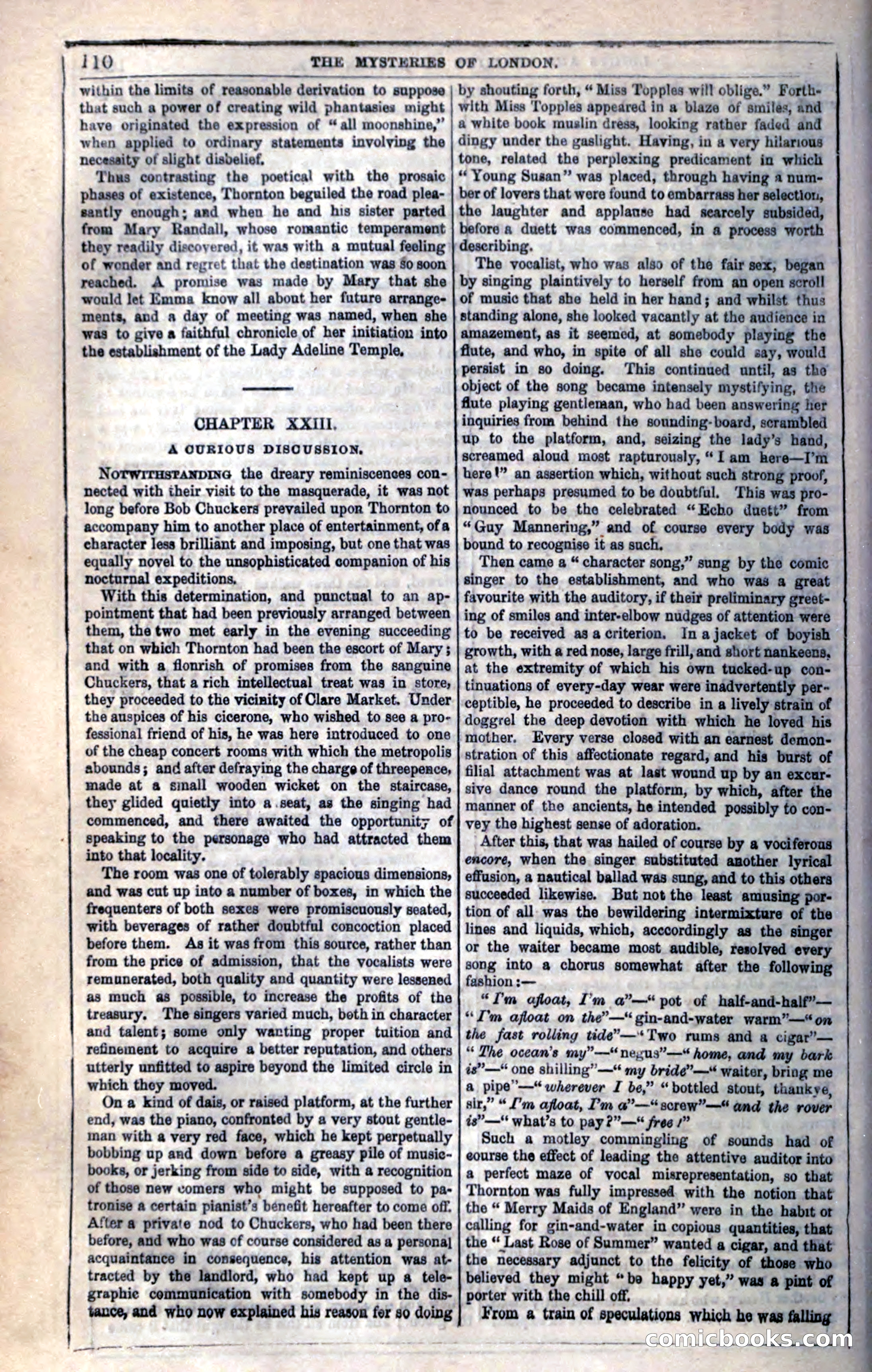
A restored page from Penny Dreadfuls, 1850. Page through the whole issue in the reader above.
📄 Transcribed text from this page (OCR, searchable)
Machine-transcribed from the original scan — historical spelling and the odd misread are preserved.
st lL NT ET EE TT a , —_—_— 110 within the limits of reasonable derivation to suppose that such a power of creating wild phantasies might have originated the expression of “all moonshine,” when applied to ordinary statements involving the necessity of slight disbelief, Thus contrasting the poetical with the prosaic phases of existence, Thornton beguiled the road plea- santly enough; and when he and his sister parted from Mary Randall, whose romantic temperament they readily discovered, it was with a mutual feeling of wonder and regret that the destination was $0 soon reached. A promise was made by Mary that she would Jet Emma know all about her future ments, and a day of meeting was named, when she was to give a faithful chronicle of her initiation into the establishment of the Lady Adeline Temple, CHAPTER XXIII, A CURIOUS DISCUSSION, NOTWITHSTANDING the dreary reminiscences con- nected with their visit to the masquerade, it was not long before Bob Chuckers prevailed upor Thornton to accompany him to another place of entertainment, of a character less brilliant and imposing, but one that was equally novel to the unsophisticated companion of his nocturnal expeditions, With this determination, and punctual to an ap- pointment that had been previously arranged between them, the two met early in the evening succeeding that on which Thornton had been the escort of Mary ; and with a flonrish of promises from the sanguine Chuckers, that a rich intellectual treat was in store, they proceeded to the vicinity of Clare Market. Under the auspices of his cicerone, who wished to see a pro- fessional friend of his, he was here introduced to one of the cheap concert rooms with which the metropolis abounds; and after defraying the charge of threepence, made at a small wooden wicket on the staircase, they glided quietly into a.seat, as the singing had commenced, and there awaited the opportunity; of speaking to the personage who had attracted them into that locality. The room was one of tolerably spacious dimensions, and was cut up into a number of boxes, in which the frequenters of both sexes were promiscuously seated, with beverages of rather doubtful concoction placed before them. As it was from this source, rather than from the price of admission, that the vocalists were remunerated, both quality and quantity were lessened as much as possible, to increase the profits of the treasury. The singers varied much, both in character and talent; some only warting proper tuition and refinement to acquire a better reputation, and others utterly unfitted to aspire beyond the limited circle in which they moved. On a kind of dais, or raised platform, at the further end, was the piano, confronted by a very stout gentle- man with a very red face, which he kept perpetually bobbing up and down before a greasy pile of music- books, or jerking from side to side, with a recognition of those new vomers who might be supposed to pa- tronise a certain pianist’s bénefit hereafter to come off. After a ptivate nod to Chuckers, who had been there before, and who was of course considered as a personal] acquaintance in consequence, his attention was at- tracted by the landlord, who had kept up a tele- graphie communication with somebody in the dis- tance, and who now explained his reason fer so doing 2 es a ——— THE MYSTERIES OF LONDON, Ne ee naieiadiinedmmamntianattelimtemeetnteen iene tel by shouting forth, “ Miss Topples will o oblige.” Forth- with Miss Topples appeared in a blaze of smilés; and * a white book muslin dress, looking rather faded and dingy under the gaslight. Having, in a very hilarious tone, related the perplexing predicament in which “Young Susan” was placed, through having a num- ber of lovers that were found to embarrass her selection, the laughter and applanse had searcely ad, before a duett was commenced, in a process Wo! describing. The vocalist, who was also of the fair sex, wot by singing plaintively to herself from an open of music that she held in her hand; and whilst standing alone, she looked vacantly at the esta in amazement, as it seemed, at somebody pla the flute, and who, in spite of all sho could say, would persist in so doing. This continued until, as the object of the song became intensely mystifying, the flute playing gentleman, who had been answering her inquiries from behind the sounding-board, scrambled up to the platform, and, seizing the lady’s hand, screamed aloud most rapturously, “I am here—I'in heret” an assertion which, without such strong pr was perhaps presumed to be doubtful. ‘This was pro- nounced to be the celebrated “Echo duett” from “ Guy Mannering,” and of course every body was bound to recognise it as such, Then came a “ character song,” sung by the comic singer to the establishment, and who was a favourite with the auditory, if their preliminary ing of smiles and inter-elbow nudges of attention were to be received asa criterion. In a jacket of boyish growth, biranialnimers re ing rey at the extremity of which his own tucked-up con- tinuations of every-day wear were ceptible, he proceeded to describe in a lively strain of doggrel the deep devotion with which he loved his ‘mother. Every verse closed with an earnest demon- stration of this affectionate regard, and his burst of filial attachment was at last wound up by an excur- sive dance round the platform, by which, after the manner of the ancients, he intended possibly to con- vey the highest sense of adoration. After this, that was hailed of course by a vociferons encore, when the singer substituted another lyrical effusion, a nautical ballad was sung, and to this others succeeded likewise. But not the least amusing por- tion of all was the bewildering intermixture of the lines and liquids, which, acccordingly as the singer or the waiter became most audible, resolved every song into a chorus somewhat after the following ashion :— “I'm afloat, I’m a”—* pot of half-and-half” — “I'm afloat on the”—“gin-and-water warm’—*on the fast rolling tide” —" Two rums and a cigar’— “The ocean’s my”—“nezus”—*“ home, and my bark is” —“ one shilling” —“ my bride”—“ waiter, bring me a pipe”—“ wherever I be,” “bottled stout, thankye, sir,” “1’m afloat, ’'m a?’ —* screw” —“ and the rover is” —“ what’s to pay ?”—“ free /” Such a motley commingling of sounds had of eourse the effect of leading the attentive auditor into a perfect maze of vocal misrepresentation, so that Thornton was fully impressed. with the notion that oe Merry Maids of England” were in the habit or calling for gin-and-water in copious tities, that the “ Last Rose of Summer” wanted aie and that |— the necessary adjunct to the felicity of those who | believed they might “ be HAPPY yet,” waa & plat of ‘; porter with the chill off, ya © ai From a train of speculations which he was £ COM coootk Sicom