
Penny Dreadfuls, 1850 · page 118 of 394
The Mysteries of London; or, Lights and Shadows of London Life — page 118: what you’re looking at
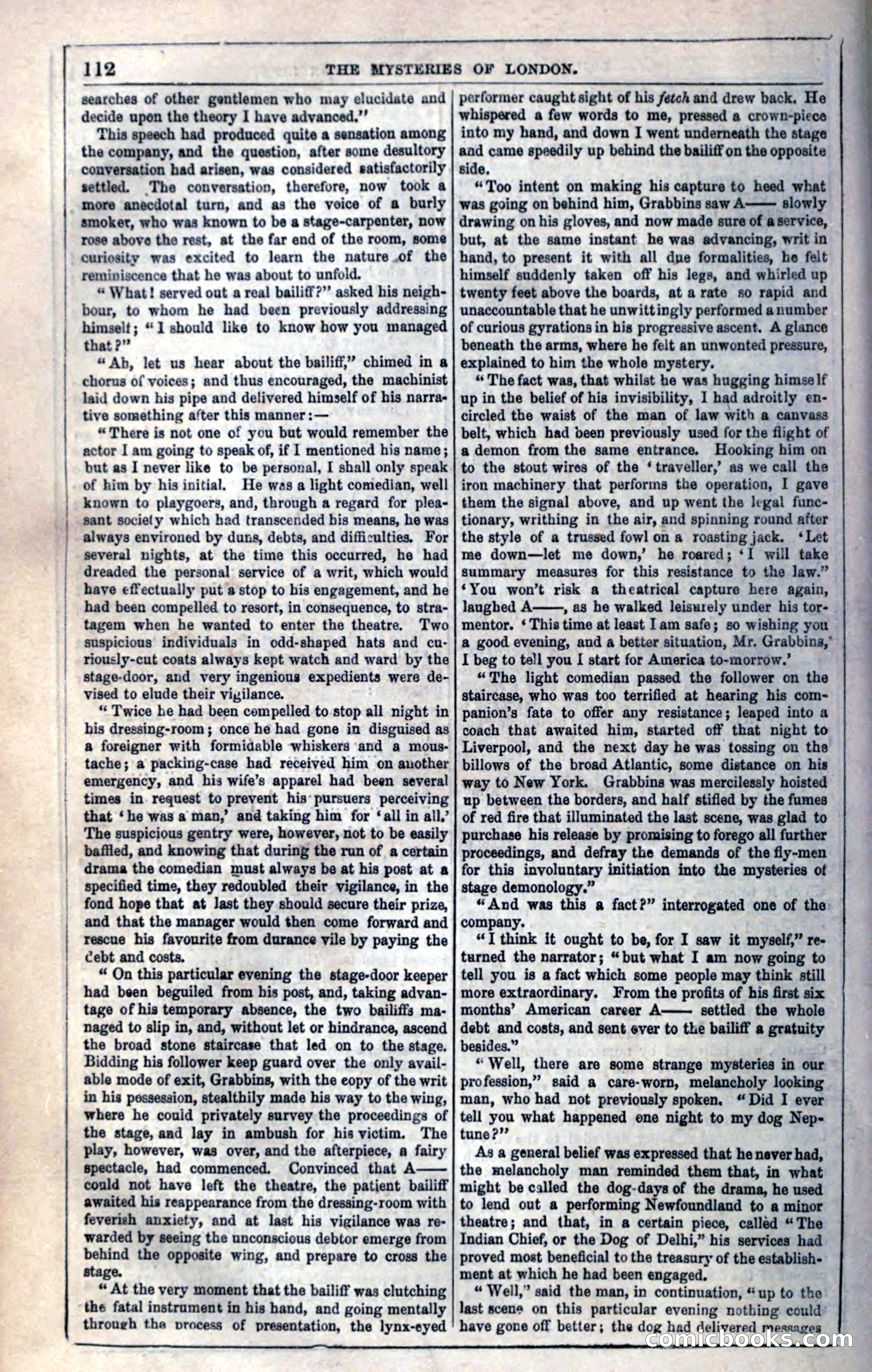
A restored page from Penny Dreadfuls, 1850. Page through the whole issue in the reader above.
📄 Transcribed text from this page (OCR, searchable)
Machine-transcribed from the original scan — historical spelling and the odd misread are preserved.
eS SS SS TT = me yg a ac TT a mae nm ee ee ee -——<—<— 112 searches of other gentlemen who may elucidate and decide upon the theory I have advanced,’’ This speech had produced quite a sensation among the company, and the question, after some desultory conversation had arisen, was considered satisfactorily settled. The conversation, therefore, now took a more anecdotal turn, and as the voice of a burly smoker, who was known to be a stage-carpenter, now rose above the rest, at the far end of the room, some curiosity was excited to learn the nature of the reminiscence that he was about to unfold. “ What! served out a real bailiff?” asked his neigh- bour, to whom he had been previously addressing himselt; “I should like to know how you managed that?” “Ab, let us hear about the bailiff,’ chimed in a chorus of voices; and thus encouraged, the machinist laid down his pipe and delivered himself of his narra- tive something after this manner :— , “There is not one of you but would remember the actor I am going to speak of, if I mentioned his name; but as I never like to be personal, I shall only speak. of him by his initial. He was a light comedian, well known to playgoers, and, through a regard for plea- sant society which had transcended bis means, he was always environed by duns, debts, and difficulties. For several nights, at the time this occurred, he had dreaded the personal service of a writ, which would have effectually put a stop to his engagement, and he had been compelled to resort, in consequence, to stra- tagem when he wanted to enter the theatre. Two suspicious individuals in odd-shaped hats and cu- riously-cut coats always kept watch and ward by the stage-door, and very ingenious expedients were de- vised to elude their viyilance. “ Twice he had been compelled to stop all night in his dressing-room; once he had gone in disguised as a foreigner with formidable whiskers and a mous- tache; a packing-case had received him on another emergency, and his wife’s apparel had been several times in. request to prevent his’ pursuers perceiving that ‘he was a man,’ and taking him for ‘all in all,’ The suspicious gentry were, however, not to be easily baffled, and knowing that during the run of a certain drama the comedian must always be at his post at a specified time, they redoubled their vigilance, in the fond hope that at Jast they should secure their prize, and that the manager would then come forward and rescue his favourite from durance vile by paying the Cebt and costs, “ On this particular evening the stage-door keeper had been beguiled from his post, and, taking advan- tage of his temporary absence, the two bailiffs ma- naged to slip in, and, without let or hindrance, ascend the broad stone staircase that led on to the stage, Bidding his follower keep guard over the only avyail- able mode of exit, Grabbins, with the eopy of the writ in his possession, stealthily made his way to the wing, where he could privately survey the proceedings of the stage, and lay in ambush for his victim. The play, however, was over, and the afterpiece, a fairy spectacle, had commenced. Convinced that A—— could not have left the theatre, the patient bailiff awaited his reappearance from the dressing-room with feverish anxiety, and at last his vigilance was re- warded by seeing the unconscious debtor emerge from behind the opposite wing, and prepare to cross the stage. “ At the very moment that the bailiff was clutching the fatal instrument in his hand, and going mentally through the process of presentation, the lynx-eyed THE MYSTERIES OF LONDON. performer caught sight of his fetch and drew back, He whispered a few words to me, pressed a crown-piece into my hand, and down I went underneath the stage and came speedily up behind the bailiff on the opposite side. “Too intent on making his capture to heed what was going on behind him, Grabbins saw A—— slowly drawing on his gloves, and now made sure of a service, but, at the same instant he was ad writ in hand, to present it with all dye formalities, he felt himself suddenly taken off his legs, and whirled up twenty feet above the boards, at a rate so rapid and unaccountable that he unwittingly performed anumber of curious gyrations in his progressive ascent. A glance beneath the arms, where he felt an unwonted pressure, explained to him the whole mystery. “ The fact was, that whilst he was hugging himself up in the belief of his invisibility, I adroitly en- circled the waist of the man of law with a canvass belt, which had been previously used for the flight of a demon from the same entrance. Hooking him on to the stout wires of the ‘ traveller,’ as we call the iron machinery that performs the operation, I gave them the signal above, and up went the legal func- tionary, writhing in the air, and spinning round after the style of a trussed fowl on a roasting jack. ‘Let me down—let me down,’ he roared; ‘1 will take summary measures for this resistance to the law.” ‘You won’t risk a theatrical capture here again, laughed A——, as he walked leisurely under his tor- mentor. ‘ This time at least Iam safe; so wishing you a good evening, and a better situation, Mr. Grabbina,” I beg to tell you [ start for America to-morrow.’ “The light comedian passed the follower on the staircase, who was too terrified at hearing his com- panion’s fate to offer any resistance; leaped into a coach that awaited him, started off that night to Liverpool, and the next day he was tossing on the billows of the broad Atlantic, some distance on his way to New York. Grabbins was mercilessly hoisted up between the borders, and half stifled by the fumes of red fire that illuminated the last scene, was glad to purchase his release by promising to forego all further proceedings, and defray the demands of the fly-men for this involuntary initiation into the mysteries of stage demonology.” “And was this a fact?” interrogated one of the company. | “J think it ought to be, for I saw it myself,” re- turned the narrator; “but what I am now going to tell you is a fact which some people may think still more extraordinary. From the profits of his first six months’ American career A—— settled the whole debt and costs, and sent ever to the bailiff a gratuity besides.” “ Well, there are some strange mysteries in our profession,” said a care-worn, melancholy looking man, who had not previously spoken, “Did I ever tell you what happened ene night to my dog Nep- tune ?”’ As a general belief was expressed that he never had, the melancholy man reminded them that, in what might be called the dog- of the drama, he used to lend out a performing Newfoundland to a minor theatre; and that, in a certain piece, called “The Indian Chief, or the Dog of Delhi,” his services had proved most beneficial to the treasury of the establish- ment at which he had been engaged, “ Well,” said the man, in continuation, “up to the last scene on this particular evening nothing could’ } have gone off better; the dog had delivered messages { comrecbookstcom