
Penny Dreadfuls, 1850 · page 120 of 394
The Mysteries of London; or, Lights and Shadows of London Life — page 120: what you’re looking at
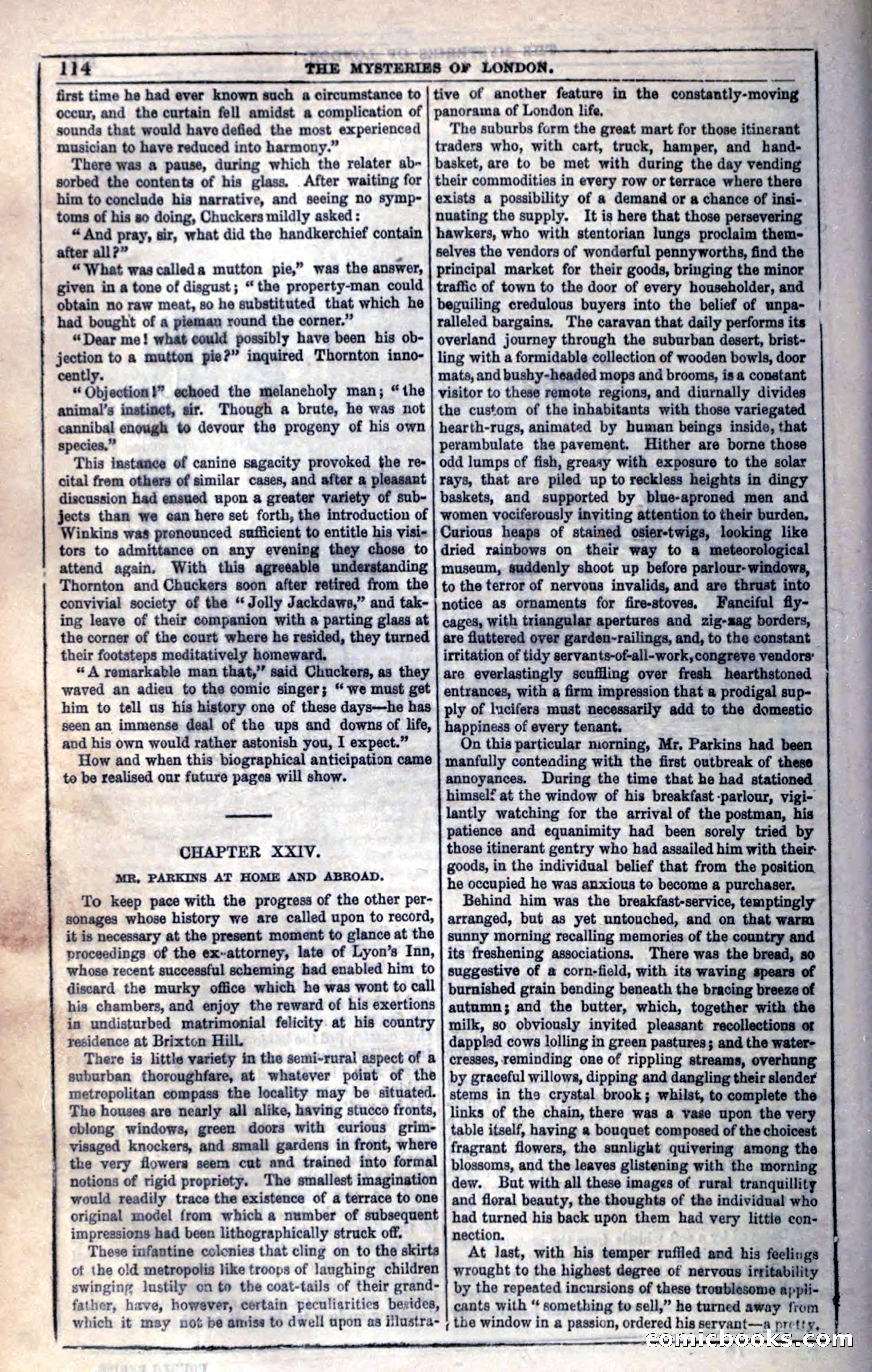
A restored page from Penny Dreadfuls, 1850. Page through the whole issue in the reader above.
📄 Transcribed text from this page (OCR, searchable)
Machine-transcribed from the original scan — historical spelling and the odd misread are preserved.
ees ie ' attend again, With this agreeable —— ne 114 sounds that would have defied the most experienced musician to have reduced into harmony.” There was a pause, during which the relater ab- sorbed the contents of his glass, After waiting for him to conclude his narrative, and seeing no symp- toms of his so doing, Chuckers mildly asked : “ And pray, sir, what did the handkerchief contain after all?” “ What was calleda mutton pie,” was the answer, given in a tone of disgust; “the property-man could obtain no raw meat, so he substituted that which he had bought of a pieman round the corner.” “Dear me! what could possibly have been his ob- jection to a mutton pie?” inquired Thornton inno- cently. « Objection !” echoed the melancholy man; “the animal’s instinet, sir. Though a brute, he was not cannibal enough to devour the progeny of his own species.” This instance of canine sagacity provoked the re- cital frem others of similar cases, and after a pleasant discussion had ensued upon a greater variety of sub- jects than we can here set forth, the introduction of Winkins was pronounced sufticient to entitle his visi- tors to admittance on any evening they chose to understanding Thornton and Chuckers soon after retired from the convivial society of the “ Jolly Jackdaws,” and tak- ing leave of their companion with a parting glass at the corner of the court where he resided, they turned their footsteps meditatively homeward, “A remarkable man that,” said Chuckers, as they waved an adieu to the comic singer; “we must get him to tell us his history one of these days—he has seen an immense deal of the ups and downs of life, and his own would rather astonish you, I expect.” How and when this biographical anticipation came to be realised our future pages will show. CHAPTER XXIV. MR, PARKINS AT HOME AND ABROAD. To keep pace with the progress of the other per- sonages whose history we are called upon to record, it is necessary at the present moment to glance at the proceedings of the ex~attorney, late of Lyon’s Inn, whose recent successful scheming had enabled him to discard the murky office which he was wont to call his chambers, and enjoy the reward of his exertions in undisturbed matrimonial felicity at his country residence at Brixton HilL There is little variety in the semi-rural aspect of a suburban thoroughfare, at whatever point of the metropolitan compass the locality may be situated. The houses are nearly all alike, having stucco fronts, oblong windows, green doors with curious grim- visaged knockers, and small gardens in front, where the very flowers seem cut and trained into formal notions of rigid propriety. The smallest imagination would readily trace the existence of a terrace to one original model from which a number of subsequent impressions had been lithographically struck off. These imfantine colonies that cling on to the skirts of the old metropolis like troops of laughing children swinging lustily on €o the coat-tails of their grand- father, have, however, cértain peculiarities besides, which it msy not be amiss to dwell upon as ilustra- THE MYSTERIES or LONDON. first time he had ever known such a circumstance to occur, and the curtain fell amidst a complication of tie tive of another feature in the constantly-moving panorama of London life, The suburbs form the great mart for those itinerant traders who, with cart, truck, hamper, and hand- basket, are to be met with during the day vending their commodities in every row or terrace where there exists a possibility of a demand or a chance of insi- nuating the supply. It is here that those persevering hawkers, who with stentorian lungs proclaim them- | selves the vendors of wonderful pennyworths, find the principal market for their goods, bringing the minor traffic of town to the door of every householder, and beguiling credulous buyers into the belief of unpa- ralleled bargains, The caravan that daily performs its overland journey through the suburban desert, brist- ling with a formidable collection of wooden bowls, door mats, and bushy-headed mops and brooms, isa constant visitor to these remote regions, and diurnally divides the custom of the inhabitants with those variegated hearth-rugs, animated by buman beings inside, that perambulate the pavement. Hither are borne those odd lumps of fish, greasy with exposure to the solar rays, that are piled up to reckless heights in dingy baskets, and supported by blue-aproned men and women vociferously inviting attention to their burden, Curious heaps of stained osier-twigs, dried rainbows on their way to a tI Ic museum, suddenly shoot up before parlour-windc to the terror of nervous invalids, and are thrust into notice as ornaments for fire-stoves, Fanciful fly- cages, With triangular apertures and zig-sag borders, are fluttered over garden-railings, and, to the constant — irritation of tidy servants-of-all-work,congreve vendors: are everlastingly scuffling over fresh hearthstoned entrances, with a firm impression that a prodigal sup- ply of lucifers must necessarily add to the domestic happiness of every tenant. On this particular niorning, Mr, Parkins had been manfully conteading with the first outbreak of these annoyances. During the time that he had stationed himself at the window of his breakfast -parlour, vigi- lantly watching for the arrival of the postman, his patience and equanimity had been sorely tried by those itinerant gentry who had assailed him with their- goods, in the individual belief that from the position he occupied he was anxious te become a purchaser, Behind him was the breakfast-service, temptingly arranged, but as yet untouched, and on that warm sunny morning recalling memories of the country and its freshening associations. There was the bread, so suggestive of a corn-field, with its waving spears of burnished grain bending beneath the bracing breeze of autumn; and the butter, which, together with the milk, so obviously inyited pleasant recollections of dappled cows lolling in green pastures; and the water- cresses, reminding one of rippling streams, p Peshe se by graceful willows, dipping and stems in the crystal brook; whilst, reeds the links of the chain, there was a vase upon the very table itself, having a bouquet composed of the choicest fragrant flowers, the sunlight quivering among the blossoms, and the leaves glistening with the morning dew. But with all these images of rural tranquillity and floral beauty, the thoughts of the individual who had turned his back upon them had very little con- nection. At last, with his temper ruffled and his feelings wrought to the highest degree of nervous irritability by the repeated incursions of these troublesome appli- cants with “ something to sell,” he turned away from ; the window in a passion, ordered his servant—a pretty, micbooks:com