
Penny Dreadfuls, 1850 · page 121 of 394
The Mysteries of London; or, Lights and Shadows of London Life — page 121: what you’re looking at
A restored page from Penny Dreadfuls, 1850. Page through the whole issue in the reader above.
📄 Transcribed text from this page (OCR, searchable)
Machine-transcribed from the original scan — historical spelling and the odd misread are preserved.
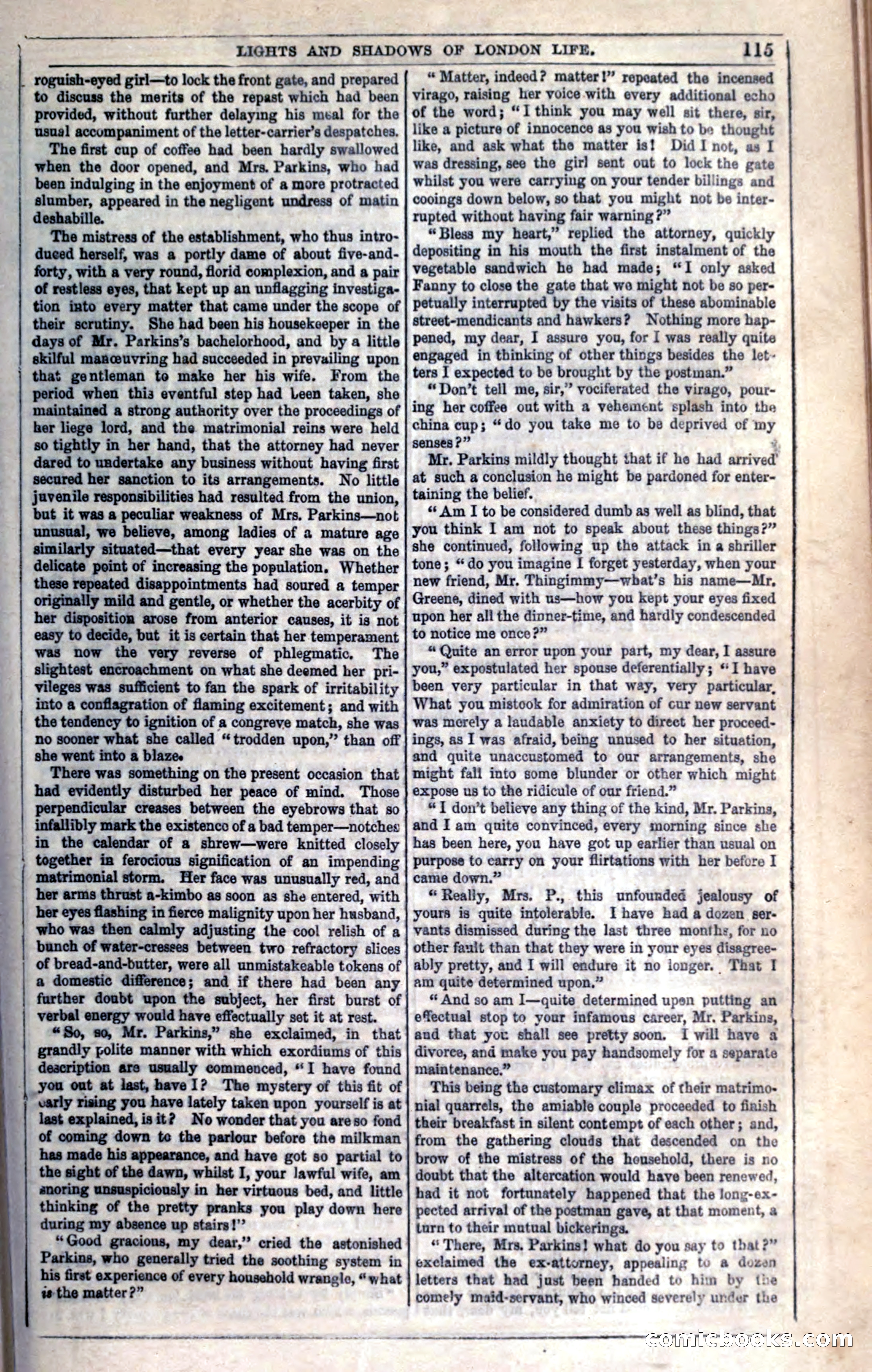
CO A LIGHTS AND SHADOWS OF LONDON LIFE, roguish-eyed girl—to lock the front gate, and prepared to discuss the merits of the repast which had been provided, without further delaying his meal for the usual accompaniment of the letter-carrier’s despatches. The first cup of coffee had been hardly swallowed when the door opened, and Mrs. Parkins, who had been indulging in the enjoyment of a more protracted slumber, appeared in the negligent undress of matin deshabille. The mistress of the establishment, who thus intro- dueed herself, was a portly dame of about five-and- ty, with a very round, florid complexion, and a pair restless eyes, that kept up an unflagging investiga- into every matter that came under the scope of scrutiny. She had been his housekeeper in the of Mr. Parkins’s bachelorhood, and by a little maskoouvring had succeeded in prevailing upon gentleman to make her his wife. From the eriod when this eventful step had Leen taken, she maintained a strong authority over the proceedings of her liege lord, and the matrimonial reins were held so tightly in her hand, that the attorney had never dared to undertake any business without having first secured her sanction to its arrangements. No little juvenile responsibilities had resulted from the union, but it was a peculiar weakness of Mrs. Parkins—not unusual, we believe, among ladies of a mature age similarly situated—that every year she was on the cate point of increasing the population. Whether these repeated disappointments had soured a temper originally mild and gentle, or whether the acerbity of her dist arose from anterior causes, it is not easy to decide, but it is certain that her temperament was now the very reverse of phlegmatic. The slightest encroachment on what she deemed her pri- vileges was sufficient to fan the spark of irritability into a conflagration of flaming excitement; and with the tendency to ignition of a congreve match, she was no sooner what she called “trodden upon,” than off There was something on the present occasion that had evidently disturbed her peace of mind. Those creases between the eyebrows that so a8 HEE ; | bunch of water-cresses between two refractory slices _ of bread-and-butter, were all unmistakeable tokens of a domestic difference; and if there had been any further doubt upon the subject, her first burst of verbal energy would have effectually set it at rest. “So, so, Mr. Parkins,” she exclaimed, in that grandly polite manner with which exordiums of this deacription are usually commenced, “I have found ‘| you out at last, have 1? The mystery of this fit of varly rising you have lately taken upon yourself is at explained, is it? No wonder that you areso fond coming down te the parlour before the milkman has made his appearance, and have got so partial to the sight of the dawn, whilst I, your lawful wife, am anoring unsuspiciously in her virtuous bed, and little thinking of the pretty pranks you play down here during my absence up stairs !’’ . “Good gracious, my dear,” cried the astonished Parkins, who generally tried the soothing system in of every household wrangle, “what ee ee 0 eee ee mm me _--- em TONAL OLONO) 115 “ Matter, indeed? matter!” repeated the incensed virago, raising her voice with every additional echo of the word; “I think you may well sit there, sir, like a picture of innocence as you wish to be thought like, and ask what the matter is! Did I not, as I was dressing, see the girl sent out to lock the gate whilst you were carrying on your tender billings and cooings down below, so that you might not be inter- rupted without having fair warning?” “Bless my heart,” replied the attorney, quickly depositing in his mouth the first instalment of the vegetable sandwich he had made; “I only asked Fanny to close the gate that we might not be so per- petually interrupted by the visits of these abominable street-mendicants and hawkers? Nothing more hap- pened, my dear, I assure you, for | was really quite engaged in thinking of other things besides the let- ters I expected to be brought by the postman.” “Don’t tell me, sir,” vociferated the virago, pour- ing her coffee out with a vehement splash into the china cup; “do you take me to be deprived of my senses ?” y Mr. Parkins mildly thought that if he had arrived’ at such a conclusion he might be pardoned for enter- taining the belief. «¢ Am I to be considered dumb as well as blind, that you think I am not to speak about these things?” she continued, following up the attack in a shriller tone; “do you imagine I forget yesterday, when your new friend, Mr. Thingimmy—what’s his name—Mr, Greene, dined with us—how you kept your eyes fixed upon her all the dinner-time, and hardly condescended to notice me once?” “Quite an error upon your part, my dear, I assure you,” expostulated her spouse deferentially; “I have been very particular in that way, very particular. What you mistook for admiration of cur new servant was merely a laudable anxiety to direct her proceed- ings, as I was afraid, being unused to her situation, and quite unaccustomed to our arrangements, she might fall into some blunder or other which might expose us to the ridicule of our friend.” “1 don’t believe any thing of the kind, Mr. Parkins, »}and Iam quite convinced, every morning since she has been here, you have got up earlier than usual on purpose to carry on your flirtations with her before I came down.” “Really, Mrs. P., this unfounded jealousy of yours is quite intolerable. I have had a dozen ser- vants dismissed during the last three months, for no other fault than that they were in your eyes disagree- ably pretty, and I will endure it no longer. That I am quite determined upon,” * And so am I—quite determined upen putting an effectual stop to your infamous career, Mr. Parkins, and that yor shall see pretty soon. I will have a divoree, and make you pay handsomely for a separate maintenance.” This being the customary climax of their matrimo- nial quarrels, the amiable couple proceeded to finish their breakfast in silent contempt of each other; and, from the gathering clouds that descended on the brow of the mistress of the heusehold, there is no doubt that the altercation would have been renewed, had it not fortunately happened that the long-ex- pected arrival of the postman gave, at that moment, a turn to their mutual bickerings, “ There, Mrs, Parkins} what do you say to that?” exclaimed the ex-attorney, appealing to a dozen letters that had just been handed to him by the comely maid-servant, who winced severely under the <S (C@)